

Three Things Every American Should Know | Part One: There is a God and You’re Not Him
As we’re coming into the Midterm elections and seeing a number of Muslims winning Democrat primaries, there’s a need to clarify three things that every American should know before they cast their ballot.
#1) There is a God and you’re not Him.
You want to think that because you have the right to be happy, you can make up your own rules.
No.
It’s because God makes the rules, that you the right to be happy.
You take God out of the picture, and you don’t have rights, you have demands. That’s why the Declaration of Independence resonated resonated the way that it did. By stating that our rights are guaranteed by God and not dispensed as a king, we were validated as patriots with a cause. Otherwise, we were traitors with a complaint.
There is a God and you’re not Him.
The Declaration of Independence was addressed to King George, the king of England as well as the head of the Church of England. Every reference to a Creator, the Supreme Judge of the Universe, or Providence was processed as a reference to the God of the Bible and not a generic deity. However you want to try and dismiss the Second Continental Congress as a group of secular politicians with no real regard for religion, let alone the empty tomb, you have to ignore…
- The sixteen times they called for a National Day of Prayer and Fasting during the Revolutionary War and the verbiage of those proclamations.
- The opening lines of the Treaty of Versailles
- The inscription on the Liberty Bell
- General Washington’s General Orders
- The testimony of John Adams
- The impact of the Great Awakening
- The reaction of the House of Burgesses to the Boston Tea Party
- The Black Robe Regiment
- Holland’s observation of the Continental Army
- Washington’s Farewell Address
- Letter read to Parliament by Sir Richard Sutton
- The words of Patrick Henry, Samuel Adams, and James Madison
- …and so much more!
Two professors, Donald S. Lultz and Charles S. Hynemman, reviewed an estimated 15,000 items, and closely read 2,200 books, pamphlets, newspaper articles, and monographs with explicitly political content printed between 1760 and 1805. They reduced this to 916 items, about one-third of all political writings longer than 2,000 words.
From these items, Lutz and Hynemann identified 3,154 references to other sources. The source most cited by the founding fathers was the Bible, which accounted for 34% of all citations.1
There is a God, and you’re not Him!
1.”Christianity and the Constitution”, John Eidsmore, Baker Book House Company, Grand Rapids, MI, 1987, p51
Test the Spirits, Don’t Just Trust the Smiles
Intro
Philippi was the first European church ever established, which makes it the oldest church in Europe. It was named after Philip II of Macedon, who was the father of Alexander the Great.
It was later conquered by the Romans and among its distinctive characteristics was the fact that many Roman soldiers made it the place where they retired.
Among the first converts to Christianity in Philippi were a slave (Acts 16:16-18), a woman (Acts 16:14), and a Roman (Acts 16:30). This is significant given the traditional prayer (Birkot Hashachar) said by Jewish men in the morning when they thanked God for being neither a slave, a woman, nor a Gentile.
Paul would address that dynamic specifically in Galatians 3:28.
Philippi was a special situation. Not only was it the scene were some significant people got save, but it was also here that Paul and Silas were arrested and thrown in prison after witnessing to the slave girl in Acts 16:16-18.
Paul had a special connection to this church and you can hear it in his letter. It’s been a decade since he had been there, but you can tell by the way he opens his letter, that those memories still bring a smile to his face.
Joy
In all my prayers for all of you, I always pray with joy 5 because of your partnership in the gospel from the first day until now, (Phil 1:4)
It’s significant that Paul is “joyful,” given the fact that he was under house arrest.
“Spiritual joy … is not an attitude dependent on chance or circumstances. It is a deep and abiding confidence that, regardless of one’s circumstances in life, all is well between the believer and the Lord. No matter what difficulty, pain, disappointment, failure, rejection, or other challenge one is facing, genuine joy remains because of that eternal well-being established by God’s grace in salvation. Thus, Scripture makes it clear that the fullest, most lasting, and satisfying joy is derived from a true relationship with God (John MacArthur)
Partnership
We share a bond in the context of our relationship with Christ.
During this time, anyone who would not declare Caesar as Lord was, by default, at odds with the Roman Empire. So, while the date of Paul’s letter to the Philippian church is before Nero’s widespread persecution of Christianity, being a Christian during this time made you an enemy of both Rome and the Jewish church.
Insight
9 And this is my prayer: that your love may abound more and more in knowledge and depth of insight, 10 so that you may be able to discern what is best and may be pure and blameless for the day of Christ, 11 filled with the fruit of righteousness that comes through Jesus Christ—to the glory and praise of God. (Phil 1:9-11)
1 Jn 4:1 says:
Dear friends, do not believe every spirit, but test the spirits to see whether they are from God, because many false prophets have gone out into the world. (1 Jn 4:1)
A record number of Muslim American candidates have won their 2026 primary contests and are advancing to November’s midterm elections, a shift that has moved the community from the political margins toward the center of several closely watched races — even as candidates face intensifying anti-Muslim attacks. (
There are 1.2 billion Muslims in the world. The radicals are estimated to be between 16% and 25% according to most of the intelligence around the world. That means you have between 180 and 300 million people dedicated to the destruction of Western civilization. Just to give you some perspective, the number of people in the US is 320 million. Connect the dots and you have the equivalent to an entire nation determined to see the US cease to exist. That by itself should be enough to give decision makers pause.
How can you tell if the Muslim that’s running for office is a militant?
You can’t.
- Taqiyya is an Islamic concept that means “prudence” or “religious dissimulation”. It allows a person to hide or deny their true religious beliefs and outwardly conform to a hostile environment when facing credible threats of severe injury or death. (https://www.britannica.com/topic/taqiyyah)
- Tamkeen is Arabic term most commonly used in political Islam for the long-term strategy of empowerment, institutional entrenchment, and placing members in key governance and societal positions.
Militant Muslims have terrorized Western Civilization and America in particular for centuries. Moderates are conflicted in their ability to denounce it because it’s not a political dispute that fuels the militant’s resolve. It is a religious zeal that has targeted America since the 18th century (Shores of Tripoli).
There is a dangerous disposition on the part of those who are currently with the current administration to support a doctrine that is fundamentally evil.
You’re not being Christlike by being indifferent, nor are you loving your neighbor by enabling their evil resolve.
Test the spirits and don’t just trust the smiles.
Socialism
Socialism is getting a lot of attention these days. It’s peddled as an economic system that provides opportunities that are otherwise denied by a free market. While it’s more than credible to dismiss Socialism in the way it wrongly assumes that if you’re wealthy, you’re corrupt and if you’re poor, you’re oppressed, there’s a darker and more sinister premise behind it that needs to be addressed.
In the end, Socialism isn’t so much an economic system as much as it’s a political monster that replaces the law of supply and demand with the coercion of force and control. The end result isn’t so much the elimination of poverty as much as it manipulates individuals and destroys lives.
Bottom line:
Socialism doesn’t work because Socialism lies.
It lies about things are worth, it lies about who you are, and it lies about what you’re able to do.
- Price controls artificially adjust the value of goods and services as part of giving the appearance of a healthy economy.
- People are defined, not according to who they are, but according to how much they make.
- Your success is not based on what you can earn, but on what the government is willing to give.
Let’s look at how this breaks down…
The Bourgeoisie
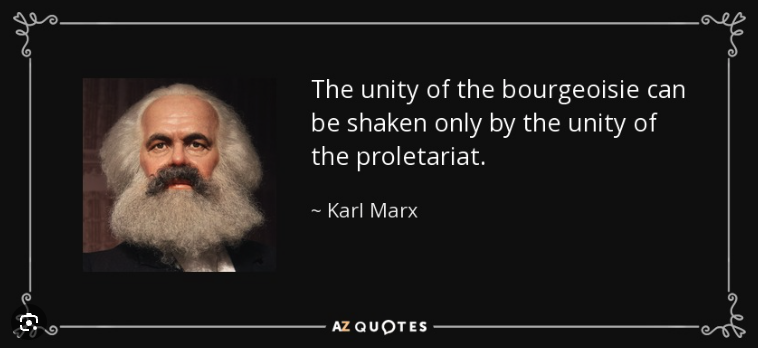
At the heart of Socialism is the philosophy of Karl Marx who believed that humanity could be categorized under two headings: The Bourgeoisie, which refers to the rich, ruling class, and the Proletariat, which is the common worker.
Society as a whole is more and more splitting up into two great hostile camps, into two great classes directly facing each other
– Bourgeoisie and Proletariat.1
Frederick Engels was a German philosopher and political theorist. He worked closely with Marx and co-wrote the Communist Manifesto. He elaborates on the class distinction which served as the foundation upon which the Socialist doctrine was built:
The basic thought running through the Manifesto – that economic production, and the structure of society of every historical epoch necessarily arising therefrom, constitute the foundation for the political and intellectual history of that epoch; that consequently (ever since the dissolution of the primaeval communal ownership of land) all history has been a history of class struggles, of struggles between exploited and exploiting, between dominated and dominating classes at various stages of social evolution; that this struggle, however, has now reached a stage where the exploited and oppressed class (the proletariat) can no longer emancipate it
self from the class which exploits and oppresses it (the bourgeoisie), without at the same time forever freeing the whole of society from exploitation, oppression, class struggles – this basic thought belongs solely and exclusively to Marx.
I have already stated this many times; but precisely now is it necessary that it also stand in front of the Manifesto itself.2
Redistribution of Wealth
One of Karl Marx’s most favorite quotes is:
From each according to his ability, to each according to his needs.3
The term, “redistribution of wealth” is a mask that conceals the real world demolition of the intellectual capital that creates wealth.
“Wealth” is more than just monetary abundance. It is the creativity and the ingenuity of those who create abundance. So, from that perspective, you can’t “redistribute” a skillset or a braintrust.
Physical wealth is a product of human capital – the knowledge, skills, talents and other qualities that exist inside the heads of people – where it cannot be confiscated. 4
More often than not, the redistribution of wealth manifests itself in the nationalization of various industries. The government assumes control of various goods and services by eliminating private ownership. But by eliminating private ownership, you also eliminate the expertise and local knowledge necessary to ensure a quality result.
Price Control
Harold Demsetz (May 31, 1930 – January 4, 2019) was an American professor of Economics at UCLA. He gave a talk in the winter of 1970 at the University of Winnipeg where he said that using price controls to reduce inflation is like responding to cold weather in Winnipeg by breaking the thermometer. His point was that just as thermometers respond to temperature, prices are an indicator of underlying economic phenomena, namely supply and demand. Breaking a thermometer doesn’t cause the temperature to rise; controlling prices doesn’t cause inflation to fall.5
- Shortages and Surpluses: Price ceilings (e.g., rent control) make goods artificially cheaper, artificially spiking consumer demand while reducing the incentive for suppliers to produce or maintain them, which inevitably results in shortages. Conversely, price floors (e.g., minimum wage) artificially inflate prices, resulting in surpluses like unsold goods or unemployment. (Wikipedia: Price Controls | Why Price Controls Always Fail | What They Don’t Want You to Know About Rent Control [Two Cents])
- Distorted Price Signals: Prices are not just numbers; they communicate critical information. High prices tell producers to increase output and tell consumers to conserve. Capping prices cuts off this vital feedback loop, masking root economic problems rather than fixing them. (Why Price Controls Are Disasters | Why Price Controls Always Fail)
- Quality Degradation: To maintain profitability under a price ceiling, suppliers often cut corners. In the housing market, for example, landlords might reduce maintenance, leading to deteriorating living conditions. (James Madison Institute | Investopedia)
- Black Markets: When a mandated price forces goods below their market value, unofficial or illegal markets frequently emerge where buyers pay much higher, unregulated prices to acquire what they need. (Investopedia | American Legislative Exchange Council)
- Reduced Investment: Price caps signal lower future revenues, which disincentivizes businesses from investing in research, development, or new construction. For instance, pharmaceutical price caps can limit the funding available for researching life-saving drugs. (United States Congress Joint Economic Committee | Information Technology and Innovation & Innovation Foundation)
China: A Case Study
Part of what makes Socialism such a failure is that it asserts several artificial catalysts into the economy simultaneously that manifest themselves in ways that inevitably lead to disastrous results.
Mao Zedong’s Five Year Plan
You can see those dynamics played out when evaluating China’s economic history. Mao Tse Tsung established the Chinese Communist Party in 1949 and immediately instituted sweeping Socialist reforms that failed horribly because of the forced introduction of programs and techniques that didn’t work (see sidebar).6
Privately owned farms and livestock were confiscated and reorganized as communes managed by the government. This was not at all consistent with what was initially promised, as far as the the land being “redistributed” to the landless. Rather, it was simply confiscated and then owned by the state.7
Those communes included toxic work conditions and an intense control over everyday life including education, social services, and even matters pertaining to marriage and having children.8 The result wasn’t merely something that could be labeled unfortunate, or a good plan that was poorly executed. Even if all the propaganda that was circulated insisting China’s economy was growing was credible, it was dramatically offset by the hardships and injustices that were exacted upon the Chinese population.
 Hundred Flowers
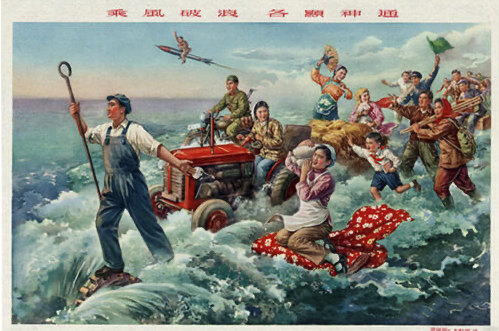
In 1957, Mao, in an attempt to position himself as accommodating and magnanimous, launched his “Hundred Flowers” campaign which was promoted as “let one hundred flowers bloom in social science and arts and let one hundred points of view be expressed in the field of science.”9 But what was originally presented as an open forum where complaints and grievances could be heard without any reprisal, quickly became a death warrant to anyone who dared to criticize the CCP.
Initially, the campaign saw enthusiastic participation, with intellectuals airing grievances about corruption, human rights abuses, and oppressive policies. However, this openness soon backfired, as many criticisms became vehement attacks against the CCP. Faced with a wave of dissent, Mao and the party leadership shifted their approach, leading to the Anti-Rightist Campaign, which targeted hundreds of thousands of individuals labeled as “rightists.”10
“Rightists” became the target of persecution in the form of losing their jobs, being assigned to labor camps where they were to be “re-educated.” Many were simply executed.
Deng Xiaping who would later go on to lead the Chinese Communist Party, was one Mao’s most aggressive officers when it came to executing dissidents. At one point, Mao wrote to him and advised to slow down the killings because, “If we kill too many, we will forfeit public sympathy and a shortage of labor power will arise.”11
Real Results
Mao’s socialist approach was being propped up by what appeared to be good numbers, but those numbers were not indicative of what was really going on.
Some aspects of the policy regime probably helped in alleviating poverty over the 30 years following 1950, such as by attenuating income and wealth disparities and investing in basic education and health care. However, the historical record makes it hard to believe that there could have been a large reduction in rural poverty in China over 1950-80. Food availability per capita changed negligibly between the beginning and the end of the 30 years after 1949 (Roser and Ritchie 2013). The real earnings of China’s farmers had also stagnated on average over this period (Lardy 1983). Retained grain output (output less procurement) per capita of the rural population grew at only 0.6% per annum over 1952-77 (Li and Yang 2005). Multiple indicators point to long-term economic stagnation for the rural sector (Huang et al. 2008). 12
The Great Leap Forward
Undaunted, Mao pressed on, determined to convert China’s agricultural economy into something more industrial by focusing on steel production. He called it “The Great Leap Forward.”
Up until now collectivization had been encouraged, now it was official policy. Communes that had numbered 20 to 40 households were now increased to 100-300 households.13 And while agriculture was still necessary, it was subordinated to the production of steel.
Mao’s flawed approach to steel production coupled with absurd agricultural techniques, outrageous goals, and inflated results all culminated in a famine that lasted for three years and claimed between 36 and 40 million lives.14
 China is Transformed
After the death of Mao Zedong in 1976, new leadership introduced economic reforms that were nothing short of transformational:
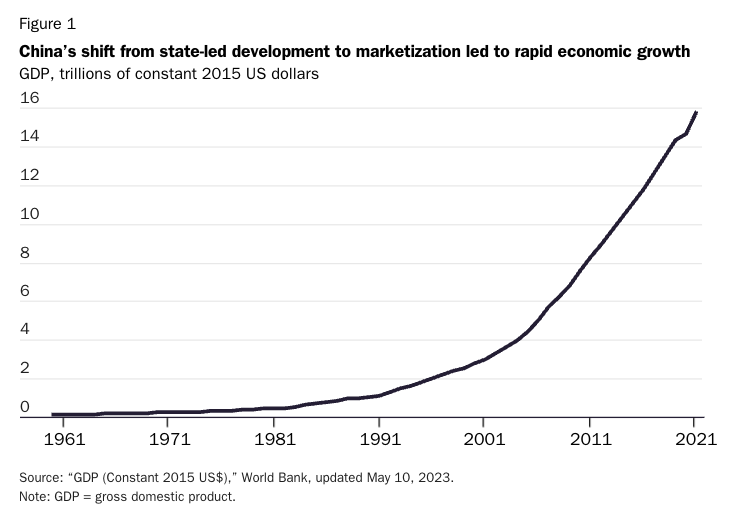
China’s rapid economic growth following its shift from state-led development (central planning) to marketization in 1978 and its drive to join the WTO are testaments to the idea that widening the range of choices open to people—via internal and external trade—is a winning strategy. Under Mao Zedong, protectionism and top-down planning led to a focus on developing heavy industry rather than improving people’s lives by using the market price system to guide economic decisions. In 1970, Chinese real gross domestic product (GDP) stood at only $232 billion (measured in 2015 U.S. dollars). However, once widespread marketization took place and individuals had more opportunities to get rich, real GDP grew to nearly $16 trillion by 2019 (Figure 1).15
Dr James Dorn has a PhD in Economics and has a prestigious resume of academic accomplishments and publications. He has testified before the U.S China Security Review Commission and the Congressional-Executive Commission on China and has served on the White House Commission on Presidential Scholars. He summarizes China’s economic history by saying:
China became an economic powerhouse by opening its markets, recognizing the nonstate sector, and allowing individuals to lift themselves out of poverty. Attempts at industrial policy under the SASAC (State-Owned Assets Supervision and Administration Commission) failed. The lesson for China is to continue on the path of marketization and liberalization, not to revert to destructive state control and repression.16
Socialism Doesn’t Share, It Steals
Markets are based on consent, not coercion. Socialism doesn’t work because it replaces freedom with force, and real results with restrictions. In a nutshell, you could describe it as, “I’m going to take what doesn’t belong to me and then enslave those who are trusting me.”
On the surface, Socialism resonates as a noble collaboration that allows everyone to equally benefit. But you’re not really collaborating if your first act is confiscating all privately owned resources, nor are you facilitating an equitable distribution of the benefits if those benefits don’t exist.
Some historians want to promote the idea that China’s first Five Year Plan worked, but they’re basing their assessment on a very carefully curated collection of criteria.
Historians will look at China’s evolution to a more industrial economy and for that reason give Mao’s Five Year Plan an A+. Economists look at Mao’s Five Year Plan and notice that the per capita income was actually lower, adjusted for inflation, in the 1950s than it had been at the end of the Song Dynasty in the 1270s.17
In addition…
Food availability per capita changed negligibly between the beginning and the end of the 30 years after 1949 (Roser and Ritchie 2013). The real earnings of China’s farmers had also stagnated on average over this period (Lardy 1983). Retained grain output (output less procurement) per capita of the rural population grew at only 0.6% per annum over 1952-77 (Li and Yang 2005). Multiple indicators point to long-term economic stagnation for the rural sector (Huang et al. 2008) 18
Socialism doesn’t share, it steals. It doesn’t redistribute wealth, it kills it at the source and then has to control every aspect of the human existence in order to give the appearance of economic stability.
Richard Ebeling is professor of Economics at the Citadel. He’s recognized as one of the leading members of the Austrian School of Economics and has written several books. He says that Socialism creates a situation where the…
…individual is totally and inescapably dependent on the political authority for his very existence.19
You saw that in Cuba where citizens were given a ration book that told them how much food and what type of food they could get.20
Senator Bernie Sanders is well known for his support of Socialism. He often points to Scandinavian countries as successful examples of Socialism.21 The problem, however, is that these countries have a market based economy. In 2015, at an address at Harvard’s Kennedy School of Government, former Danish Prime Minister Lars Løkke Rasmussen said…
I know that some people in the US associate the Nordic model with some sort of socialism. Therefore I would like to make one thing clear. Denmark is far from a socialist planned economy. Denmark is a market economy.22
What is the Appeal?
Given Socialism’s historical and practical failures, you would think that anyone who would subscribe to it is somehow nonsensical.
But that isn’t the case…
The whole political vision of the left, including socialism and communism, has failed by virtually every empirical test, in countries all around the world. But this has only led leftist intellectuals to evade and denigrate empirical evidence.23
Its toxic nature is often responded to with even greater passion and resolve.
Socialism appeals to different people for different reasons.
- A way to appear sensitive to the poor and marginalized
- A lack of experience with the real world in terms of the complexities of resource allocation, incentives, and human behavior at scale.24
But there’s also a spiritual dynamic that positions Socialism as a superior economic system. Rather than seeing individuals as having been made in the image of their Creator, they’re instead seen as distinguished exclusively according to their income. Any assistance that allows for an improvement in one’s situation is going to come from the state and not from God.25
Dr. Thomas Sowell is an economist who sees both the economy and society in general as a conflict between two visions; the Unconstrained Vision and the Constrained Vision. You see in his hypothesis something that resonates with Scripture…
This “vision” is diametrically opposed to the “Constrained Vision…”
Dr. Sowell explains how these two different visions manifest themselves in an economic context by saying…
The two visions entail every different views of the relationship between members of the existing society. The unconstrained vision has tended historically toward creating more equalized economic and social conditions in society, even if the means chosen imply great inequality in the right to decide such issues and choose such means. Clearly, only very unequal intellectual and moral standing could justify having equality imposed, whether the people want it or not, as Dworkin26 suggests, and only very unequal power would make it possible. It is consistent for the unconstrained vision to promote equalitarian ends by unequalitarian means, given the great differences between those whom Mill called “the wisest and best” and those who have not reached that intellectual and moral level.
Conversely, those with the constrained vision have tended to be less concerned with promoting economic and social equality, but more concerned with the dangers of an inequality of power, producing an articulate ruling elite of rationalists. In Hayek’s27 words:
“The most dangerous state in the growth of civilization may well be that in which man has come to regard all these beliefs as superstitions and refuses to accept or to submit to anything which he does not rationally understand. The rationalist whose reason is not sufficient to teach him those limitation of the power of conscious reason, and who despises all the institutions and customer which have not be consciously designed, would thus become the destroyer of the civilization built upon them.”28
In other words, the Constrained Vision sees humanity as imperfect and requires both boundaries and incentives to regulate what would otherwise be an unhealthy preoccupation with themselves. The Unconstrained Vision sees humanity as his own absolute and whatever institutions and doctrines that he would otherwise be accountable to are subordinated to the perspective of those who qualify as intellectual elites.
A Biblical Interpretation of Socialism
However you want to logically dispute those who agree with Socialism, the fact that it runs contrary to Biblical Absolutes qualifies this topic as something that needs to be regarded as a spiritual issue, and not just a socioeconomic topic.
- The Bible advocates sharing (Acts 2:43-45)
- Be kind and compassionate (Eph 4:32)
- Be generous to the poor (Prov 19:17 [Dt 15:7-11])
- Don’t be greedy (1 Jn 3:17-18)
But these gestures are voluntary acts of obedience, as opposed to a flawed system lording it over its constituents.
- Don’t take what isn’t yours (Lev 19:13)
- Dishonest pricing (Prov 11:1; 20:23)
In addition, Scripture commends:
- Personal responsibility (Prov 12:14; Gal 6:7-8)
- Solid work ethic (Prov 6:6-11; 2 Thess 3:10)
- Good business decisions (Matt 25:16, 20)
The reason Socialism often translates to pure evil is because the foundation upon which it is built denies the Truth of humanity being created and not merely sorted according to a human convention.
Conclusion
Socialism often poses as a compassionate methodology that eliminates poverty and mediates greed.
But unlike Scripture where sharing and charity are voluntary and personal responsibility is emphasized (Prov 27:23-27), Socialism forces the surrender of all personal property, artificially manipulates the marketplace, and demands total obedience to the state.
Not only does it fail when evaluated according to any practical metric, there is nothing voluntary or charitable about any act that is done under compulsion. You’re not improving the economy by instituting price controls, nor are you fostering teamwork by demonizing personal achievement.
Whatever “doctrine” is being asserted, anything based on the limited, flawed, and corruptible character of the individual is ultimately revealed as being incapable of achieving a perfect outcome, let alone a healthy result.
This was the distinction between the Revolutionary War and the French Revolution.
On one side we have the republican project of the American founders. Their revolution for freedom was grounded in a Lockean understanding of natural rights, in the moderate Scottish Enlightenment, and in the Hebrew and Christian scriptures. “We have no Government armed with Power capable of contending with human Passions unbridled by…morality and Religion,” wrote John Adams. “Avarice, ambition, Revenge or Gallantry, would break the strongest Cords of our Constitution as a Whale goes through a Net.” On the other side is the French project, inspired by Jean-Jacques Rousseau and Francois-Marie d’Arouet (better known as Voltaire), by the most radical strain of the Continental Enlightenment, and by a supreme confidence in human reason to chart man’s destiny. “Man is born free,” Rousseau declared, “but he is everywhere in chains.” One of the first chains to be cut was the authority of the Christian churches.29
Your identity is your starting point. If the way you see yourself and the world around you is based on the Reality of God and the Truth He brings to the table, you are both empowered by, and accountable to Something greater than yourself.
Jesus said that apart from me, you can do nothing (Jn 15:5). At the same time, Scripture says, nothing is impossible for God and it is His Power and Perspective that works through you (Matt 17:20; 19-26; Phil 2:13).
It’s the perfect and unchanging aspect of God that serves as the source for the prosperity and fulfillment we seek (Josh 1:9). Anything less is a toxic strategy used by the enemy that distracts from all that God is, all that He expects, and all that He would offer.
1. “Communist Manifesto”, Karl Marx and Frederick Engels, https://www.marxists.org/archive/marx/works/download/pdf/Manifesto.pdf, p15, accessed July 17, 2026)
2. Ibid, Preface to the 1833 German Edition
3. “Wikipedia”, “From Each According to His Ability, to Each According to His Needs”, https://en.wikipedia.org/wiki/From_each_according_to_his_ability,_to_each_according_to_his_needs, accessed July 26, 2026
4. “Thomas Sowell: Why Income Redistribution Fails in the Long Run” “The Thomas Sowell Show”, https://www.youtube.com/watch?v=Pnr8OQ04NDs, accessed July 17m, 2026
5. “Price Controls: Still a Bad Idea”, Hoover Institution, David R. Anderson, https://www.hoover.org/research/price-controls-still-bad-idea, accessed July 17, 2026
6. “The Collector”, “Trofim Lysenko: The Controversial Scientist Who Changed the Soviet Union”, https://www.thecollector.com/trofim-lysenko-controversial-scientist-soviet-union/, accessed July 21, 2026
7. “Adam Smith Institute”, “Mao’s First Five Year Plan & the Great Leap Forward”, https://www.adamsmith.org/the-real-history-of-communism/v/maos-first-five-year-plan-the-great-leap-forward, accessed July 21, 2026
8. “Despite these improvements, the state maintained its control over its citizens. Life for urban Chinese was tightly regimented by way of danwei or work units. The danwei provided the basic structure for labour and regulated many aspects of everyday life, including accommodation, education and social services. Chinese civilians even had to consult their danwei in matters regarding to marriage, having children or travel.” (“Alpha History”, “The First Five Year Plan”, https://alphahistory.com/chineserevolution/first-five-year-plan/, accessed July 21, 2026)
9. “Wikipedia”, “Hundred Flowers Campaign”, https://en.wikipedia.org/wiki/Hundred_Flowers_Campaign, accessed July 21, 2026
10. “EBSCO”, “Mao’s Hundred Flowers Campaign Begins”, https://www.ebsco.com/research-starters/history/maos-hundred-flowers-campaign-begins, accessed July 21, 2026
11. “Wikipedia”, “Anti-Rightist Campaign”, https://en.wikipedia.org/wiki/Anti-Rightist_Campaign, accessed July 21, 2026
12. “National Bureau of Economic Research”, “Poverty in China Since 1950: A Counterfactual Perspective”, https://www.nber.org/system/files/working_papers/w28370/w28370.pdf, accessed July 21, 2026
13. “Alpha History”, “The Great Leap Forward”, https://alphahistory.com/chineserevolution/great-leap-forward/, accessed July 21, 2026
14. “We have known for some time that Mao Zedong, founder of the People’s Republic of China, was one of the last century’s most brutal and vicious mass murderers. In 2005, Jung Chang and Jon Halliday’s biography of Mao was published in this country to wide acclaim, and for the first time, many of the myths surrounding his rise to power and the nature of his rule after 1949 were brought to light. The authors estimated that Mao “was responsible for over 70 million deaths in peacetime, more than any other twentieth-century leader.”
“One period they covered was Mao’s ‘Great Leap Forward,’ his attempt to rapidly industrialize China in the five years between 1958 and 1962. Chang and Halliday had argued that not only did the program fail; it produced mass starvation, with areas of China resorting to cannibalism. Peasants and city dwellers alike were forced to build home steel furnaces, and all metal implements — including pots and pans used for cooking — were to be smelt, turning each home into a mini local steel producing factory. Mao also ordered that all sparrows be killed, since they ate grain. The “bourgeois” bird was condemned; the result was the upsetting of nature’s ecological balance, as pests and other birds once killed by sparrows began to attack crops. Before long, Mao was asking the Soviet Union to send them 200,000 sparrows from the Soviet Far East.”
Mao had said: ‘Half of China may well have to die,’ and he was prepared for such an outcome. It almost came true. Thirty-eight million people died of starvation and overwork during the Leap and the subsequent famine, which lasted for four long years. This greatest of 20th century manmade famines exceeded the deaths caused by Stalin’s collectivization of the Ukraine. As Mao told his staff, ’50 million (might have to) die … you can’t blame me when people die.'” (“Hudson Institute”, “Mao’s ‘Great Leap Forward’ and the Power of History” Ronald Radosh, https://www.hudson.org/node/34988, accessed July 21, 2026)
15. “Cato Institute”, “China’s Post-1978 Economic Development and Entry into the Global Trading System”, James Dorn, https://www.cato.org/publications/chinas-post-1978-economic-development-entry-global-trading-system#china-needs-free-market-ideas, accessed July 22, 2026
16. Ibid
17. “The Case Against Socialism”, Rand Paul, Broadside Books eBooks, 2019, Kindle Version, p173
18. “National Bureau of Economic Research”, “Poverty in China Since 1950: A Counterfactual Perspective”, https://www.nber.org/system/files/working_papers/w28370/w28370.pdf, accessed July 21, 2026
19. “The Case Against Socialism”, Rand Paul, Broadside Books eBooks, 2019, Kindle Version, LOC 2457
20. Ibid, LOC 989
21. “World Socialist Website”, “Bernie Sanders and the “Scandinavian model”, Jordan Shilton, February, 2016, https://www.wsws.org/en/articles/2016/02/26/scan-f26.html?utm_source=chatgpt.com, accessed July 23, 2026
22. “Institute of Economic Affairs”, “The Myth of Scandinavian Socialism”, Corey Iacono, February 26, 2016, https://iea.org.uk/blog/the-myth-of-scandinavian-socialism/#, accessed July 23, 2026
23. “Adam Smith Institute”, “Young People and Socialism” Madsen Pirie, https://www.adamsmith.org/blog/young-people-and-socialism, accessed July 23, 2026
24. “American Enterprise Institute”, “Thomas Sowell Quotations on the ‘vision of the Political Left'”, https://www.aei.org/carpe-diem/thomas-sowell-quotations-on-the-political-left/, accessed July 23, 2026
25. “There is an undeniable correlation between socialism and secularism, but does it prove causation? A strong case is made by analyzing the “Nones” at different stages of their flight from faith. Pew Research asked “Nones” in late 2017 the reason they no longer affiliate with a religion. The overwhelming majority of atheist “Nones” (75 percent) said they do not believe in God, while a plurality of agnostic “Nones” (38 percent) said they “question a lot of religious teachings.” Those “Nones” who still believe in God are equally motivated by two factors: They question religious doctrines (25 percent), and they “don’t like the positions churches take on social/political issues” (21 percent).
Further, the data show that “Nones” are becoming increasingly secular as time goes on. The percentage of “Nones” who do not believe in God increased by half from 2007 to 2014. This leads to an inescapable conclusion: The social and political issues that drive a wedge between young people and traditional Christianity – including the envy that drives socialism – eventually blossom into full atheism.” (“Action Institute”, “How socialism causes atheism”, Rev. Ben Johnson, December 11, 2019, https://www.acton.org/religion-liberty/volume-29-number-3/how-socialism-causes-atheism, accessed July 23, 2026)
26. Ronald Dworkin was a Professor of Law who had a very liberal approach to jurisprudence and was referred to by Thomas Sowell as an example of how his perspective contributed to the decline of the rule of law.
27. Friedrich Hayek was an Austrian economist and shared the 1974 Nobel Memorial Prize in Economic Sciences with Gunnar Myrdal for work on money and economic fluctuations, and the interdependence of economic, social and institutional phenomena.
28. “Conflict of Visions” Thomas Sowell, William Morrow & co, United States, 1987, Kindle LOC 776
29. “The Heritage Foundation”, “Two Revolutions for Freedom”, Joseph Loconte, Ph.D., https://www.heritage.org/american-history/commentary/two-revolutions-freedom, accessed July 25, 2026
Bibliography
The Presidency of Salvador Allende
CIA Briefing of the Political Climate in Chile by Richard Helms, November 5, 1970
Office of the Historian, Chile’s Emerging Economic Problems, July 1971
Macroeconomic populism in Chile: Allende and the recession of 1973
Alternative Trade Strategies and Employment Implications: Chile
The Allende Years and the Pinochet Coup, 1969–1973
China’s Post-1978 Economic Development and Entry into the Global Trading System
Daniel Di Martino – Why Socialism Failed in Venezuela, From Someone Who Lived It
Why Can’t Conservatives See…?
This was a question on quora.com…
Why are so many Americans unable to see what Trump is?
Here’s my response…
Anytime you’re talking with someone who spends more time mocking the intelligence of their opponent then they do actually proving they have a point, you’re usually talking to someone who doesn’t have something to say as much as they’ve got something to hide.
While the Democrat party insisted that the border security was a problem that couldn’t be solved, President Trump secured the border. What was a situation where hundreds of thousands of illegal immigrants were streaming into our country, that no longer is happening (BBC).
The Inflation Reduction Act was peddled as an economic boost, when, in fact, it was the largest climate investment in U.S. history, dedicating approximately $369 billion to limit greenhouse gas emissions (americanprogress.org) It had promised a reduction in inflation which was at 2.25% when it passed. A year later, it was at 5.25% (heritage.org).
Meanwhile, President Trump has successfully secured roughly $10 trillion in new domestic investment, onshoring jobs and revitalizing American manufacturing. And while critics want to question the substance of promises made by countries that agreed to invest only when threatened with increased tariffs, the fact is you have American financial interests being championed in the context of fair trade agreements and a positive return on investments – something the Democrat party can only talk about yet never really achieve apart from manipulating the numbers…
- United Arab Emirates: $1.4 trillion committed over the next decade.
- Qatar: $1.2 trillion in bilateral economic exchange.’Japan: $1 trillion in pledged investments.
- Saudi Arabia: $600 billion committed over a four-year period.
- South Korea: $450 billion committed to U.S. energy products. (whitehouse.gov)
Your party has tried to kill Trump on four different occasions. You ignore results, you make excuses, your ideas don’t work, and, more often than not, you are the very thing you claim to despise.
It’s not Conservatives that are having a hard time “seeing” what’s real. We’re watching your world of nonsensical and unsustainable ideas revealed for what they are, as well as the pointless claim of victimhood your use to ensure you’re never evaluated just accommodated.
…and we love the view!
Imaginary Sermon
Brothers and sisters in Christ, greetings!
I come before you today in the Name of Christ Who, with His death and Resurrection, destroyed every social construct that would otherwise be used by sinful men to restrict the rights and opportunities that God gives to every man ❶.
We are here today to consider the tragic death of George Floyd and to determine if his death is the result of a wicked mindset manifested in the actions of ones entrusted with the role of keeping the peace. ❷
We, as a culture, have been conditioned to project any one of a number of assumptions on to scenarios such as these and believe that it is all part of the insidious sin of Racism our ancestors had to endure for centuries. But I come to you in the Name of Christ today to remind you that we become the very thing we claim to despise if we first do not mediate on the Truth of Scripture which is what gives Divine Credence to our cause. ❸
Here me.
You Who Pass Judgment Do the Same Things
If we do not call out these officers by name and instead condemn the entire law enforcement community – if we do not address those individuals within the system who are corrupt and instead indict the entire system… Are we not doing the very thing that we accuse others of doing to us? ❹
Set Them an Example
Moreover, when we take the stand in the court of public opinion, how does our testimony resonate in the minds of the jury? It says in Proverbs 3:1-4:
My son, do not forget my teaching, but keep my commands in your heart, 2 for they will prolong your life many years and bring you peace and prosperity 3 Let love and faithfulness never leave you; bind them around your neck, write them on the tablet of your heart. 4 Then you will win favor and a good name in the sight of God and man. (Prov 3:1-4)
Later in chapter 22, it says;
A good name is more desirable than great riches; to be esteemed is better than silver or gold. (Prov 22:1)
As believers, you bear the Name of Christ. As a son and as a daughter you bear the name of your forefathers and of your immediate family. It is because of this Truth, that your reputation is so important because your actions reflect, not only on yourself, but also on those whose name you bear. ❺
What is our reputation?
- 41% of our young people drop out of High School
- 70% of our infants are born out of wedlock.
- Combine that with the fact that while we account for only 13% of our nation’s total citizenry, the population of our country’s prisons are 34% African American.
When a police officer kisses his wife good bye in the morning, there is an unspoken reality that he is seeing his bride for the last time given the risks he takes to serve and protect. Does our reputation put him at ease or does it put him on his guard? Is our reputation such where the words we speak are immediately embraced as the legitimate concerns that they are or does our notoriety drown out the voice of our hurting and the sound of our appeal? ❻
Jesus said you will know a tree by its fruit. What sort of produce do our collective vineyards yield? Is it characterized by law abiding citizens or arrest records? Do we have more abortion clinics than nurseries? Does it boast a rich collection of graduates or a large number of empty classrooms? Are we collectively setting an example that compliments our cause or does it distract from it?
We Each Are Responsible
We accuse our own within the law enforcement community of being corrupt, we assault the character of anyone who dares to suggest that our bad reputation is deserved, we complain that the system is rigged, that our image is distorted and even now, we prepare to protest the newest appearance of Police Brutality because we believe that it was not only Racism that caused the death of George Floydm but it’s Racism that’s to blame for all the adversity we contend with. ❼
But to what extent do our collective actions place us in the position we’re in? Are we victims of a biased infrastructure or are we merely victims of our own immoral decision making? ❽ We complain that the police project on to every one of us the trouble and the harm they have suffered at the hands of our brethren. But should not a portion of our indignation be directed to those of us who are lawless instead of hating the one who enforces the law? ❾
We burn the flag that elects a black man as president, we spurn the anthem that destroyed slavery, we denounce the system that gives us free education and all the while it is our fathers who are leaving, it is our grades that are lacking and it is our own that we are killing.
If our platform is to have any credibility – if our indignation is to resonate as righteous – than we cannot be hypocritical in our accusations, we must set an example in our conduct and we must take responsibility for our actions.
Regardless of Race
And it is here where I would pause and remind you that at this point I do not speak only to those who are gathered in this sanctuary, but to all men regardless of race. We stifle the resolution we seek by referring to men as either black or white. And ladies, I beseech you to hear me include you when I say, “men” in that I’m referring to all humanity.
We are not “white,” we are not “black” we are all God’s offspring ❿ and we are all therefore obligated to not only hold the Bible we own with our hands, but to obey the God it proclaims with our whole heart. ➀
More Than An Authority
As an officer of the law, you are tasked with keeping the peace and assuming all suspects are innocent until proven guilty. Even those whose records are tarnished with past mistakes, the Bible rebukes those who make false assumptions. ➁
Your badge must be more than an authority, it must also be an example. And however you are maligned and even threatened, your response must go beyond being merely “smart,” you have to be “wise.” ➂
And I am not suggesting that by being “wise,” you are therefore restricted from using deadly force. It’s not that you are restricted as much as you are resolved to kill only when it’s appropriate to do so. And yes, there are times when it’s appropriate to kill. ➃ But there is also a time to heal and you must be able to make that distinction.
Should it be determined that you are using your position to lord it over those who are obligated to obey, you are identified in Scripture as a wicked oppressor and a false teacher and there is a special kind of destruction awaiting you on Judgement Day. ➄
To those who are breaking the law, in whatever capacity, know this: You are not just violating a human regulation, you are breaking a Divine Directive. If you commit murder, if you steal, you not only incur the righteous wrath of of the law, you also sin against God.➅
Just like the Police Officer who has to answer to a Higher Standard than his immediate supervisor, you also have to answer to a Higher Law. And should your behavior be revealed as violent and disrespectful when you are apprehended, you do nothing but add to your guilt both in the sight of your jurors as well as in the sight of your King. ❾
It’s Not Only the Law That You Are Breaking
And to those who murder, steal and destroy and excuse it as a reasonable reaction to “not being heard” or a “miscarriage of justice,” let me remind you that the moment you break the law, you are no longer a protester or an activist, you are a criminal and, again, it is not only the law that you are breaking, it is your God that you are offending – especially if you do your wanton acts insisting that you represent a godly disposition ➆.
What Are We Doing?
In the sixties, a number of extraordinary people emerged who had labored beneath the weight of racial prejudice and went on to accomplish some amazing things:
- Rosa Parks was a soft spoken black woman whose refusal to surrender her seat because of her race would inspire the Montgomery Bus Boycott and lead to her being honored with the Medal of Freedom in 1996.
- James Meredith was a nine year veteran of the United States Air Force who would go on to become the first black American to attend the University of Mississippi despite the riots his enrollment inspired which would be dispersed only with the intervention of Federal Troops.
- Percy Julian is one of the most influential chemists in American history despite his not being able to attend High School and had to study abroad in order to secure his doctorate because of his color.
- Barbara Jordan grew up in a poor, black neighborhood in Houston, Texas and, despite the challenges of being an African American in an area where Jim Crow laws was common, she was nevertheless able to make history by being the first black female in congress to come from the deep south.
These are among the heroes of the Civil Rights Movement. They inspired change, in part, by presenting an argument that reeked of moral and professional excellence. By living and performing in a manner that was beyond reproach, they were able to silence the criticisms that would’ve otherwise distracted from the injustices they sought to resolve and the result was dramatic ➇.
Today, we are instructed to embrace an entirely different kind of individual and and honor them in the same way we do the noble persons who carried the baton of the Civil Rights issue decades ago.
- George Floyd had a criminal record that included five arrests and five years spent in prison for aggravated robbery.
- Rodney King, at the time of his arrest in 1991, had been sentenced to two years in prison for robbing a convenience store armed with a tire iron.
- Freddie Gray had been arrested on multiple occasions for drug related crimes.
In each case, you have a person that had a criminal record and was resisting arrest when they were initially apprehended. Now, rather than being able to prosecute our cause in the context of moral courage and professional excellence, we are seen as accusing others of being unprincipled when our champions seemingly have no principles ourselves. ⑨
What are we doing?
If we would answer that question with a response that included successful appeals for justice and productive conversations that yielded positive results, we need to cease all attempts to qualify an event by asking whether or not it involved a black man or a white man and instead ask whether or not it involved a good man – be they the one being arrested or the one that is making the arrest. And if Christ really did die and come back to life, than the definition of a good man is a godly man, can I get an “Amen?”
Let Us Move Forward
Let us move forward, then, by refusing to express our concerns in the context of labels, mobs and crowds. Let us avoid becoming the very thing we claim to despise by by directing our questions to the individuals involved and not the institutions they represent. Let us labor to be living manifestations of the moral excellence we would demand in others. Let us move beyond race and instead look at one another as fellow soldiers battling our eternal enemy as a unified force, sanctified by the blood of Christ and empowered by His Holy Spirit. And let our cause be a racially diverse venture that battles true bigotry by holding up specific instances of moral excellence responded to with an undeniably sinful bias- and not the flawed campaigns triggered by legitimate arrests and prosecuted with even more criminal activity.
That is how you effectively assert the Truth of your God, that is how you lead by example and that is how you effect true and enduring change. Let us move forward and let us pray now for both the Strength and the Wisdom to do just that.
Lets’ pray…
❶ There is neither Jew nor Gentile, neither slave nor free, nor is there male and female, for you are all one in Christ Jesus. (Gal 3:28)
❷ When the righteous increase, the people rejoice, but when the wicked rule, the people groan. (Prov 29:2)
❸ Whoever is slow to anger is better than the mighty, and he who rules his spirit than he who takes a city. (Prov 16:32)
❹ You, therefore, have no excuse, you who pass judgment on someone else, for at whatever point you judge another, you are condemning yourself, because you who pass judgment do the same things. (Rom 2:1)
❺ I will say to the north, ‘Give them up!’ and to the south, ‘Do not hold them back.’ Bring my sons from afar and my daughters from the ends of the earth— everyone who is called by my name, whom I created for my glory, whom I formed and made. (Is 43:6-7 [emphasis added]) On that day you will realize that I am in my Father, and you are in me, and I am in you. (Jn 14:20)
❻ In the same way, let your light shine before men so that they may see your good deeds and praise your Father in heaven. (Matt 5:16) In everything set them an example by doing what is good. In your teaching show integrity, seriousness 8 and soundness of speech that cannot be condemned, so that those who oppose you may be ashamed because they have nothing bad to say about us. (Titus 2:7-8)
❼ He repays everyone for what they have done; he brings on them what their conduct deserves. (Job 34:11) When a man’s folly brings his way to ruin, his heart rages against the Lord. (Prov 19:3) Pay careful attention to your own work, for then you will get the satisfaction of a job well done, and you won’t need to compare yourself to anyone else. 5 For we are each responsible for our own conduct. (Gal 6:4-5 [NLT])
❽ Can a man scoop fire into his lap without his clothes being burned? Can a man walk on hot coals without his feet being scorched? (Prov 6:27-28)
❾ For the one in authority is God’s servant for your good. But if you do wrong, be afraid, for rulers do not bear the sword for no reason. They are God’s servants, agents of wrath to bring punishment on the wrongdoer. (Rom 13:4) Have nothing to do with the fruitless deeds of darkness but rather expose them. (Eph 5:11)
❿ For in him all things were created: things in heaven and on earth, visible and invisible, whether thrones or powers or rulers or authorities; all things have been created through him and for him. (col 1:16)
➀ Do not merely listen to the word, and so deceive yourselves. Do what it says. (Jas 1:22)
➁ Do not hastily bring into court, for what will you do in the end, when your neighbor puts you to shame? (Prov 25:8) Do not be quick with your mouth, do not be hasty in your heart to utter anything before God. God is in heaven and you are on earth, so let your words be few. (Ecc 5:2)
➂ “Who has known the mind of the Lord so as to instruct him?” But we have the mind of Christ. (1 Cor 2:16) My dear brothers and sisters, take note of this: Everyone should be quick to listen, slow to speak and slow to become angry, (Jas 1:19)
➃ a time to kill and a time to heal, a time to tear down and a time to build, (Ecc 3:3)
➄ Like a roaring lion or a charging bear is a wicked ruler over a helpless people. (Prov 28:15) But false prophets also arose among the people, just as there will be false teachers among you, who will secretly bring in destructive opinions. They will even deny the Master who bought them—bringing swift destruction on themselves. Even so, many will follow their licentious ways, and because of these teachers the way of truth will be maligned. And in their greed they will exploit you with deceptive words. Their condemnation, pronounced against them long ago, has not been idle, and their destruction is not asleep. (2 Pet 2:1-3)
➅ For I know my transgressions, and my sin is always before me. Against you, you only, have I sinned and done what is evil in your sight; so you are right in your verdict and justified when you judge. (Ps 51:3-4)
➆ You shall not misuse the name of the Lord your God, for the Lord will not hold anyone guiltless who misuses his name. (Ex 20:7)
➇ For it is God’s will that by doing good you should silence the ignorant talk of foolish people. (1 pet 2:15)
⑨ “Do not judge, or you too will be judged. 2 For in the same way you judge others, you will be judged, and with the measure you use, it will be measured to you. (Matt 7:1-2)
Copy / Paste
You always want to be explain what you believe and why (1 Pet 3:15). You never want to be guilty of simply “copying and pasting” what someone else said and use that as the basis for your convictions.
There’s a lot of that going on today. You’ll hear people rant about policies and personalities, yet when you look at what they use to justify their indignation, you’re met with what sounds like a script that they’ve just copied and pasted from their favorite news outlet.
There’s nothing wrong with citing a credible resource, but you want to make sure that it’s credible before you refer to it as conclusive.
Fact is, it’s possible to be honest without telling the whole truth.
- Some will pose as outraged by a particular behavior, yet are suspiciously silent when that same behavior is exhibited in those they support.
- Others are critical of the accomplishments of those they disagree with, yet applaud those same accomplishments when done by those they admire.
It’s more than a double standard, because you have to have a standard to begin with in order for it to be duplicated.
If you’re among those that define an “open mind” as someone who will say things like, “What’s true for you isn’t necessarily true for me,” you’ve declared yourself to be utterly meaningless, because, according to your own logic, a person can accuse you of being a liar and not be wrong.
You want to “evaluate” all of the relevant facts based on their substance and relevance to the issue being discussed. You don’t want to simply “eliminate” those facts that are credible, yet contradict the conclusion that aligns with what you want to hear. However compelling an appeal for pity may sound, it’s revealed as a fool’s paradise when it’s determined that the pain they’re feeling is a result of them having shot themselves in the foot.
If you want to be taken seriously, you want to be able to demonstrate the fact that you have evaluated the facts and not just eliminated the facts you don’t want to consider. You do that by being able to explain what you believe and why you believe it, and that’s not accomplished by simply “copying and pasting” from your preferred collection of resources.


