Prove It! | Part V: Science and History

This is Part V of a 6 part series where we’re looking to “prove it!” We’re rehearsing some of the evidence that validates the authenticity of the Christian doctrine.

In this installment, we’re looking at the fingerprint of God as it shows up in Science and History.

Science

When you ponder the Reality of God in the context of creation, the most obvious indicator of His involvement is the elegant intricacy of the universe.

While there are any one of a number of examples that demonstrate the complex nature of the cosmos (see sidebar), let’s consider some of the more compelling anomalies that leave a person both awestruck and inspired.

Cosmological Constant

The cosmological constant is a mathematical value assigned to what astronomers call “dark energy.” When you look at the universe, you see things moving in a way that doesn’t make sense in that they’re things are being pushed and pulled around despite the fact that there is nothing around them. In other words, when you see a moon orbiting a planet, that makes sense because the planet has a gravitational pull that maintains that moon’s trajectory. But there are objects in space that are moving as though they’re being influenced by a gravitational force, yet there’s nothing visible to provide that force. Hence the term “dark energy” was coined to describe the obvious force being exerted upon these objects by seemingly invisible entities.

Where Did God Come From?

Dr. Kent Hovind is an educator and apologist who is known for being both articulate and compelling when it comes to a biblical explanation for the universe.

In a debate with Reinhold Schlieter of the Embry Riddle Aeronautical University, Hovind was asked, “Where does God come from?” Here’s his response:

Your question, where does God come from assumes that you are thinking, obviously displays, that you are thinking of the wrong god. Because the God of the Bible is not affected by time, space or matter. If He is affected by time, space or matter, He is not God. Time, space and matter, what we call a continuum, would have to come into existence at the same instance. Because if you had matter and no space, where would you put i? If there was matter and space but no time, when would you put it? You cannot have time, space or matter independently, they have to come into existence simultaneously.

The Bible answers that in 10 words: In the beginning, (there’s time), God created the heavens (there’s space), and the earth (there’s matter). So you have time, space, matter, the trinity of trinities: Time – has past, present, future. Space – has breadth, length , height. Matter has solid, liquid, gas. We have a trinity of trinities created instantaneously, and the God who created them has to be outside of them.

If He is limited by time, He is not God. The God who created this computer is not in the computer. He is not running around changing the numbers on the screen. The God who created this universe is outside the universe. He is above it, beyond it, in it, He is not affected by it.

So [if you have] the concept that a spiritual force cannot have an effect on a material body, then you have to explain to me why there are emotions, and love, and hatred, and envy, and jealousy and rationality – I mean, if your brain is a collection of chemicals formed by chance over billions of years, how on earth can you trust your own reasoning process and the thoughts that you think?

Your question, where does God come from, is assuming a limited God. And that is your problem. The God that I worship is not limited by time, space or matter. If I could fit the infinite God into my 3-pound brain, He would not be worthy worshiping, that is for certain. So, that is the God I worship.

Fact is, this dark energy accounts for over 70% of our universe. And what makes that significant is that if this dark energy was characterized by a gravitational dynamic that was pulling everything in, then the universe would ultimately collapse on itself and life in general would cease to exist. If, on the other hand, this dark energy wielded a gravitational force that was too weak to temper the way in which our universe is expanding, then our solar system would unravel as would the entire cosmos.

This, then, is the cosmological constant: The value assigned to this force that continues to allow the universe to expand and therefore not collapse on itself, yet not spin out of control.

Initially, astronomers believed that the cosmological constant was very large. After all, you’re going to need a big broom to move planets around. But that is not the case. The cosmological constant is actually very small.

How small?

One part in a hundred million billion billion billion billion billion. That’s a ten followed by fifty three zeroes. Contemplate the precision of that number. And if you move the dial or change the settings in even the most incremental way, the end result is something that no longer sustains life because of the way the universe would either collapse or unravel.1

Water

Water is one of the few known substances that are less dense as a solid than as a liquid. This is significant because if it wasn’t all aquatic life would by crushed beneath the weight of the ice that would form in the winter.

Here again you see something that is far too intentional to be written off as a lucky accident. In other words, the intent and design of a Creator.

Cambrian Explosion / Fossils

The Cambrian Explosion refers to a layer of rock where you find a sudden abundance of fossils. In other words, you don’t seem to have much life in layers of rock further down, like Evolution would like to suggest. Evolutionary theory proposes a lengthy process where simpler life forms became more complex over time. That geological record doesn’t exist. Instead, you have an abrupt presence of life with no apparent precursor.

Evolution can’t explain this, but a global flood can.

If logic is the theme of our discussion, then it would “logical” to go with what represents the most obvious explanation, which would be a worldwide catastrophe that instantly destroyed and buried multitudes of organisms instantaneously.

For more reading about Creation and the Theory of Evolution, refer to the articles listed to the right.

History

Jesus isn’t just a religious figurehead. There was a point where you could’ve shaken His Hand.

Max Lucado in his book, “When God Came Near” does a great job of capturing the “feeling” that you might’ve experienced interacting with Jesus, knowing Who He was by listing a series of questions for Mary…

When God Came Near

1. What was it like watching him pray?

2. How did he respond when he saw other kids giggling during the service at the synagogue?

3. When he saw a rainbow, did he ever mention a flood?

4. Did you ever feel awkward teaching him how he created the world?

5. When he saw a lamb being led to the slaughter, did he act differently?

6. Did you ever see him with a distant look on his face as if he were listening to someone you couldn’t hear?

7. How did he act at funerals?

8. Did the thought ever occur to you that the God to whom you were praying was asleep under your own roof?

9. Did you ever try to count the stars with him….and succeed?

10. Did he ever come home with a black eye?

11. How did he act when he got his first haircut?

12. Did he have any friend by the name of Judas?

13. Did he do well in school?

14. Did you ever scold him?

15. Did he ever have to ask a question about Scripture?

16. What do you think he thought when he saw a prostitute offering to the highest bidder the body he made?

17. Did he ever get angry when someone was dishonest with him?

18. Did you ever catch him pensively looking at the flesh on his own arm while holding a clod of dirt?

19. Did he ever wake up afraid?

20. Who was his best friend?

21. When someone referred to Satan, how did he act?

22. Did you ever accidentally call him Father?

23. What did he and his cousin John talk about as kids?

24. Did his brothers and sisters understand what was happening?

25. Did you ever think, That’s God eating my soup?

Archaeology offers a powerful testament to the historical integrity of Scripture. Nelson Glueck, the renowned Jewish archaeologist, wrote: “It may be stated categorically that no archaeological discovery has ever controverted a biblical reference.” He continued his assertion of “the almost incredibly accurate historical memory of the Bible, and particularly so when it is fortified by archaeological fact.”

Here are some examples:

Scripture and Archaeology

Sergius Paulus Inscriptions

In Acts 13, we read of how Saul and Barnabas set off on a missionary journey to the Island of Cyprus. Upon arriving at Paphos, they meet the proconsul, Sergius Paulus, leading him to faith in Christ. Luke describes him as “a man of intelligence” (Acts 13:7). This is true as Sergius Paulus was also a first-century author and is one of the authorities referenced by Pliny the Elder in his classic, Naturalis Historia.Numerous inscriptions have been discovered that may refer to Sergius Paulus; the Sergii Paulii’s seem to have bene a prominent family in the Roman Empire. In 1877, an inscription was discovered at Soli, not far from Paphos that references, “the proconsul Paulus.” Another inscription from Rome, dating to the mid-40’s, names Lucius Sergius Paulus as one of the curators of the Tiber River under the Emperor Claudius. Finally, numerous inscriptions, most famous of which names a “L. Sergius Paulus” have been discovered near Pisidian Antioch. (Bible Archaeology Report)

The Tel Dan Inscription

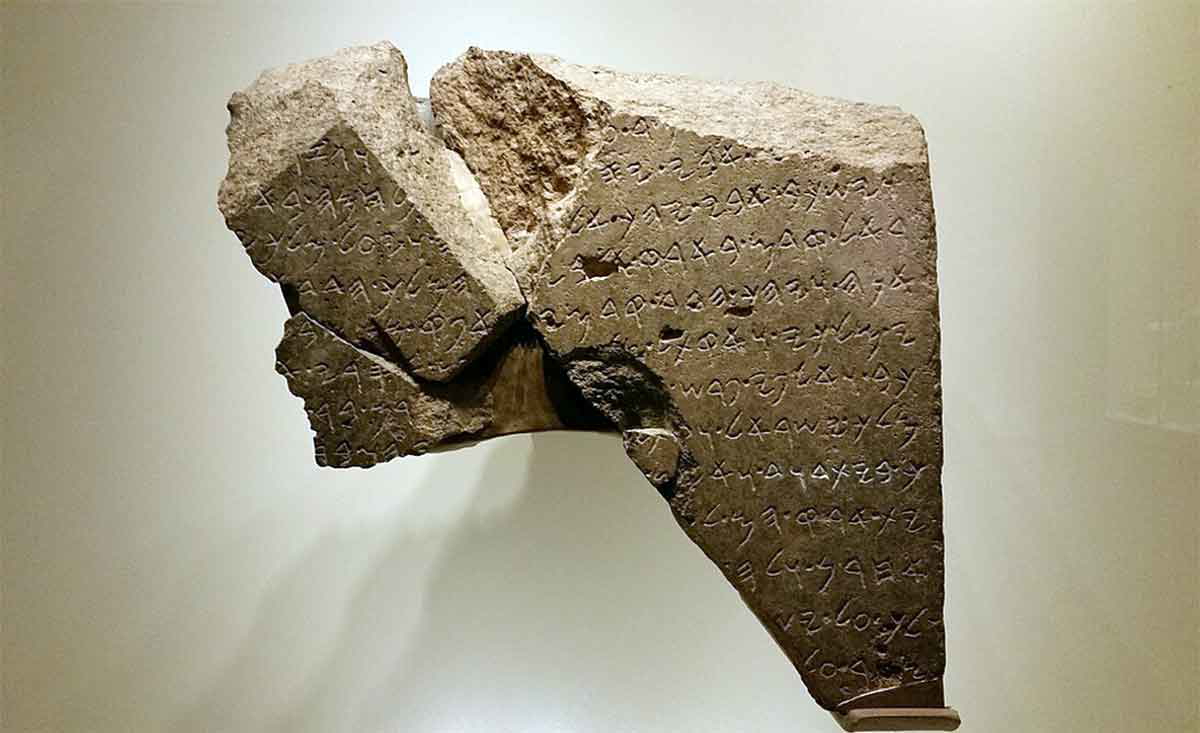
The lack of reference to King David in the historical record once gave rise to the idea that no such king existed, or that he was merely a local, tribal chieftain of no real significance. The Tel Dan Inscription, discovered in 1993–94 during excavations at Tel Dan in northern Israel, proved the contrary. The inscription consists of several fragments of an Aramaic victory stele erected by an Aramean king, most likely Hazael or his son Bar-Hadad II.

The inscription references the “House of David,” which scholars believe refers to the dynasty of King David from the Bible. This inscription is the first extra-biblical mention of King David. The term “House of David” indicates that he was the first of a line of kings, which confirms the biblical account of the reign of David, his son, grandson, and so forth.

The Tel Dan Inscription dates to the 9th century BCE and aligns with biblical accounts of geopolitical conflicts and Israel’s interactions with neighboring nations during the same period. The inscription also refers to the House of Israel, further supporting the Bible narrative. (The Collector)

The Dead Sea Scrolls

The Dead Sea Scrolls found at Qumran in 1947 contain fragments of every book in the Old Testament except for the Book of Esther. Some of these manuscripts date to the third century BCE. What is significant about this discovery is that it proves how little manuscripts have changed since the time of Christ. The narrative that changes, omissions, and additions over time had a corrupting effect on the Bible manuscripts, was proven incorrect. (The Collector)

Shishak’s Invasion

The Bible mentions the Egyptian king Shishak invading Judah and plundering the Temple in 1 Kings 14:25-26 and 2 Chronicles 12:2-9. Some inscriptions and reliefs in Egypt, particularly at Karnak Temple in Thebes (Luxor), provide corroborating evidence of the military campaign by Shishak into Judah and neighboring areas. The place names correlate with Biblical names and places, confirming the narrative.

The list of the spoils of war brought back to Karnak Temple corroborates the biblical account of the seizure of wealth from the Temple by Shishak. This archaeological evidence validates the historical accuracy of the biblical description of Shishak’s actions during his campaign against Judah. (The Collector)

Caiaphas Ossuary

In 1990, a construction team was building a water park near Jerusalem when their bulldozer plowed through a the roof of a first-century tomb. Archaeologists were called in and discovered a variety of ossuaries (bone boxes used in the first-century), including an ornate one that was inscribed with the name “Joseph son of Caiaphas.” Inside were the bones six people, including those of a 60-year old man which scholars believe are the remains of Caiaphas himself.

Caiaphas was the high priest who presided over the trial of Jesus according to the gospels (Mt 26:3, 57; Lk 3:2; Jn 11:49). The ancient historian, Josephus, records that Caiaphas’s full name was Joseph Caiaphas and that he held this role from AD 18-36 (Jewish Antiquities, 18:35 & 18:95). It appears that he was widely known by his surname/family name, Caiaphas, in the same way that many of the sons of Herod were simply known as Herod (ie. Herod Antipas, Herod Archelaus, etc).

Many scholars are convinced that this is the ossuary of the high priest who played a prominent role in the trial of Jesus. His ossuary and physical remains provide archaeological evidence confirming the existence of a prominent person in the New Testament. The Caiaphas ossuary is currently on display in the Israel Museum in Jerusalem. (Bible Archaeology Report)

Ruins in the City of Jericho

Archaeological discoveries in Jericho support the Bible’s story about the destruction and burning of the city. Excavations at Jericho have revealed evidence of a fortified city with massive walls dating to the Late Bronze Age (around 1550–1200 BCE). These dates correspond to the biblical time frame of the Israelite conquest. Archaeologists have identified layers of destruction within the city’s ruins, indicating that Jericho experienced violent destruction around the time traditionally associated with Joshua’s conquest.

Archaeological findings suggest that the city’s walls did collapse outward, matching the description in Joshua 6:20: “The wall collapsed, so that every man charged straight in, and they took the city.” This collapse aligns with the biblical account of the Israelites’ marching around the city, sounding trumpets and shouting. In addition, evidence of extensive burning within the city is consistent with the biblical narrative that the Israelites burned Jericho after its conquest (Joshua 6:24).

Following its destruction, Jericho remained uninhabited for several centuries, as evidenced by the absence of significant occupation layers in the archaeological record. This matches the biblical account, which describes Jericho as being placed under a curse, with Joshua declaring, “Cursed before the Lord be the man who rises up and rebuilds this city, Jericho” (Joshua 6:26).(The Collector)

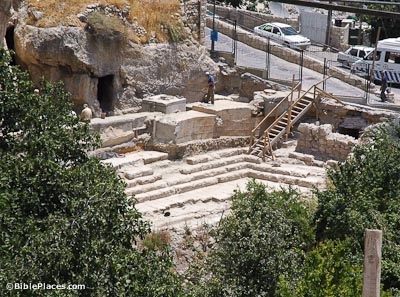
Pool of Siloam

In John 9, Jesus heals a blind many by making a mud poultice and applying it to his eyes, and then telling him to go and wash in the Pool of Siloam. Visitors to Jerusalem have long visited a 5th-century Byzantine “Pool of Siloam” that had been built by Empress Eudocia to commemorate this miracle. The Byzantine pool is at the end of Hezekiah’s Tunnel, the aqueduct that brings water from the Gihon Spring into the city. The exact location of the Pool of Siloam of Jesus’ day remained a mystery until its discovery in 2004.

In the summer of that year, repairs were being made to a drainage system when two ancient steps were uncovered. Archaeologists were called in and when the excavations were complete, a large pool was uncovered. In all at least 20 steps leading down from the street level into the pool were revealed. Pottery from one end of the pool was used to date it to the First-Century AD, while at the southern end, a large wall and section of the pool dating to the Old Testament period was discovered.

Given that it was in the exact location that scholars had long believed the actual Pool of Siloam to be – only 70 meters from the Byzantine pool – and that it dated to the time of Jesus, it was identified as the actual Pool of Siloam where the blind man had washed to receive healing. (Bible Archaeology Report)

Conclusion

Dr. James Allan Francis penned the following words which very effectively sum up the life of Christ…

“Here is a man who was born in an obscure village, the child of a peasant woman. He grew up in another village. He worked in a carpenter shop until He was thirty. Then for three years He was an itinerant preacher.

“He never owned a home. He never wrote a book. He never held an office. He never had a family. He never went to college. He never put His foot inside a big city. He never traveled two hundred miles from the place He was born. He never did one of the things that usually accompany greatness. He had no credentials but Himself. . . .

“While still a young man, the tide of popular opinion turned against Him. His friends ran away. One of them denied Him. He was turned over to His enemies. He went through the mockery of a trial. He was nailed upon a cross between two thieves. While He was dying His executioners gambled for the only piece of property He had on earth—His coat. When He was dead, He was laid in a borrowed grave through the pity of a friend.

“Nineteen long centuries have come and gone, and today He is a centerpiece of the human race and leader of the column of progress.

“I am far within the mark when I say that all the armies that ever marched, all the navies that were ever built; all the parliaments that ever sat and all the kings that ever reigned, put together, have not affected the life of man upon this earth as powerfully as has that one solitary life.”2

Wilbur Smith, a respected Bible scholar, once wrote, “The latest edition of the Encyclopedia Britannica gives twenty thousand words to this person, Jesus, and does not even hint that He did not exist—more words, by the way, than are given to Aristotle, Alexander, Cicero, Julius Caesar, or Napoleon Bonaparte.”3

George Buttrick, recognized as one of the ten greatest preachers of the twentieth century, wrote: “Jesus gave history a new beginning. In every land he is at home. . . . His birthday is kept across the world. His death-day set a gallows against every skyline.”4

Even Napoleon himself admitted, “I know men and I tell you that Jesus Christ was not a man. Superficial minds see a resemblance between Christ and the founders of empires, and the gods of other religions. That resemblance does not exist. There is between Christianity and whatever other religions the distance of infinity…

“Everything in Christ astonishes me, His spirit overawes me, and His will confounds me. Between Him and whoever else in the world, there is no possible term of comparison. He is truly a being by Himself. His ideas and sentiments, the truth which He announces, His manner of convincing, are not explained either by human organization or by the nature of things…

“The nearer I approach, the more carefully I examine, everything is above me everything remains grand, of a grandeur which overpowers. His religion is a revelation from an intelligence which certainly is not that of man…

“One can absolutely find nowhere, but in Him alone, the imitation or the example of His life…

“I search in vain in history to find the similar to Jesus Christ, or anything which can approach the gospel. Neither history, nor humanity, nor the ages, nor nature, offer me anything with which I am able to compare it or to explain it. Here everything is extraordinary. “5

There is almost an element of bravado when you look at some of what Paul wrote when he talked about that which validates the authenticity of Christianity when he said in Romans:

For since the creation of the world God’s invisible qualities—his eternal power and divine nature—have been clearly seen, being understood from what has been made, so that people are without excuse. (Rom 1:20)

He said that if Christ hadn’t rose, than Christians are to be pitied…

For if the dead are not raised, then Christ has not been raised either. 17 And if Christ has not been raised, your faith is futile; you are still in your sins. 18 Then those also who have fallen asleep in Christ are lost. 19 If only for this life we have hope in Christ, we are of all people most to be pitied. (1 Cor 15:16-19)

Even Peter says, “We didn’t make this stuff up…”

For we did not follow cleverly devised stories when we told you about the coming of our Lord Jesus Christ in power, but we were eyewitnesses of his majesty. (2 Pet 1:16)

We have available to us more than what we need to know that ours is an intelligent faith, based on evidence and not just charisma.

It happened…

Let’s act like it!

Therefore, since we are surrounded by such a great cloud of witnesses, let us throw off everything that hinders and the sin that so easily entangles. And let us run with perseverance the race marked out for us, fixing our eyes on Jesus, the pioneer and perfecter of faith. (Heb 12:1)

1. “The Case for a Creator”, Zondervan, Grand Rapids, MI, 2004, p139-141
2. “Who was the real historical Jesus?”, gotquestions.org, https://www.gotquestions.org/real-historical-Jesus.html, accessed May 14, 2026
3. Ibid
4. Ibid
5.“Evidence That Demands a Verdict”, Josh McDowell, Here’s Life Publishers, San Bernardino, CA, 1972, p106

What is That Feeling?

What is that “feeling?”

Why do you “feel” a dark presence when you walk into a situation that is celebrating something that God has defined as heinous?

When you’ve got God’s Spirit living in you, it impacts, not only the way you think, but it resonates in that place that constitutes the sum total of who you are (1 Cor 2:12; Eph 1:13-14).

The Bible calls it your heart (see sidebar). It’s more than just your brain or a mere emotion. It’s an awareness that is as unmistakeable as it is substantial.

The Heart

Heart – the inner self that thinks, feels and decides1

The heart is the core of our being, and the Bible sets high importance on keeping our hearts pure…(gotquestions.org)

Above all else, guard your heart, for everything you do flows from it. (Prov. 4:23)

The heart is deceitful above all things and beyond cure. Who can understand it? 10 “I the Lord search the heart and examine the mind, to reward each person according to their conduct, according to what their deeds deserve.”
(Jer 17:9-10)

From within, out of men’s hearts, come evil thoughts, sexual immorality, theft, murder, adultery, greed, malice, deceit, lewdness, envy, slander, arrogance and folly. All these evils come from inside and make a man unclean.
(Mk 7:21-23)

Jesus references it specifically in John 16:

When he comes, he will prove the world to be in the wrong about sin and righteousness and judgment: 9 about sin, because people do not believe in me; 10 about righteousness, because I am going to the Father, where you can see me no longer; 11 and about judgment, because the prince of this world now stands condemned. (Jn 16:8-11)

In verse 13 of the same chapter, He says:

But when he, the Spirit of truth, comes, he will guide you into all the truth. He will not speak on his own; he will speak only what he hears, and he will tell you what is yet to come. (Jn 16:13 [see also Matthew Henry Commentary])

What Does it Look Like?

You can see examples of the way the Spirit guides a person in the way Simeon was “moved by the Spirit” so that he could meet the promised Messiah…

25 Now there was a man in Jerusalem called Simeon, who was righteous and devout. He was waiting for the consolation of Israel, and the Holy Spirit was on him. 26 It had been revealed to him by the Holy Spirit that he would not die before he had seen the Lord’s Messiah. 27 Moved by the Spirit, he went into the temple courts. When the parents brought in the child Jesus to do for him what the custom of the Law required, 28 Simeon took him in his arms and praised God, saying: 29 “Sovereign Lord, as you have promised, you may now dismiss[d] your servant in peace. 30 For my eyes have seen your salvation, 31which you have prepared in the sight of all nations: 32 a light for revelation to the Gentiles, and the glory of your people Israel.” (Lk 2:25-32)

You also see the way the Spirit prevented Paul from making his way into Bythnia…

Paul and his companions traveled throughout the region of Phrygia and Galatia, having been kept by the Holy Spirit from preaching the word in the province of Asia. When they came to the border of Mysia, they tried to enter Bithynia, but the Spirit of Jesus would not allow them to. (Acts 16:6-7)

No doubt, this gets into subjective territory, but it is real nevertheless.

Observe, It is the great privilege of Christians that they have the mind of Christ revealed to them by his Spirit. (Mathew Henry)

Paul talks about us having the mind of Christ (1 Cor 2:16). In Romans, it talks about how the mind controlled by the Spirit is life and peace (Rom 8:6). So, when you combine the Biblical Realities of God being able to speak through the thoughts you have in your head, as well as the deep seated conviction that the Holy Spirit triggers when God wants to get your attention, you have an empirical basis for the “feeling” you sometimes get when you walk into an environment that doesn’t have God’s approval. Generally speaking, those are not healthy scenarios and you want to remove yourself from that situation, not just because it might make sense to do so, but because you want to be obedient to what God is telling you.

Conviction of sin is one of the rarest things that ever strikes a man. It is the threshold of an understanding of God. Jesus Christ said that when the Holy Spirit came He would convict of sin, and when the Holy Spirit rouses the conscience and brings him into the presence of God, it is not his relationship with men that bothers him, but his relationship with God. (Oswald Chambers)

1. Nelson’s Illustrated Bible Dictionary, 1986, Thomas Nelson Publishers, Nashville, TN, p466

Broaden Your Base

If you’re a hockey fan at all, you may have heard about the “bongo anthem” – a unique version of the National Anthem sung by Bruce Gust, a nine year veteran of the USMC and a former national recording artist. While it’s been referenced in multiple news outlets, it got yet another boost recently on ESPN’s TikTok channel where in the space of only 3 days, it got over 3 million views.

As it turns out, Bruce has got an interesting resume that includes having sung and played with a band that broke the Country Music Top 40, in addition to having served in the USMC for nine years, five of which were as a Drum Instructor at the Armed Forces School of Music. He credits his career path to a piece of advice he got from a retired Marine Corps Major when he was getting ready to graduate High School…

High School Graduation

Eastman Community Music School – Eastman School of MusicYears ago, when I was getting ready to graduate High School, I sat down with a retired Marine Corp Major who gave me some counsel as I was attempting to navigate my options after graduation. He suggested that I “broaden my base.” He went on to explain that when you broaden your base, you’re making choices that afford you more opportunities, rather than those d

ecisions that unnecessarily regulate you to a limited number of options.

I decided to enlist in the Marine Corps. My rationale at the time was I wanted to serve, given my Dad’s recommendation, and I was determined to go to college – an aspiration I figured the military could help finance in some way, though I wasn’t completely sure what major I wanted to pursue. It was an audition for the Marine Corps band program, however, that initiated a professional trajectory that truly “broadened my base.”

I had been attending the Eastman School of Music Preparatory Department (now the Eastman Community School), studying under Ruth Cahn, one of the principle percussionists with the Rochester Philharmonic Orchestra. Under her guidance, I was exposed to mallet percussion as well as orchestral snare. That, coupled with my involvement with my High School’s music program positioned me in a way that made me a strong candidate for training as a military musician.

The Marine Corps

I went to Parris Island and from there reported to the Armed Forces School of Music (Modern Drummer did an article about the School while I was an Instructor there). I spent two years in Hawaii and then came back to the School and became a Drum Instructor.

As a drummer in the military, you are required to be able to function in a variety of playing situations. In the morning, you may do a colors ceremony, where you’ll be playing rudimental snare. Later that day, you’ll be in a concert band rehearsal where you’re playing bells, orchestral snare, and timpani. Later that night, you’re behind the kit playing selections that require a familiarity with swing, and several latin styles.

In addition, in order to graduate from the School of Music, you have to successfully complete courses in Theory and Ear Training. As a non-commissioned officer, the Intermediate Course takes that same training a step further and you’re now learning traditional harmony and how to arrange for a stage band. And this is on top of qualifying with your rifle and keeping your physique in line with military physical fitness requirements.
It’s a phenomenal program and several drumming icons including Steve Gadd and Billy Cobham are among those who have served as military musicians.
As an instructor, you have to be able to teach and lead by example. All of what’s expected in your students has to be personified in both your appearance and your ability to demonstrate the skills they need to learn. It’s both an inspiring and sobering responsibility and provides a huge incentive to be more than just adequate.
It was while I was serving as a Drum Instructor that I finished my degree in Business Management by attending night school – a program I began while stationed at Pearl Harbor. Now I’m practicing more than I might otherwise and my study habits are more focused in part because of the way the Marine Corps emphasizes discipline.
I was about a year away from my discharge that I was introduced to Norman Miller who used me on a project featuring his wife, Sheila Walsh, a successful Contemporary Christian Music artist, who was co-hosting the 700 Club with Pat Robertson at the time. That lead to me being his drummer for another project he produced called the Young Messiah Tour, which featured an entire roster of Contemporary Christian music icons.

Handel's Young Messiah - Handel's Young Messiah - Amazon.com Music
So, what began in Boot Camp was now a chance to tour as a college graduate with people whose albums I owned. After the tour, I moved to Nashville. I joined Two Rivers Baptist Church and it was in the context of playing in the church orchestra that I met some talented musicians who were looking to start a country band.

Western Flyer

Together we formed the band, “Western Flyer.” Initially, I was a little hesitant, however, having cut my teeth on Jazz Fusion. I had been part of Jazz Trio that played music by Spyro Gyra, David Sanborn, Jeff Lorber, and others. And while I had played and sang in a band in Virginia that played Top 40, Country Music was not part of my musical vocabulary and singing parts was uncharted territory.

But instead of restricting my opportunities to only those styles that resonated as familiar, I again chose to “broaden my base.” As it turned out, although we were categorized as a country band, we all had influences that extended beyond a singular genre. Instead of being compelled to follow a conventional template, I was encouraged to apply concepts I had gleaned from some of Dave Weckl’s instructional content to our title cut. It was Steve Gadd’s approach to “Friends” by Chick Corea that informed my approach to another one of the selections on our first album. In addition, it was the Ear Training I learned at the School of Music that helped me get up to speed when it came to singing harmony.

Western Flyer would tour all over the country. We were featured on national television and my engagement to my future bride was announced in Country Weekly magazine. But, while it’s tempting to think that a record deal translates to a career, that’s not always the case. Regardless of how many arenas you play, or how popular your songs are on the radio, the business side of it can sometimes override your aspirations and you wind up having to reinvent yourself in order to pay your bills.

It’s here where the counsel of that Marine Corps major would surface once again. While being a former national recording artist is a prestigious credential, it doesn’t necessarily guarantee you opportunities as a studio musician or even a position as a touring drummer. But instead of resolving to define myself exclusive according to my drum kit, I chose to “broaden my base.”

More Opportunities

I became a Corporate Trainer and taught myself web programming. I then expanded my portfolio to the point where I would secure a position as a full-time web developer.

Simultaneously, I wrote a book on how to play the drums. That translated to clinics that occurred throughout the country. I made my activity known to Pintech, Peavey, and Taye Drums and they responded by providing the necessary gear to perform at these events. And by drawing from my training in Arranging, theory, and chord progression at the School of Music, I created a play-along series based on arrangements of hymns designed to feature the drummer.

Given my military background and a commitment to fitness, I got certified as a Group Fitness Instructor and developed an audio workout system featuring…drums! You can see it at https://loosecannonfitness.com/

Lasting Impressions: Thank You, Benjamin Franklin!The NHL performance that has since gone viral was the result of a conversation with the mother of one of my drum students who happened to work as part of the Nashville Predators who was able to contact me with the right people who then got me on the ice.

Your Signature

Many of those who pick up a drumstick see their musical fulfillment defined according to a very narrow collection of criteria. They will, in some cases, make unhealthy sacrifices in pursuit of a goal that sometimes proves either illusive or less than satisfying.

But there’s a prize to be won that provides a level of fulfillment that doesn’t depend on circumstances and opportunities that one can’t always control. It’s both accessible and motivating and it all comes down to “broadening your base.”

Benjamin Franklin was an incredibly accomplished individual. He signed the Declaration of Independence, he was a part of the Constitutional Convention, and he was there to sign the Treaty of Versailles. In addition, he invented the Franklin Stove, he was revered throughout the world as the one who developed the lighting rod. He invented the Public Library, the postal service, and organized the very first volunteer Fire Department. Given all these accomplishments, it’s interesting to note that he often signed his name, “B. Franklin, Printer.”

As musicians, we are similar. We have the capacity to contribute in ways that go beyond a solitary passion, yet maintain a signature that acknowledges our favored pursuit. Consider some of the most successful musicians. In many cases, not only are they singers or instrumentalists, they’re also entrepreneurs that maintain successful business ventures. They don’t see multiple obligations as distractions. Rather, they see them as additions to a platform characterized by healthy priorities and a variety of professional accomplishments.

They have “broadened their base.”

When you do that, you’re not longer restricted in seeing your craft as either a full-time effort or a side hustle. Rather, you see yourself as a conglomeration of skills and talents that, taken together, translate to a full color resume and the opportunities that result.

My Imaginary Conversation with Oprah

Oprah has been quoted as having said that her view of God was changed after hearing her pastor refer to God as “jealous.” This is an imaginary conversation between Oprah and myself where I suggest that “jealousy,” when processed from a perspective that accommodates the Hebrew language, isn’t a reason to doubt the Character of God, rather it’s another reason to appreciate the Love of God.

Bruce: Oprah! How are you doing? Man, it’s a treat to be talking with you.

Oprah: Bruce, I’m doing great! What’s on your mind?

Bruce: I wanted to ask you about something I saw on the internet where you were apparently put off a little bit by your pastor referring to God as a “jealous” God. Here’s what I heard:

Years ago I went faithfully, 8 o’clock service, 12 o’clock service. I was a tither. I was making 227 dollars a week, and I tithed 22 dollars and 70 cents every week. But after Jim Jones led the mass suicide in Guyana, I started to feel differently. The church I went to had a really charismatic pastor—you had to show up early to get a seat—and I remember sitting there one Sunday while he was preaching about how “the Lord thy God is a jealous God, the Lord thy God will punish you for your sins.” I looked around and thought, “Why would God be jealous? What does that even mean?” And I’m looking at the people in the church, and everybody’s up, shouting. And I started wondering how many of these people—including myself—would be led to do whatever this preacher said. That’s when I started exploring taking God out of the box, out of the pew. And eventually I got to where I was able to see God in other people and in all things—in graciousness and kindness and generosity and the spirit of things1. Read more

Pack. Don’t Predict.

Why Did Jesus Walk On Water?Did He Say That?

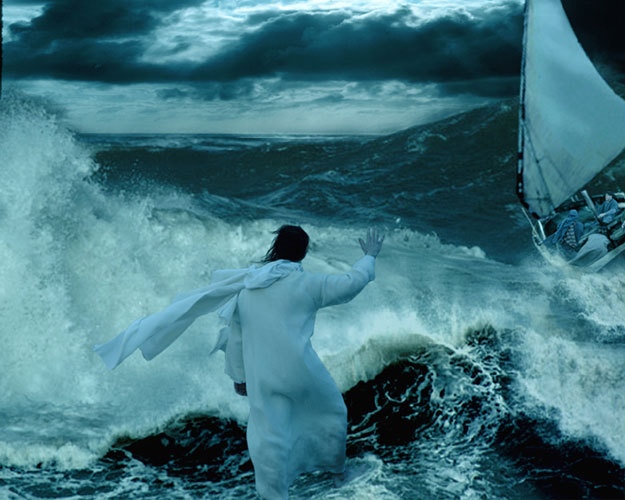
25 Shortly before dawn Jesus went out to them, walking on the lake. 26 When the disciples saw him walking on the lake, they were terrified. “It’s a ghost,” they said, and cried out in fear.

27 But Jesus immediately said to them: “Take courage! It is I. Don’t be afraid.”

28 “Lord, if it’s you,” Peter replied, “tell me to come to you on the water.”

29 “Come,” he said. (Matt 14:25-29)

Take a minute and try to think of all the reasons why Peter might’ve hesitated in leaving the boat.

  • Did Jesus just tell me it was OK to leave the boat?
  • Did He actually say that, or am I just hearing what I want Him to say?
  • Do I want to walk on the water because I want to please Him, or am I being prideful?
  • Is He aware that there’s a storm happening right now?

There are always reasons to doubt and that’s why, regardless of the decision you’re getting ready to make, to some extent, you’re going to have to trust in Him.

And without faith it is impossible to please God, because anyone who comes to him must believe that he exists and that he rewards those who earnestly seek him. (Heb 11:6)

And while decisions are pretty easy to make, other decisions represent life altering consequences. But regardless of what’s at stake, the principle is always the same: If you’re going to walk on water, you’ve got to trust in Him.

You’re Never Going to Know

Some want to be able to take an inventory of their motives and ensure their intentions are pure…

The heart is deceitful above all thing and beyond cure. Who can understand it? (Jer 17:9 [see also Ps 51:5])

Some don’t want to move forward without being able to know all of what’s getting ready to happen…

Can any one of you by worrying add a single hour to your life…Therefore do not worry about tomorrow, for tomorrow will worry about itself. Each day has enough trouble of its own. (Matt 7:27, 34)

Some want to be able to have complete confidence in discerning God’s direction for their lives…

21 So I find this law at work: Although I want to do good, evil is right there with me. 22 For in my inner being I delight in God’s law; 23 but I see another law at work in me, waging war against the law of my mind and making me a prisoner of the law of sin at work within me. 24 What a wretched man I am! Who will rescue me from this body that is subject to death? 25 Thanks be to God, who delivers me through Jesus Christ our Lord! (Rom 7:21-25)

Neither your intellect nor your intentions are immune to the influence of sin. That’s why faith is so important because it’s only His Voice and His Strength that’s going to prove be both dependable and accurate.

You have God’s “Word” that He will guide your thoughts and your actions…

Let the morning bring me word of your unfailing love, for I have put my trust in you. Show me the way I should go, for to you I entrust my life. (Ps 143:8)

Trust in the Lord with all your heart and lean not on your own understanding; in all your ways submit to him, and he will make your paths straight. (Prov 3:5-6)

The mind governed by the flesh is death, but the mind governed by the Spirit is life and peace. (Rom 8:6)

Do not conform to the pattern of this world, but be transformed by the renewing of your mind. Then you will be able to test and approve what God’s will is—his good, pleasing and perfect will. (Rom 12:1-2)

Pack, Don’t Predict

Imagine you’re getting ready to go to the beach for a long weekend. You’re going to pack based on the amount of time you’re going to be there and the things you plan to do.

If you try to anticipate everything that might happen, not only do you wind up with an outrageous amount of luggage, but there’s a chance you may never leave your house because of your inability to predict all that may occur while you’re gone.

God asks us to pack (Prov 11:14). He never asks us to predict.

He’s always willing to give us direction (Jas 1:5), but He rarely gives us a full description of all that we can expect. He didn’t tell Abraham where he was headed, He didn’t tell Moses how the Red Sea was going to part, He didn’t tell Gideon how he was going to defeat the Midianites, and He didn’t tell Joseph that this son would be born in a stable.

He just told them to pack.

You Always Have a Reason

As long as you’re a part of the human race, you will have both the capacity and the inclination to doubt. You’re never going to be able to remove every question mark. As certain as you may be, or as obvious as the situation may appear, there will always be something to justify a reason to stop, wait, hesitate, or doubt.

Even a burning bush wasn’t enough to convince Moses that he would succeed (Ex 4:13). Paul had seen Christ alive, but was still able to feel completely overwhelmed by circumstance that appeared hopeless (2 For 1:8-10).

And Peter had heard Jesus say it was alright to step out of the boat. But the moment he was able to take a logical inventory of his surroundings, he found all kinds of reasons to second guess his decision.

You will always have a reason to doubt, but, more importantly, you will always, have a reason to trust in Him.

It’s wise to confirm God’s Direction in your life (1 Jn 4:1). But if you’re ever going to walk on water – if you’re going to be obedient and realize God’s Purpose for whatever lies on the other side the decision you need to make – that first step is going to require some faith.

Too often we get distracted by the default uncertainty that accompanies our attempts to answer the question “How do I know?”

Perhaps the question you need to be asking yourself is, “Why do I doubt?”

Pack.

Don’t Predict.

A Position of Strength

Overcoming Adversity

There was a time I worked for a guy who, although he was good to me, was the kind of character where if you were interested in securing a favorable deal for yourself, you needed to be able to approach him from a position of strength.

At least, that’s what I called it: A “position of strength.” 

By that, I mean that you had to be able to substantiate your terms with something that compelled him to agree to what you’re saying. For example, I want to see my hourly wage increase. If I was going to emerge from his office as a successful negotiator, I needed to be able say something like, “I’ve got another job offer,” or something comparable.

Short of that, he had you in a place where you obligated to accept his deal, which wasn’t always inspiring.

The bottom line, though, is that you could get what you were hoping for as long as you had that trump card – as long as you were approaching him from a position of strength.

Wouldn’t That Be Sweet?

Negotiating life is similar. Of course, in life you’re not interacting with an individual per se, but if you could, for a moment, envision your need to overcome some kind of adversity as something you could manipulate via an exchange between yourself and this figure who can hypothetically alter your circumstances, you can see how approaching this meeting from a “position of strength” would constitute a huge tactical advantage.

So, just as they’re getting ready to refuse your terms, you could lay that “something” on the table and suddenly your platform is dominant and you emerge with an ideal scenario. Wouldn’t that be sweet?

Obviously, we don’t have access to that kind of life-altering dynamic, but we do have something that often gets overlooked and it does equate to a legitimate “position of strength.” The things that most exasperates us are those things that we can’t control.

It’s part of life.

No matter how you prepare, no matter how you plan, life includes a number of elements that simply cannot be controlled or anticipated. It’s those unexpected setbacks that take the wind out of our sails and that “position of strength” you would theoretically occupy is processed as an impractical pipedream than it is anything else.

But look at your scenario in the light of God’s Truth.

Asserting Some Truth Into Your Situation

It says in the Psalms that all our days were ordained before one of them came to be (Psalm 139:16). There is a plan – there is a purpose that infuses every triumph and every setback with significance and meaning (Eph 2:10; Phil 2:13).

Nothing is random. 

At one point Paul is attempting to get over into Bithynia. He can’t. Who knows what that situation looked like, but according to Scripture, Paul documents it as Divine direction and not a physical obstacle (Acts 16:7).

Do you see that?

How many times have things fallen short of what you were hoping for and your reaction was aimed at the tangible entities that comprised your dilemma? Perhaps it was a person. Maybe your car broke down. Perhaps you were working towards a particular goal and something went south leaving you in a puddle of disappointment and confusion. It’s then when you need to be intentional about asserting some Truth into your situation. Otherwise, you’re prone to linger in that zone characterized by discouragement and even bitterness. 

Take some of the Scriptures that pertain to purpose and lay them down side by side….

• All the days ordained for me were written in your book before one of them came to be. (Psalm 139:16)

• A man’s steps are ordered by the LORD; how then can man understand his way? (Prov 20:24)

• And we know that in all things God works for the good of those who love him, who have been called according to his purpose. (Rom 8:28)

• For we are God’s handiwork, created in Christ Jesus to do good works, which God prepared in advance for us to do. (Eph 2:10)

• for it is God who works in you to will and to act in order to fulfill his good purpose. (Phil 2:13)

You see where this is going?

Nothing Random

Remember Simeon? Check out Luke 2:25-32. He’s an older gentleman who has his heart set on seeing the Messiah before he takes his last breath. In verse 27, it says “Moved by the Spirit, he went into the temple courts…” 

I’m not sure what that looked like, as far as being “moved by the Spirit,” but I like to think that it was a series of very practical events that had him thinking he needed to be at the temple. And because it was God pulling the strings, he happened to be there when an obscure couple comes walking out holding the One Who he had been praying to see.

There’s nothing random about our lives. From a human standpoint, we cling to the idea that we are the master or our own fate. Hence, we get the credit when things go well and we bear the blame when things do not.

Certainly we are responsible for our actions, as far as being obedient go God’s commands (Dt 11:1; Jn 14:21). But we are not victims of circumstance, nor are we the reason for our own success. All those things that we can’t control – both the good and the bad – it all culminates in a beautiful exclamation point: God’s in charge!

You’re in a Position of Strength

So, as you’re going about your day, be mindful of the fact that you are in a position of strength. That imaginary person you’re negotiating with in an effort to secure a positive outcome – you have that trump card in that while you don’t know what a day may bring forth, you know Who does. And the Lord makes firm the steps of those who delight in him. (Psalm 37:23).

That’s a position of strength!

Financial Planning When You’re Not, You Don’t, You Can’t, and You Won’t

A Healthy Desire

On one hand, you’ve got greed and a “love of money.” (1 Tim 6:10) On the other hand, you have a healthy desire to succeed (Josh 1:8) and prosper (1 Chron 4:10).

What distinguishes those two extremes is not always readily apparent. However noble a particular venture or desire may be, apart from being intentional about your relationship with Christ, “compromise” poses as “reasonable” and you’re on your way to something unhealthy (1 Pet 5:8).

But assuming you’re on top of your spiritual game, you’re quest for more in the way of material resources is not so much about satisfying a selfish agenda as much as it’s a desire to bless others. Perhaps you want to alleviate someone else’s angst over a financial burden, maybe you just want to surprise someone with an unexpected blessing. Whatever the reason, it’s an honorable one, but regardless of how hard you work, how hard you pray, your hand keeps getting slapped by different forms of discouragement. Whatever “financial planning” you would like to do, you can’t, because you’re not, you won’t,  and you don’t.

You’re Not, You Don’t, You Can’t and You Won’t

You’re not, you don’t, you can’t and you won’t… It’s not a negative disposition, it’s not a lack of confidence. It’s a fact.

  • I’m not qualified
  • I don’t have the platform I need
  • I can’t make someone give me more money
  • I won’t ever get beyond my current situation

And being a person of faith, you’re more than willing to believe that God can completely transform your situation. But that can make it even more exasperating in that He’s not responding and your situation, rather than being remedied, continues to drag on and on.

Brace Yourself Like a Man

It’s interesting  that when God finally responded to Job’s plea for some kind of explanation as far as why he was being allowed to suffer the way he was, God didn’t start by apologizing nor did He let Job in on the conversation with Satan that had set the stage for the disasters that Job would have to contend with. Instead, God’s first comment to Job was:

“Who is this that darkens my counsel with words without knowledge? Brace yourself like a man; I will question you, and you shall answer me.” (Job 38:2-4)

In the verses that follow God’s introductory statement in Job 38:2-4, He enumerates various examples of His Absolute Authority in the context of creation. His Attributes are so obvious and so overwhelming that Job, who is still in the throws of physical pain and emotional despair, does a complete one eighty. However “deserving” he felt a moment ago, as far as some kind of rational explanation for everything he’s had to endure, he enthusiastically embraces the opportunity to simply revere his King.

He goes as far as to say “I repent in dust and ashes.” (Job 42:6) He says that because he’s awestruck by the Grandeur or God. The instant God appears, His Perfection effortlessly overwhelms whatever indictments Job had prepared and the only thing that registers as present and worthy of consideration is God Himself.

A Position of Strength

It’s imperative to realize that Job’s response is not fearful, nor is he begrudgingly  admitting a subordinate position relative to God’s Omnipotence. Confronted with a clear view of God’s Reality, He figuratively runs to God’s Throne and drinks in every drop of Substance and Glory that emanates from it. And while it may not change Job’s situation, it completely changes Job. Rather then feeling like a hopeless victim of unfortunate circumstances, he’s now on his feet and facing his situation from a position of strength.

By reminding Job of Who it is that commands every nuance of creation, Job is able to perceive the true nature of his status. It is neither random nor is it intimidating when viewed from the perspective that recognizes God’s unchanging commitment to his welfare and the subsequent sense of Purpose that now characterizes every aspect of his dilemma.

Psalm 16

David’s being pursued Saul who’s determined to kill him. Things were looking especially bleak in that Saul was closing in and David’s options were nonexistent. That is the setting for Psalm 16. At one point, he says:

The boundary lines have fallen for me in pleasant places; surely I have a delightful inheritance. (Psalm 16:6)

 Strange verbiage, considering it’s coming from someone being hunted and on the threshold of complete destruction. David would be delivered and he would go on to great things. But the point here is that David penned this Psalm at a point where he could say with confidence: “I’m not, I don’t, I can’t and I won’t.”

But David was also aware of the fact that his plight was not based solely on what he could see or what he could control. He knew that, not only God CAN deliver, but He IS in the process of doing that presently.

That’s the Truth that needs to be recognized.

God hears and God answers. There’s no disconnect and there’s no delay. His response is exactly what it needs to be in order for His Purposes to be accomplished.

And while His Purposes don’t always include the immediate relief you’re hoping for, the fact of the matter is, you’re being heard and your situation is being addressed. You can, you are, you will and you do.

You can, you are, you will and you do.

Job’s pain did not go away in Job 38 and David was still several chapters removed from becoming king of Israel as God had promised. But in both instances, they experienced the same strength that you and I have access to right now. The perspective that gives meaning and purpose to the pain, the mindset that’s founded on God’s Awareness and Power and the disposition that’s authentically optimistic because of Who it is that’s Ultimately in charge.

It’s the basis for the contentment that Paul refers to in Philippians 4:13 and it’s the Truth that gives us what we need to not only endure, but to excel and to grow into the enhanced character that God has designed us to become.

You’re not, you don’t, you can’t and you won’t…?

No.

You are, you can, you will and you do.

Why You Want to be Spiritually Ripped

What’s the difference between the unsaved version of you and the saved version of you?

Beyond the fact that you’re going to Heaven and you have the option of dropping to your knees and and whispering a prayer in crisis situations, what is it that constitutes a practical advantage over that version of you that doesn’t know Christ? Imagine this:

I) On Your Stomach

Lay down on your stomach and close your eyes. This is the perspective that you have of yourself and the world around you, as far as the unsaved version of you (Ps 19:8; 36:2; Is 6:10; Matt 13:15; 2 Cor 3:14; 4:4; Eph 4:18; Jas 4:13-14).

You’re virtually “blind” to what is going on around you in terms of the spiritual realities that comprise the human experience. And before you dismiss the term, “spiritual” as some kind of ethereal mysticism that has no place in the context of a practical perspective, bear in mind that you can’t put anger in your pocket nor can you put happiness on like a ball cap. That which irritates us or makes us feel good may be a solid object of some kind, but the emotions and the psychological machinery that’s initiated by those objects aren’t things you can quantify or package.

Our whole world is one big box of “spiritual” commodities that we’re constantly processing according to the way our personalities are wired. It’s what inspires our values, it’s our mood, it’s our outlook, it’s all of what make us unique as individuals – it’s that host of intangibles that we encounter and contend with everyday (Eph 6:12).

When you’re spiritually dead, everything that drives the way you process yourself and the world around you is based on what you “feel,” rather than what you can truly see and know (see 2 Cor 4:4; Phil 3:19). Rather than being upright with your eyes open – and even standing on top of something so you have a good view of what’s going on -you’re in the dirt and incapable of processing the world as it truly is.

We’re oblivious to what’s under the hood. We can hear the car running, maybe, but we don’t see life as anything beyond what we want and what we feel. The bigger and the more important picture is “hidden” and we tend to wear ourselves out attempting to understand and control that which cannot be managed or anticipated (Jas 4:14).

II) Do You Smell That?

On the other hand, the born-again version of you has a clue. At least, we have access to a perspective that takes into account the Reality of that which is unseen (Heb 11:1). Purpose (Eph 2:10), Peace (Gal 5:22-23) and Power (Acts 1:8) – we have the mind of Christ (1 Cor 2:16) and our eyes have been open to what constitutes the difference between light and darkness (Jn 9:39; Acts 26:18).

For the sake of our illustration, we’re on our knees with our eyes now fully open. Do you smell that? That is the aroma of Divine Perfection and it lives within us (1 Cor 1:30; Col 1:27).

That’s motivating!

But what does that mean?

There’s no doubt, that’s True. But how does that translate to something practically advantageous? And let’s go ahead and acknowledge the obvious perk of being able to bring our troubles before our King in prayer. That piece of it, along with the guarantee of Heaven, is a given (Jn 3:16; Phil 4:6).

But what about Monday morning?

How does being a follower of Christ resonate in the context of homework, bills, bad debt, dreams and car tags? What’s the difference in the way you negotiate the everyday, as far as the approach the saved version of you is going to take as opposed to the spiritually clueless version of you and the way that person is going to engage the day?

Are you ready?

Buckle up…

wait for it…

Everything.

Everything is different.

Take a look:

III) Every Moment –  It’s Never About “What’s Happening…”

It’s never about what’s “happening,” it’s what God is doing. You are not a victim of circumstance – ever. Your triumphs, your defeats as well as all of the decision you make – both the good and the bad – are laid out before your King Who’s not limited by the constraints of time or space. In Psalm 139:16 it says, “…all the days ordained for me were written in your book before one of them came to be.” Couple that with Jeremiah 29:11:

 For I know the plans I have for you,” declares the Lord, “plans to prosper you and not to harm you, plans to give you hope and a future. (Jer 29:11)

…and Ephesians 2:10:

For we are God’s handiwork, created in Christ Jesus to do good works, which God prepared in advance for us to do. (Eph 2:10)

…and you have a life that reeks of Purpose, Significance and Substance. However this particular moment appears from a human standpoint, there is a stamp of Divine Purpose upon it and when you get your head around that, something shifts in the way you process your activity and your surroundings. It’s motivating. Even if you’re just cutting the grass, that’s a point in time that was on God’s radar long before you decided the yard needed mowing. And while knocking out some chores doesn’t reverberate as profoundly as the career you choose or the person you marry, it is nevertheless an investment of time and effort and that is therefore a part of your life – the existence that God purposefully initiated before you were even born.

And the thing is, God didn’t just haphazardly throw you together and give you a role as an “extra.” The Plan that’s in place for your life is uniquely tailored for you and the strengths He gave you. The greatest amount of fulfillment you could ever hope to experience is in the context of living out the Purpose that He created you for.

Park here for a minute because this really is a game-changer.

Years ago, I was working a job that lacked substantially in prestige. I had just gotten out of the USMC as a Staff Sergeant and I had moved to Nashville on the tail end of a very successful tour that had me thinking I was on the cusp of a successful career as a full time musician. Fast forward several months later and I’m working for a buddy that owned and operated a fast food franchise at the local food court. What started out as “temporary” thing had bloomed into a full time dynamic and I was smelling like a chicken nugget at the end of everyday.

Not happy.

But as I was making my way into the mall one particular morning, I was encouraging myself with the fact that I had yet to be asked to clean the commode. That was one task that I had not been assigned.

That morning, as if by Divine Appointment, my buddy, the manger, greeted me at the door with a green scouring pad and a can of Comet. “I’ve got a job for you,” he said.

Moments later, I’m on my hands and knees scrubbing the ceramic throne and having a very frank exchange of ideas with my Heavenly Father. I was reflecting on the how I had exchanged some stripes on my sleeve for a nametag on my shirt. Where I had been interacting with a who’s who of Contemporary Christian Music artists and hearing the thunderous applause of arena sized crowds every weekend, I was now listening to disgruntled customers complaining about the availability of certain menu items.

And now, here I am, scrubbing the contaminated floor surrounding the toilet in the employee restroom.

“You seein’ this?” I asked. I’m praying as I’m scrubbin’… I’m talking to God and I heard Him in my mind ask me a question:

“What if I had been the One Who asked you to clean the commode rather than Michael? Would that have made a difference?”

“Well, sure!” I said.

Then God replied, “Well, guess what…?”

At that point, I remembered Psalm 139:16 and other verses that talk about God’s Sovereignty.

Fact is, because “…all the days ordained for me were written in your book before one of them came to be,” He had tasked me with that job and while the clean up operation didn’t suddenly become anymore prestigious, my perspective changed dramatically. It’s never simply a matter of “what’s happening,” it’s what God is doing.

There’s a Plan in place that allows you to process even the most inconvenient and annoying occurrence as something that has Purpose. When you’re confronted with something that takes you by surprise, you can maintain an even disposition by claiming every Resource that God’s already unpacked and placed on the table because He knew this moment would come long before it happened.

And when the pressure’s on and it’s up to you to turn in a truly noteworthy performance, there’s something about how God’s had this on His screen for quite some time that makes the inclination to reach for the Strength along with the Calm that He offers that much stronger and intuitive.

Even when things are going great, by reflecting on how it is God that orchestrated your situation, the tendency to be thankful is that much more automatic (Rom 12:3; 2 Thess 5:16-18).

The Bible is full of personalities that God elevated in the context of wealth and power who then allowed themselves to become corrupted by crediting themselves with the success they enjoyed (Dt 8:17-18). Authentic gratitude is more than just “thanking God” as a courtesy, as much as it’s a comprehensive theme of reverence and humility that characterizes your perspective on yourself and your accomplishments.

Being intentional about constantly seeing yourself within the framework of God’s overarching Purpose is not automatic, despite it being the most logical and the most healthy approach one could take. But it’s far easier to do so when you remain cognizant of how this moment and every moment of your life was known and planned by your Heavenly Father long before it ever showed up on your calendar.

IV) Momentum – the Guarantee of Forward Movement

While we can rest assured that every moment of our lives is chock full of Divine Purpose, there’s also the guarantee of forward movement.

In Chemistry, there’s an anomaly called the “Latent Heat of Fusion.” You can see it illustrated in the graph to the right. What you’re looking at is the change in temperature as an ice cube is being melted. You’ll notice in the first blue area, there’s no change in temperature despite the fact that you’re increasing the amount of heat you’re applying to said ice cube. You see the same thing happen when it’s going from a liquid phase to a gaseous state. Again, there’s a zone where, although you’re increasing the amount of heat, yet there’s no measurable change in the temperature.

The two segments of the graph that are highlighted in blue represent what’s called the “Latent Heat of Fusion.” On the molecular level, what’s happening is that rather than the molecules moving about more “furiously”- which is registered in terms of temperature – the energy is being absorbed by the process by which the molecules that are grouped together according to whatever state they’re in are now coming apart.

During that timeframe, there’s no change in temperature.

Life can be like that sometimes. You’re working towards a goal, you’re waiting for additional information so you can make a sound decision – it’s during these seasons that you can feel as though you’re stalled.

Nothing’s happening.

But we can rest assured that God’s not dormant nor is our situation being ignored.

One of the best examples of that is the story of Joseph. Bolstered by dreams and his father’s favoritism, Joseph is convinced he’s on the threshold of great things. Apparently the gift of subtlety was not among Josephs strengths, however, nor was humility given the way he saw fit to inform his older brothers that one day that would bow down before him.

You know the story of how they sold him into slavery and how he eventually ended up in prison. By this time, Joseph doesn’t seem as forthcoming when it comes to promoting himself. As a matter of fact, when he’s given the chance to distinguish himself before Pharaoh, he’s quick to say that it’s not by his own ability that he’s able to discern the meaning of dreams, rather it’s God.

That’s quite a move for one who’s spent the majority of his young adult life either as a slave or as a captive.

Think about it.

Why would you not attempt to take as much credit as you could for being able to do something extraordinary when you’re standing before the one individual who has the power to set you free? How often do you think Joseph asked for God to intervene and end his enslavement or to commute his prison sentence? He was sold into slavery when he was seventeen (Gen 37:2). He entered Pharaoh’s service when he was 30 (Gen 41:46). 13 years spent waiting for…

something.

A Good Plan God uses the word “agathos,” often in the New Testament which means “good.” But it’s more than “good,” as in the way some might process that to mean “acceptable,” but not especially noteworthy. It means, “moral and spiritual excellence.” The Greeks used it to describe a skilled and noble warrior. It’s more than being merely “nice,” it’s more than just a silver medal as opposed to first place finish. It is a standard and a goal that goes beyond victories, accomplishments and acquisitions. It is the Perfect Storm of character and quality actions. Not just “good behavior,” but a standard of excellence that originates from one’s core and spills over into everything that they engage. That’s “good!”

That’s a lot of “latent heat.” But it was during that time that God was transforming the character of Joseph into what would need to be in place in order to administrate the largest political power in the world. God wasn’t slow, He was intentional.

There may be something you’ve been praying about for a while. Perhaps you’ve reached that point where you’re poised on the threshold of some serious disillusion thinking, “This prayer thing doesn’t work!”

Don’t throw in the towel.

Remember there’s a Divine Purpose attached to every moment including those moments when you don’t seem to be moving forward. Even then, there’s supernatural activity being conducted Look… John 5:17 says:

17 In his defense Jesus said to them, “My Father is always at his work to this very day, and I too am working.” (Jn 5:17)

God is always working. He’s never idle so to be suspicious that your appeal has been ignored or lost is a pointless perspective. Things are moving forward and they’re moving forward at a pace that is nothing short of perfect in that it’s consistent with the tempo that matches the flawless Plan and Purpose of the One Who’s got your best interests at heart.

V) The Mandate to be Excellent

 Do not conform to the pattern of this world, but be transformed by the renewing of your mind. Then you will be able to test and approve what God’s will is—his good, pleasing and perfect will. (Rom 12:2)

“Good” is more than just “acceptable.” It’s the Greek word, “agathos.” The Greeks used it to describe a noble warrior. Scripture uses it to describe moral and spiritual excellence.

Think about this for a minute: Imagine an employee that’s good at what they do (Col 3:17). They show up to work on time (Matt 5:16), and when you’re needing to get something done, this person is one of the first people that comes to mind because they’re that dependable (Prov 25:13). They function well as a team player and when the situation calls for someone to step up to the plate and lead, they have a knack for bringing out the best in others (Matt 7:12; Phil 2:3-4) and they’re able to oversee an effort that achieves the kind of results that exceeds expectations (Ecc 9:10).

What do you with that kind of employee?

You promote them!

You put them in a position where they can effect the greatest amount of good (Prov 22:29). Thing is, even if they don’t get the kind of recognition they deserve, the thing that makes this individual extraordinary is that they don’t go out of their way to be noticed by others. The applause they get from the crowd is not what drives them. Rather, they’re focused on personifying and pursuing a standard of excellence as a means to honor their King.

There’s a great scene in the movie, “Cinderella Man,” where Jimmy Bradock, played by Russell Crowe, is being interviewed by a mob of reporters who want to better understand how he was able to be in contention for the heavyweight championship of the world after having had to contend with several years of poverty and unemployment due to an injury and the Great Depression. His response included a comment where he said that he now knew what he was fighting for.

It wasn’t the money, it’s wasn’t the title, it was “milk.”

To him, the “prize” wasn’t about promoting himself, as much as it was being able to provide for his family – something he hadn’t been able to do for a while. His drive and his resolve were now fueled by something greater than himself. In a similar way, we are commanded to be “lights” (Matt 5:16) and “standouts” (Prov 22:29; Titus 2:7). Colossians 3:24 says it best:

Whatever you do, work heartily, as for the Lord and not for men, knowing that from the Lord you will receive the inheritance as your reward. You are serving the Lord Christ. (Col 3:24)

VI) On Top of my Spiritual Disciplines

Go back to that earlier illustration of being on your stomach with your eyes closed. That’s the unsaved version of you. Spiritually blind and limited in the way you see yourself and the world around you, as far as the spiritual realities that define the human experience (2 Cor 4:4; Eph 6:12).

Now imagine a person on their knees with their eyes open. This is the saved version of you. You’re aware of your need for Christ and you’ve handed Him the keys to your life (Acts 26:18). Now, picture a person standing on their feet. This person also has their eyes open, but because of their being on their feet, they have a better view of the world around them.

The qualifying factor in what defines the difference between themselves and the person on their knees is that they’re not only aware of God, they’re familiar with God’s Word (2 Tim 2:15).

Finally, the fourth and final person is standing on a chair and significantly higher than the version of themselves that’s simply on their feet. They’re not blind, their eyes are open and they’re aware of their need for God’s grace. But while they know God’s Word, more importantly they know God.

It’s not just an informed faith, it’s a tenured relationship. That’s where you want to be!

Being on top of my spiritual disciplines increases my capacity to see myself for who I truly am and to see the world as it truly is. And it’s more than just an intellection / emotional disposition. Ultimately, it’s a Presence that commands the majority of who and what I am. It’s not just a filter, it’s a default setting and the benefits that go along with that kind of spiritual maturity cannot be overstated in terms of an active strength, an influential character, a practical wisdom and an appealing depth. It is the greatest level of success you could ever aspire to in that it resonates on all levels.

I want to be spiritually ripped because that kind of fitness prevents me from seeing myself as a victim of circumstance, rather, I’m an agent of change. I’m not defined by things that are destined to die, quit or fail, I target that which endures and that is what fires me up. I aim to achieve a level of excellence in all that I do because I’m commanded to do just that.

Regardless of the scoreboard or who’s not returning my calls, my focus is on the King of kings, my God, my Redeemer. I am being constantly inspired in the most profound yet practical way to reach, to accomplish and triumph over a casual work ethic, a lazy sense of morality and a self absorbed agenda.

The Moment, the Momentum and the Mandate.

Constantly reaching for more of Christ that I might become all that He created me to be.

Bring it!

My Bride

When I’m in my car, I like listening to either music or comedy. On occasion, I’ll listen to a podcast of some sort, but generally speaking, I usually want to either groove or laugh.

A lot of the comedians I listen to will poke fun at domesticity – specifically the dynamic that often exists between a man and his wife. For the most part, it’s hysterical. But every now and then, I’ll get a little uncomfortable at the way marriage is portrayed as an institution that robs a man of his masculinity.

The schtick usually revolves around the way a man is prohibited from doing what he wants to do. It may be something trivial or it may be something significant, but in either case the wife is portrayed as an obstacle to her husband’s preferences in terms of how he wants to spend his time and even the way he thinks.

It’s funny because there isn’t a married man who can’t identify with the task of having to occasionally alter his perspective on himself and the world around him in order to preserve the harmony that exists between himself and his bride. But does that qualify as a surrender of one’s hold on what it means to be a “man?”

I don’t think so.

When I took my vows, I promised to honor Michelle. To honor her, I’ve got to be both willing and able to make her perspective a priority. That’s not difficult for a man who’s secure in himself, but it’s a potential dealbreaker to the male who’s determined to remain fundamentally prideful and self absorbed.

That’s not to say my wife is always right, but I will say that I have benefited from my bride’s viewpoint on multiple occasions. I may not have been open to it initially, but because I had been taught that true strength is expressed in the context of humility and a willingness to listen, my situation as well as our collective dynamic, was dramatically improved (Phil 2:3-4).

Much of the literature that’s out there that pertains to leadership emphasizes the importance of character and leading by example. Nowhere is that more important than in the way a man leads his family, which starts with the relationship he has with his wife. There’s no other person on the planet who possesses a more comprehensive view on my strengths as well as those areas where there’s room for improvement than Michelle.

In the same way, there’s no other human being that can breathe life into me as profoundly as she can. The reason she has such complete access to me is because I love her and the reason I listen to her, even when I may be inclined to dismiss what she has to say, is because I choose to honor her above myself. That’s not a compromise of my masculinity, that’s an expression of it.

Your Billboard

16 In the same way, let your light shine before others, that they may see your good deeds and glorify your Father in heaven. (Matt 5:16)

However you want to craft your billboard, be eye catching. Make those on the outside looking in wonder how you’re able to keep all of your stuff in one bag and make them want whatever it is you have.

In Christ, you don’t just endure, you excel.

It’s all good, pray big, reek of excellence and be eye catching.

Now, go out there and make a difference!

The Question

If you have to create a billboard that promoted a relationship with Jesus, what would that billboard say if you couldn’t mention life after death or how He helps you through difficult circumstances?

If you’re like most, while you can envision a catchy slogan or a memorable slogan that’s Biblically sound and is as true as it is motivating, it’s not uncommon to not have something on the tip of your tongue.

Crisis Only Situations

Reason being is because conventional church culture tends to promote discipleship as something that comes to bear primarily in the context of a crisis.

  • Prayer: help me, heal me
  • Bible Study: guide me, guard me
  • Praise and Worship: save me, show me

It’s a constant rehearsal of who we are apart from Christ with the result being I’m not, I don’t, I can’t and I won’t.

You see it in Scripture…

In John 16, Jesus says that in this world, you will have trouble. Earlier in chapter 15, He says that apart from Him, we can do nothing. In Romans 7, Paul talks about the tension that lingers within him, as far as how he knows what he should do, yet he can’t get it done. He describes himself as, “wretched.”

Apart from Christ, we are destitute and yes, we are in desperate need of assistance.

It says so in God’s Word, we reiterate it repeatedly in the way we process ourselves and the world around us…

…and so Christ becomes this Divine Survival Kit. He’s that File Folder we reach for every time things go south and He’s the crutch we use to prop ourselves up with because, after all, there’s no way we can stand up on our own.

But you have to keep reading.

Keep Reading

In John 16:33, Jesus says that…

“I have told you these things, so that in me you may have peace. In this world you will have trouble. But take heart! I have overcome the world.” (Jn 16:33)

In John 15:5, He says that apart from Him we can nothing, but just before that, He says…

“I am the vine; you are the branches. If you remain in me and I in you, you will bear much fruit; apart from me you can do nothing.” (Jn 15:5)

And when Paul is lamenting his situation in Romans 7, he goes on to ask who is going to save him, and then he answers his own question…

24 What a wretched man I am! Who will rescue me from this body that is subject to death? 25 Thanks be to God, who delivers me through Jesus Christ our Lord! (Rom 7:24-25)

When you process things in their proper context, the message isn’t so much a reinforcement of how insufficient we are as much as it’s highlighting the all-sufficiency of Christ!

We are more than our wounds and better than our sin. Not because of who are but because of Who Christ is in us. And while it’s healthy and appropriate to remember just how toxic sin is (Jas 4:9) and just how outrageous it is that God would love us enough to take upon Himself the death that we deserved, the name of the game is not to sit on the bench and lament our shortcomings, but to get out on the field and put some points on the board (Eph 2:10; Titus 2:14).

That’s part of what makes this question such a healthy exercise.

It compels a comprehensive appreciation for the whole of God’s Word that pertains to who we are and what we’re capable of when we embrace Christ as the Filing Cabinet and not just a File Folder.

Our Marketing Campaign

That said, what would your billboard say?

Here’s some ideas…

It’s All Good (Romans 8:28) – everything has a point and that makes both the good and the bad something that can be processed in a way that avoids either pride or despair.

Pray Big (Jn 15:7-8) – no, you’re not being given a blank check. God doesn’t give you everything you ask for anymore than you would give a four year old an M16 just because it’s his birthday.

That’s not love, that’s neglect.

The point here is that you can dream and you can know that if God’s in it, than you get it done.

Reek of Excellence (Col 3:17) – whether it’s the way you work out or the way you mow your lawn, everything needs to be done in a way that reflects well on your Heavenly Father.

That’s not something to obsess over, but it’s something to shoot for. And when you make the effort to give 100%, 100% of the time, inevitably you become the kind of person that people don’t just hire, you become the kind of person people promote (Prov 22:29).

Conclusion

Being a Christian gives you an edge. Your work ethic, your decision making, your career, your role as a husband and a father – all of these tasks and responsibilities become opportunities to excel when you’re deploying the mind of Christ (1 Cor 2:16) and the Power of God (Phil 2:13; Col 1:29).

And when you’re doing it right, you’re not just profound statement plastered on a billboard, you are genuinely…

…eye catching.

Joseph was eye catching (Gen 41:37-38), David was eye catching (1 Sam 16:6-13), Paul was a brilliant Pharisee (Acts 22:3; Phil 3:5), a Roman citizen (Acts 22:28) and a follower of Christ. His religious training, his intellect and his citizenship combined to make him…

…eye catching.

Look at Matthew 5:16:

16 In the same way, let your light shine before others, that they may see your good deeds and glorify your Father in heaven. (Matt 5:16)

However you want to craft your billboard, be eye catching. Make those on the outside looking in wonder how you’re able to keep all of your stuff in one bag and make them want whatever it is you have.

In Christ, you don’t just endure, you excel.

It’s all good, pray big, reek of excellence and be eye catching.

Now, go out there and make a difference!