Prove It! | Part I: Faith
 It says in Scripture that without faith, it’s impossible to please God (Heb 11:6).
Why? Why is it so important to accept something to be true based solely on faith as opposed to being able to prove that it’s credible?
Critics often sneer at Christianity. Christopher Hitchens, a very vocal opponent of Christianity, once said that Christianity, “…can’t be believed by a thinking person.1” Richard Dawkins, the author of “The God Delusion” said, “Faith is the great cop-out, the great excuse to evade the need to think and evaluate evidence. Faith is the belief in spite of, even perhaps because of, the lack of evidence.”2
On the surface, faith seems to be something that exists only in the context of a willingness to believe in the supernatural – something that can’t be proven in the context of something you can touch, understand, and anticipate.
But that’s not the case.
You cannot function as a human being without deploying a measure of faith in some way, shape, or form.
Think about it.
When you drive down the expressway, you can’t “prove” that the driver coming at you from the other direction is going to stay in their lane. You’ve got to trust that when you take public transportation, the driver isn’t going to steer you into the ditch. Whenever you board a commercial flight, you’ve got to have faith in both the aircraft and the pilot.
Anytime they put you under to do some surgery on you, you’ve got to have faith in the anesthesiologist and the surgeon.
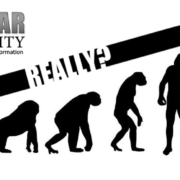
Evolution requires an outrageous amount of faith in that you have no fossil evidence or logic to substantiate the idea that something can come from nothing, or that a fish can grow wings and become a bird (see sidebar).
At the end of the day, those who sneer at faith, not only ignore the extent to which they embrace faith as part of their everyday activities, they use their sarcasm to conceal the fact that their criticisms aren’t rooted so much in the absence of “proof,” as much as it’s about the lack of “control.”
Even Darwin had faith. When he first published his Origin of Species, while he was very aware of the logical inconsistencies that existed between his theory and the geological record that existed at the time, he had “faith” that, in time, the record would validate the credibility of his theory.
Faith isn’t the problem. You see that dynamic documented in Lee Strobel’s book, “The Case for Christ” when he admitted that part of his skepticism as an atheist was partly inspired by not wanting to answer to a standard other than himself.5
The challenge isn’t the need to have faith, as much as it’s the need to relinquish control.
Perhaps this is part of the reason why non-believers refuse to consider the evidence that validates the Christian faith, but it’s also something for believers to ponder when they feel as though they’re “struggling” to have faith.
When you perceive the difficulties of having faith as a subliminal resistance to a lack of control, the dialogue changes. It’s not so much about the object of your faith and the evidence that validates your confidence in what you believe to be true, as much as it’s about not wanting to surrender control of your situation.
Maybe that’s why God says it’s impossible to please Him without faith. Until you’re willing to, not only give up your control, but to admit that you were never in control to begin with, you keep God and what He can accomplish at a distance (Phil 2:13).
It’s important to be able to explain what you believe and why you believe it (1 Pet 3:15). Saying that, “…you just believe” doesn’t resonate as something that indicates you’ve actually thought things through. So, from that standpoint, being familiar with the discipline of Apologetics is a healthy exercise.
But in the end, the issue is control on a profoundly spiritual level (Jn 6:65). Your witness to the unbeliever, as well as the mindset you deploy when dealing with both triumphs and trials needs to factor in the bottom line of control and Who’s ultimately in charge. That is the beginning of the faith Scripture refers to and that is the faith that changes lives.
1. “Goodreads”, “Christopher Hitchens > Quotes > Quotable Quote”, https://www.goodreads.com/quotes/919133-let-s-say-that-the-consensus-is-that-our-species-being”, accessed April 7, 2026
2. “Goodreads”, “Richard Dawkins > Quotes”, https://www.goodreads.com/author/quotes/1194.Richard_Dawkins, accessed April 7, 2026
3. Michael Denton, Evolution a Theory in Crisis (Chevy Chase, Md.: Adler and Adler, 1986, 162
4. In his book, Origin of Species, Darwin says: “Why then is not every geological formation and every stratum full of such intermediate links? Geology assuredly does not reveal any such finely graduated organic chain; and this, perhaps, is the most obvious and gravest objection which can be urged against my theory. The explanation lies, as I believe, in the extreme imperfection of the geological record.” (“Darwin Online”, http://darwin-online.org.uk/Variorum/1859/1859-484-c-1860.html, accessed April 8, 2026)
5. Lee Strobel explained his inclination to dismiss Christianity in part because of the way it would compel him to surrender his right to himself. “Sure, I could see some gaps and inconsistencies, but I had a strong motivation to ignore them: a self-serving and immoral lifestyle that I would be compelled to abandon if I were ever to change my views and become a follower of Jesus.” (“The Case for Christ”, Lee Strobel, Zondervan, Grand Rapids, MI, 1998 Kindle, LOC 233)