
The SIC-ness of the Left
There are times when you’re talking to someone and, while they may push back initially, once they see your logic and understand that there’s more to the issue then what they originally thought, they change their mind and you’re now both in agreement.
But there are other times when you’re going back and forth with someone and regardless of how obvious the truth may be, they simply refuse to change their mind.
They’re not just “stubborn.” It goes deeper than that. It’s as though they’re invested in something that will not allow them to consider any perspective other than they’re own.
Its as though they’re basing their assessment of the issue on a scale that is calibrated according to a fluctuating standard as opposed to a fixed point of reference. The end result is a conviction that is not at all consistent with reality.
When you’re confronted with this kind of individual, you want to be able to understand the way they think and what is the root cause of the irrational vitriol that often characterizes these kind of situations.
Buckle up!
I Am My Own Absolute
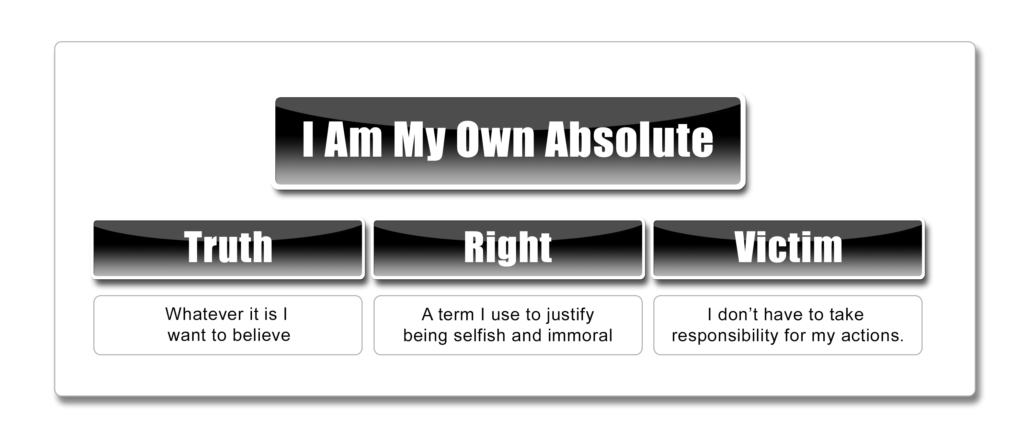
In many instances, the person who refuses to change their mind is someone who sees themselves as their own absolute. They see themselves as not only entitled to discern the difference between right and wrong, they live in a manufactured reality where they have the right to dictate the difference between right and wrong.
It breaks down into three main poisons:
Three Poisons
Truth
Katherine Maher, in a speech she made at a Ted conference said that truth is based on many things and for that reason cannot be restricted to a singular viewpoint. In other words, what’s true for you may not be true for me. The problem with that perspective, however, is that if truth is not based on a fixed point of reference, then all knowledge is reduced to a meaningless collection of personal preferences.
People who want to pretend that truth is whatever it is they want to believe ignore the fact that by saying that they have declared themselves to be irrelevant. According to their own logic, they don’t have a point, they have only a preference.
Right
A right is a term that’s been emptied of its original meaning, as far as the way its used in the Declaration of Independence, and instead is used to justify being selfish and immoral.
According to the Declaration of Independence, rights come from God. They are Divine entitlements that exist independently of the way any human convention may try to alter them. That’s what makes them immutable.
The moment you remove God from the equation, however, while you have eliminated the transcendent nature of the “right” you want to assert, you have also removed the moral standard that you would otherwise be accountable to.
That is the intent of the person who sees themselves as the gauge by which all things are measured. Whatever is sacrificed in the context of now being dependent on like minded individuals in order to secure a legal endorsement for one’s behavior, that is a trivial concession when compared to the way in which a person can now be morally accountable to no one other than themselves.
Victim
A self-serving paradigm can’t be championed directly without sounding both absurd and pretentious. But you don’t have to get people to agree with you if you can get them to feel sorry for you. You can’t criticize someone who’s in pain without immediately being labeled cruel and hateful. This is how a person who sees themselves as their own bottom line can avoid having to explain themselves or take responsibility for their actions.
S.I.C
People who think this way do not process those who disagree with them as intellectual adversaries as much as they see them as existential threats. You are not questioning their logic, you are challenging their authority. This is what shapes the way in which they attempt to defend the way they think and this is how you can tell when you’re talking to someone who sees themselves as their own absolute.
RULE 12: Pick the target, freeze it, personalize it, and polarize it.” Cut off the support network and isolate the target from sympathy. Go after people and not institutions; people hurt faster than institutions. (This is cruel but very effective. Direct, personalized criticism and ridicule works.) (Saul Alinski’s 12 Rules for Radicals
Instead of attempting to refute the substance of what’s being said, they attack the character of the person who’s speaking. By making them look bad, anything that they say is now assumed to be corrupted and therefore something you don’t need to listen to. They do this in three phases…
Stupid (They’re not qualified)
Phase One is to criticize their intellect. You don’t need to pay attention to someone who doesn’t know what they’re talking about.
Immoral (They can’t be trusted)
Phase Two: If your opponent’s platform can’t be effectively refuted by accusing them of being “stupid,” the next phase is to accuse them of being immoral. You don’t have to have any basis for your accusation. Your opponent now has to prove their innocence before they can be perceived as credible, and because of the way it’s assumed that a guilty person will insist they’re innocent, apart from something irrefutable, there is now a shadow of suspicion that will linger over anything your adversary would say.
Criminal (They can’t be supported)
The final phase is to indict them. Charge them with a crime and make it difficult for anyone to support or agree with them given their criminal status.
Untouchable
Embedded within each of these accusations is the idea that the person who’s having to contend with these dynamics is being forced to conform either to an inferior intellect or a depraved character. They are sophisticated victims attempting to stand up against uneducated villains. And because you can’t be critical of someone who’s in pain without being labeled cruel or hateful, all a person has to do is claim to be either offended or oppressed and they become untouchable – perpetually excused from having to explain themselves or take responsibility for their actions.
This is how bad ideas and solutions that don’t work get introduced into the marketplace. Not because of their intellectual or practical merit, but because of the way anyone who opposes them is dismissed due to their supposed lack of intelligence or integrity. But they’re not accusations as much as they’re distractions. By keeping the focus on the person speaking rather than on what is being said, topics are replaced with tactics and principles are subordinated to preferences.
What’s truly bizarre is the way people who see themselves as their own bottom line will accuse others of the very thing they themselves are doing. By pointing an accusatory finger in the opposite direction, it’s assumed that the person making the accusation is innocent of the stupidity, immorality, and criminality they would insist is being perpetrated by another. This was a tactic applauded by Joseph Goebbels, the head of Nazi Propaganda during the second World War (see sidebar).
Ask the Right Questions
Overcoming these tactics is not accomplished by reason and debate. All the boundaries otherwise established by truth, logic, and common sense are nonexistent once truth has been redefined as something that is based on a personal preference as opposed to a fixed principle. In addition, if you’ve been labeled in a way that makes everything you say resonate as something either stupid or sinister, you first have to prove you’re credible before you can prove that you’re right. Given the way guilty people are expected to claim that they’re innocent, regardless of how compelling the defense of your character may be, there is nevertheless a shadow of doubt that’s been cast over your platform that you can never completely eliminate.
There is, however, another approach that can prove very effective in revealing the lack of intellectual and practical merit that characterizes a particular perspective.
Simply ask the right questions.
Jesus did this every effectively when the Pharisees tried to trap Him with a topic they thought would incriminate Him.
When you ask a question, in that moment you control the conversation. Your opponent is now obligated to provide an answer that will either resonate as logical or hesitant. That hesitation can do more for proving your point than the argument you would articulate, regardless of how eloquently you might be able to state your case. Instead of providing the necessary space for tactics and distractions to be deployed, you’re now able to clear the field of everything save the reality that your opponent needs to either qualify or dismiss entirely.
You can see several examples of this approach that cover topics such as Racism, Homosexuality, and Voter Fraud by clicking here. Another issue that serves as a great example of the way those who recognize standards that exist independently of the way a person thinks or feels are accused of being “SIC,” is Illegal Immigration.
Those who would label the current administration as a Nazi operation, given its direct approach to the deportation of illegal immigrants, will not sound especially confident if compelled to answer the following questions honestly.
While you often see “SIC-ness” in the context of Politics, it’s not limited to the disagreements between Conservatives and Liberals. Anytime you encounter someone who sees themselves as their own bottom line, you inevitably encounter the approach where what’s being spoken is being ignored in favor of trying to discredit the person who’s speaking. While that’s not always inappropriate, it is a common tactic used by someone who doesn’t have something to say as much as they’ve got something to hide.
In the end, it’s a spiritual darkness, given the way it can be accurately described as a person elevating themselves to the status of a deity. While that’s not something you can completely address from a human standpoint (Eph 6:12), we are nevertheless doing well to be capable of effectively explaining what we believe and why (1 Pet 3:15).
Being able to ask the right questions is a good start. It’s an effective strategy that protects something we can’t live without…
The Truth…



Trackbacks & Pingbacks
[…] If the philosophy that drives the legislation includes the idea that the individual is ultimately accountable to something greater than themselves, that is an unacceptable mindset. Regardless of what’s being said or who’s saying it, if it’s coming from a perspective that doesn’t allow a person to proclaim themselves as their own bottom line, it is dismissed first as stupid, then immoral and, ultimately criminal (see the “SIC-ness of the Left“). […]
Comments are closed.