
Broaden Your Base
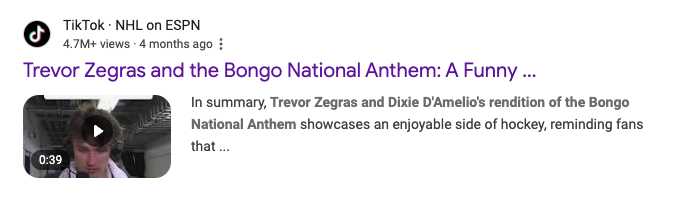 If you’re a hockey fan at all, you may have heard about the “bongo anthem” – a unique version of the National Anthem sung by Bruce Gust, a nine year veteran of the USMC and a former national recording artist. While it’s been referenced in multiple news outlets, it got yet another boost recently on ESPN’s TikTok channel where in the space of only 3 days, it got over 3 million views.
As it turns out, Bruce has got an interesting resume that includes having sung and played with a band that broke the Country Music Top 40, in addition to having served in the USMC for nine years, five of which were as a Drum Instructor at the Armed Forces School of Music. He credits his career path to a piece of advice he got from a retired Marine Corps Major when he was getting ready to graduate High School…
High School Graduation
Years ago, when I was getting ready to graduate High School, I sat down with a retired Marine Corp Major who gave me some counsel as I was attempting to navigate my options after graduation. He suggested that I “broaden my base.” He went on to explain that when you broaden your base, you’re making choices that afford you more opportunities, rather than those d
ecisions that unnecessarily regulate you to a limited number of options.
I decided to enlist in the Marine Corps. My rationale at the time was I wanted to serve, given my Dad’s recommendation, and I was determined to go to college – an aspiration I figured the military could help finance in some way, though I wasn’t completely sure what major I wanted to pursue. It was an audition for the Marine Corps band program, however, that initiated a professional trajectory that truly “broadened my base.”
I had been attending the Eastman School of Music Preparatory Department (now the Eastman Community School), studying under Ruth Cahn, one of the principle percussionists with the Rochester Philharmonic Orchestra. Under her guidance, I was exposed to mallet percussion as well as orchestral snare. That, coupled with my involvement with my High School’s music program positioned me in a way that made me a strong candidate for training as a military musician.
 The Marine Corps
I went to Parris Island and from there reported to the Armed Forces School of Music (Modern Drummer did an article about the School while I was an Instructor there). I spent two years in Hawaii and then came back to the School and became a Drum Instructor.
As a drummer in the military, you are required to be able to function in a variety of playing situations. In the morning, you may do a colors ceremony, where you’ll be playing rudimental snare. Later that day, you’ll be in a concert band rehearsal where you’re playing bells, orchestral snare, and timpani. Later that night, you’re behind the kit playing selections that require a familiarity with swing, and several latin styles.
In addition, in order to graduate from the School of Music, you have to successfully complete courses in Theory and Ear Training. As a non-commissioned officer, the Intermediate Course takes that same training a step further and you’re now learning traditional harmony and how to arrange for a stage band. And this is on top of qualifying with your rifle and keeping your physique in line with military physical fitness requirements.
 It’s a phenomenal program and several drumming icons including Steve Gadd and Billy Cobham are among those who have served as military musicians.
As an instructor, you have to be able to teach and lead by example. All of what’s expected in your students has to be personified in both your appearance and your ability to demonstrate the skills they need to learn. It’s both an inspiring and sobering responsibility and provides a huge incentive to be more than just adequate.
It was while I was serving as a Drum Instructor that I finished my degree in Business Management by attending night school – a program I began while stationed at Pearl Harbor. Now I’m practicing more than I might otherwise and my study habits are more focused in part because of the way the Marine Corps emphasizes discipline.
I was about a year away from my discharge that I was introduced to Norman Miller who used me on a project featuring his wife, Sheila Walsh, a successful Contemporary Christian Music artist, who was co-hosting the 700 Club with Pat Robertson at the time. That lead to me being his drummer for another project he produced called the Young Messiah Tour, which featured an entire roster of Contemporary Christian music icons.

So, what began in Boot Camp was now a chance to tour as a college graduate with people whose albums I owned. After the tour, I moved to Nashville. I joined Two Rivers Baptist Church and it was in the context of playing in the church orchestra that I met some talented musicians who were looking to start a country band.
Western Flyer
Together we formed the band, “Western Flyer.” Initially, I was a little hesitant, however, having cut my teeth on Jazz Fusion. I had been part of Jazz Trio that played music by Spyro Gyra, David Sanborn, Jeff Lorber, and others. And while I had played and sang in a band in Virginia that played Top 40, Country Music was not part of my musical vocabulary and singing parts was uncharted territory.
But instead of restricting my opportunities to only those styles that resonated as familiar, I again chose to “broaden my base.” As it turned out, although we were categorized as a country band, we all had influences that extended beyond a singular genre. Instead of being compelled to follow a conventional template, I was encouraged to apply concepts I had gleaned from some of Dave Weckl’s instructional content to our title cut. It was Steve Gadd’s approach to “Friends” by Chick Corea that informed my approach to another one of the selections on our first album. In addition, it was the Ear Training I learned at the School of Music that helped me get up to speed when it came to singing harmony.
 Western Flyer would tour all over the country. We were featured on national television and my engagement to my future bride was announced in Country Weekly magazine. But, while it’s tempting to think that a record deal translates to a career, that’s not always the case. Regardless of how many arenas you play, or how popular your songs are on the radio, the business side of it can sometimes override your aspirations and you wind up having to reinvent yourself in order to pay your bills.
It’s here where the counsel of that Marine Corps major would surface once again. While being a former national recording artist is a prestigious credential, it doesn’t necessarily guarantee you opportunities as a studio musician or even a position as a touring drummer. But instead of resolving to define myself exclusive according to my drum kit, I chose to “broaden my base.”
More Opportunities
I became a Corporate Trainer and taught myself web programming. I then expanded my portfolio to the point where I would secure a position as a full-time web developer.
Simultaneously, I wrote a book on how to play the drums. That translated to clinics that occurred throughout the country. I made my activity known to Pintech, Peavey, and Taye Drums and they responded by providing the necessary gear to perform at these events. And by drawing from my training in Arranging, theory, and chord progression at the School of Music, I created a play-along series based on arrangements of hymns designed to feature the drummer.
Given my military background and a commitment to fitness, I got certified as a Group Fitness Instructor and developed an audio workout system featuring…drums! You can see it at https://loosecannonfitness.com/
 The NHL performance that has since gone viral was the result of a conversation with the mother of one of my drum students who happened to work as part of the Nashville Predators who was able to contact me with the right people who then got me on the ice.
Your Signature
Many of those who pick up a drumstick see their musical fulfillment defined according to a very narrow collection of criteria. They will, in some cases, make unhealthy sacrifices in pursuit of a goal that sometimes proves either illusive or less than satisfying.
But there’s a prize to be won that provides a level of fulfillment that doesn’t depend on circumstances and opportunities that one can’t always control. It’s both accessible and motivating and it all comes down to “broadening your base.”
Benjamin Franklin was an incredibly accomplished individual. He signed the Declaration of Independence, he was a part of the Constitutional Convention, and he was there to sign the Treaty of Versailles. In addition, he invented the Franklin Stove, he was revered throughout the world as the one who developed the lighting rod. He invented the Public Library, the postal service, and organized the very first volunteer Fire Department. Given all these accomplishments, it’s interesting to note that he often signed his name, “B. Franklin, Printer.”
As musicians, we are similar. We have the capacity to contribute in ways that go beyond a solitary passion, yet maintain a signature that acknowledges our favored pursuit. Consider some of the most successful musicians. In many cases, not only are they singers or instrumentalists, they’re also entrepreneurs that maintain successful business ventures. They don’t see multiple obligations as distractions. Rather, they see them as additions to a platform characterized by healthy priorities and a variety of professional accomplishments.
They have “broadened their base.”
When you do that, you’re not longer restricted in seeing your craft as either a full-time effort or a side hustle. Rather, you see yourself as a conglomeration of skills and talents that, taken together, translate to a full color resume and the opportunities that result.


