


Do The Math
 Given the way in which the number of new cases and the ever increasing death toll of the Coronavirus are being constantly promoted, it becomes very easy to believe that the only way in which we’ll ever completely beat this thing is to hide our faces and close our doors. The problem, however, is that there’s other credible authorities weighing in on this approach with a completely different perspective – and they’ve got both the credentials the studies to prove their point.
First and foremost, we are the only country in the West who are not opening up their schools in the Fall. Dr Scott Atlas is the Robert Wesson Senior Fellow at the Hoover Institution of Stanford University and a Member of Hoover Institution’s Working Group on Health Care Policy. He had this to say…
“You either believe in the science or you say you believe in the science and act contrary to science. The science says — and this is data from Iceland, Sweden, Switzerland, the Netherlands, France, the U.K., Australia, Canada, Ireland, everywhere in the world, Germany, everywhere in the western world has shown that children do not transmit significantly to adults, even their own parents, and that teachers are not at higher risk of getting a disease like this disease from children. You either believe the science or not. You can’t insist you believe in the science and then act contrary to science. And, by the way, like I said, we are the only country not opening schools. This is absurd” (to read more about this, click here)
As far as the numbers of new cases, this all stems from the surge in tests that are being done. While that may sound like a logical reason to be concerned, bear in mind that in Florida the number of testing errors ranges from countless testing sites dubiously reporting 100% positive cases as well as scenarios where what was originally reported as a 98% was actually 9.4%. If that sounds suspicious, it should.
Finally, however you want to “lean,” in terms of caution as opposed to fear, the one thing that you should keep in mind is that you have a greater chance of dying in a car wreck than you do from COVID-19. This is based on a recent report that had the fatality between .5 and 1%.
The chances of your dying in a car crash is .97%.
Pause for a moment.
Some have accused those who would see life return to normal as being guilty of a disposition that would, “...trade the elderly for the economy.” If that logic were sound and we would limit any activity that poses a comparable amount of risk, then we could just as easily say that anytime we’re getting into a car with our family we are sacrificing the lives or our children for a quick mode of transportation.
There is a nonsensical approach being deployed when it comes to COVID-19 and several examples of corruption in the way statistics are being calculated.
Do the math…

The Black Robe Regiment
 Peter Oliver was a lawyer and by the time of the Revolution had risen to the position of chief justice of the Superior Court in Massachusetts. He was incredibly wealthy and served in a variety of community and church positions and was fiercely loyal to the crown.
His perspective on the Revolutionary War was that of a Tory. Unlike the way in which most historians present John Adams and other such Patriots as noble statesmen, Oliver saw them as deluded troublemakers.
Not long after Cornwallis’ surrender, Oliver published a book entitled, “Origin and Progress of the American Rebellion: A Tory View.” What makes his perspective valuable is that he has nothing to gain by glamorizing or exaggerating any one aspect of the American effort to win their independence, in that he views all of it as a form of sedition.
At one point, he sets aside an entire section of his text to describe the “Black Regiment.”
He begins by saying…
It may not be amiss, now, to reconnoitre Mr. Qtis’s black Regiment, the dissenting Clergy, who took so active a Part in the Rebellion.1
He elaborates on the “dissenting clergy” as flawed ministers, who according to Oliver, were ordained only because of a grave mistake having been made by the Governors of the Church of England. He identifies several men of the cloth including Jonas Clark, Dr. Charles Chaucy and others as being, not only members of the Regiment, but also extremely influential. He references two annual conferences that hosted pastors from all of the state and it was there that the “Black Regiment” was able to exert a substantial amount of influence in the name of rebellion and evil.
In this Town was an annual Convention of the Clergy of the Province, the Day after the Election of his Majestys Charter Council; and at those Meetings were settled the religious Affairs of the Province; & as the Boston Clergy were esteemed by the others as an Order of Deities, so they were greatly influenced by them. There was also another annual Meeting of the Clergy at Cambridge, on the Commencement for graduating the Scholars of Harvard College*, at these two Conventions, if much Good was effectuated, so there was much Evil. And some of the Boston Clergy, as they were capable of the Latter, so they missed no Opportunities of accomplishing their Purposes. Among those who were most distinguished of the Boston Clergy were Dr. Charles Chauncy, Dr. Jonathan Mayhew & Dr. Samuel Cooper?* & they distinguished theirselves in encouraging Seditions & Riots, until those lesser Offences were absorbed in Rebellion.2
You see Oliver’s “concern” reiterated on multiple occasions and in different ways.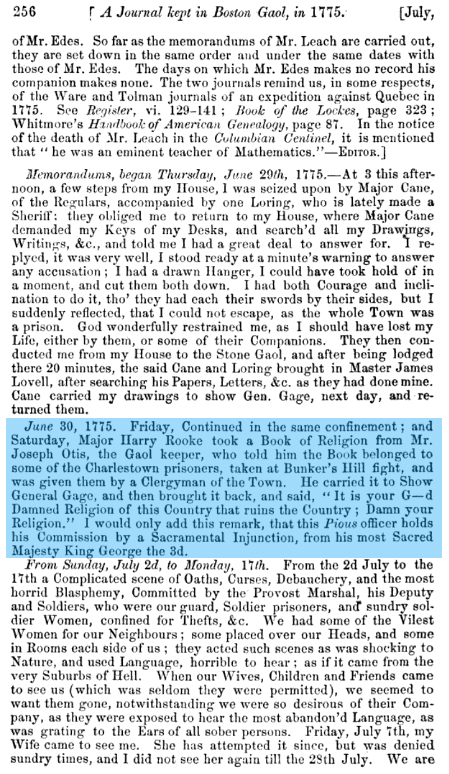
For example, John Leach was imprisoned for sending to Patriot forces information pertaining to the disposition of British troops. He recorded some of his experiences while in prison in a Journal that’s preserved in the “New England Historical and Genealogical Register for the Year 1865.”On June 30, he talks about a comment made by one of his British jailers…
June 30, 1775. Friday, Continued in the same confinement; and Saturday, Major harry Rooke took a Book of Religion from Mr Joseph Otis, the Gaol keeper, who told him the Book belonged to some of the Charlestown prisoners, taken at Bunker\’s Hill fight, and was given them by a Clergyman of the Town. He carried it to show General Gage, and then brought back, and said, “It is your G–d Damned Religion of this Country that ruins this Country; Damn your Religion.” I would only add this remark, that this Pious officer holds his commission by a Sacramental Injuection, from his most Sacred Majesty King George the 3d.3
You can also see the prominence of Christianity and even how certain denominations were regarded with a special sense of disdain by the British when you consider the diary of Thomas Hutchinson.
Thomas Hutchinson was the Governor over Massachusetts appointed by King George. He recorded a conversation he had with the monarch in July of 1774.
This would’ve been in the aftermath of “The Coercive (Intolerable) Acts of 1774” that were enacted as punishment for the Boston Tea Party. These were incendiary moves on the part on the part of King George that would result in galvanizing the colonies even further in their resolve to separate from England.
Among the things represented in the new legislation was the replacement of the Massachusetts Council with officials appointed by the crown rather than it being an elected body. You can hear King George questioning the way in which this new group of leaders was being received in the conversation he was having with his Governor.
He begins by asking what sort of doctrine is being preached in the colonies…
❶ Here is where King George is inquiring about the Massachusetts Council that used to be an elected body that has now been replaced with people who’ve been appointed by the crown.
❷ The “Dissenters from the Church of England,” in this context, refers to the Congregationalists who were loyal to the crown and had not repudiated the Church of England. These were the posterity of the early Pilgrims who had settled in the New World in the early seventeenth century.Lead by William Bradford in 1620, the Pilgrims, also called “Separatists,” were resolved to worship in a manner consistent with the Scriptures as opposed to the institutionalized church created by Henry VIII in order to secure a divorce the Pope was unwilling to grant him.
The Puritans were similar to the Separatists, but instead of wanting to break completely from the Church of England, they wanted to merely purify it. They arrived in the New World in 1630 and established the Massachusetts Bay Colony just south of Plymouth Rock.By the 18th century, the Puritans and the Pilgrims had combined to form the Congregationalists. But while they were now functioning under one denominational heading, you still had two distinct groups that were defined by their allegiance to the king.Published in 1907, “The Loyalists of Massachusetts and the Other Side of the Revolution,” written by James H. Stark, references this dynamic.
The characteristics of the separate and independent governments of these two classes of Puritans were widely different. The one was tolerant, non-persecuting, and loyal to the King, during the whole period of its seventy years\’ existence; the other was an intolerant persecutor of all religionists who did not adopt its worship, and disloyal, from the beginning, to the government from which it held its Charter, and sedulously sowed and cultivated the seeds of disaffection and hostility to the Royal government until they grew and ripened into the harvest of the American Revolution.5
This is, perhaps, one of the reasons why King George and his Governor could feel somewhat confident that they were drawing from an amicable group of people by defaulting to a specific “type” of Congregationalist. Doctrinally, they were not altogether consistent with the Anglican church, but they were at least somewhat sympathetic to their English Sovereign.
As far as Hutchinson’s reference to the Episcopalians, while they did not formally organize until 1780, during the period leading up to the Revolutionary War, they were considered the American version of the Church of England. While there were exceptions, an Episcopalian’s loyalty to the crown was more pronounced then their Congregationalist counterpart and certainly more intense than what you saw in the various sects that sprung up in the aftermath of the Great Awakening. You see this in the way many Episcopalians felt obliged to flee America after the Revolutionary War, including the Episcopalian minister referenced by Hutchinson in his conversation with King George.

In 1662, the Common Book of Prayer was revised to include a mandate for all ministers to be ordained according to an Episcopal format and to “declare his unfeigned assent and consent to the text.”
The fact that Hutchinson states that staffing the new Massachusetts Council with Episcopalians would’ve been “more disagreeable,” is indicative of the way ardent Patriots viewed Episcopalians with suspicion. Hence the choice of those coming from the Congregationalist group would be a more strategic option.
❸ To understand King George’s comment, you have to go back to the sixteenth century and look at the way in which the crown had exacted legislation that compelled a uniform approach to Christ that ultimately violated the Word of God.
Act of Uniformity
In 1558, Queen Elizabeth, as part of trying to eliminate the tensions between Catholicism and the Protestant mindset, she introduced legislation that dictated the way in which people were to pray and worship. It was called, “The Act of Uniformity” and it included a revised “Book of Common Prayer” which outlined how services were to be conducted as well as the verbiage of the prayers that were to be said everyday (click here to see the prayer that was to be repeated every morning). In addition, it made it a punishable offense to not attend Anglican services once a week.
In 1662, it was revised to include a mandate for all ministers to be ordained according to an Episcopal format and to “declare his unfeigned assent and consent to the text” (see sidebar). This resulted in over 2,000 ministers being ejected from their pastorate in what was called, “The Great Ejection. Many of those that were forcibly displaced were Presbyterians who made their way to the New World.
Thoroughly Protestant
While the Church of England represents a hybrid combination of both Protestant and Catholic doctrines, Presbyterians, on the hand, are thoroughly Protestant. From the perspective of the monarchy, they were positively toxic in part because of the way in which they recognized how the church was being manipulated by various sovereigns to perpetuate their power.
Elizabeth not unreasonably believed that the maintenance of the Episcopacy was necessary to the continuance of Royalty. She knew that the church of Geneva, which the Puritans declared to be their model, was not only essentially republican, but could not be perfectly established except in a republic...6
The Church of Geneva was founded in 1536 during the Protestant Reformation. It represented the central location of Protestant thought. As a Presbyterian, while you were not Puritanical in your doctrine, you nevertheless shared with some of your Puritan counterparts an unwillingness to allow a monarch to dictate your conscience in the way you worshipped, how you were to set up your church leadership or the way you ministered to others.
And while the Presbyterian denomination is a separate group of believers who subscribe to a particular set of doctrines, including, in some circles, a Calvinistic approach to predestination, in many instances when you hear an 18th century Englishman refer to a “Presbyterian,” it was a reference to anyone who recognized the discrepancy between engaging your faith according to a biblically based paradigm as opposed to a government imposed infrastructure.
This is where much of the real tension surfaced.
Church Government
In addition to the fact that all men are created equal (Gen1:26; Prov 2:22; Gal 3:28) thus invalidating the Divine Right of Kings, a large part of the Presbyterian doctrine pertained to church government. Churches were to be governed by elected elders not Anglican Bishops. By attempting to impose a crown appointed hierarchy to rule over the spiritual affairs of a Presbyterian who believed that leadership should be based on a biblically founded approach, England violated an Absolute documented in Scripture. As a result, Presbyterians were only too willing to oppose the established order and because of the presence they commanded in New England, the Revolution was often referred to as something inspired by a Presbyterian perspective.
Chief Instigators
You see this dynamic reflected in a pamphlet written by Joseph Galloway, who was a former speaker of the Pennsylvania Assembly. He opposed the Revolution and fled to England. He believed that the Revolution was a religious quarrel instigated by Congregationalists and Presbyterians…
But they did not stop there: The principal matter recommended by the faction in New England, was a union of the congregational and presbyterian interests throughout the Colonies…Thus the Presbyterians in the southern colonies, who, while unconnected in their several congregations, were of little significance, were raised into weight and consequence; and a dangerous combination of men, whose principles of religion and polity were equally averse to those of the established Church and Government, was formed.7
Dr. Albert S. Bolles in his history of the Province and State of Pennsylvania from 1609 to 1790 reinforces that by elaborating on the enemy’s regard for Presbyterian clergy…
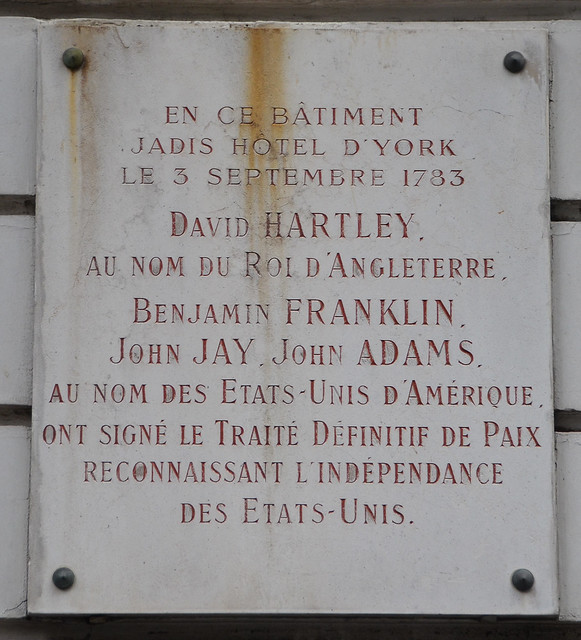
English Translation: “In this building formerly York Hotel on September 3, 1783 David Hartley, on behalf of the King of England, Benjamin Franklin, John Jay, John Adams, on behalf of the United States of America, signed the Final Treaty of Peace recognizing the independence of the United States.”
To the Presbyterian clergy the enemy felt an especial anitpathy. There were accounted the ringleaders of the rebellion. For them there was often not so much safety in their own dwellings as in the camp. When their people were scattered, or if it was no longer safe to reside among them, the only atlernative was to flee or join the army, and this alternative was often presented. Not unfrequently the duty of the chaplain or the pastor exposed him to dangers as great as those which the common soldier was called to meet. There was risk of person, sometimes capture, and sometimes loss of life.8
David Hartley was Britain\’s Minister Plenipotentiary. He had full diplomatic powers and represented the crown when he signed the Treaty of Paris with John Adams, Benjamin Franklin, and several others in 1783. Hartley and Franklin were good friends and Hartley frequently spoke against the Revolution in Parliment. After Cornwallis\’ surrender at Yorktown, it was Hartley and Franklin that composed the Treaty of Paris.On February 3rd, 1779, Franklin responded to Hartley who had written a letter proposing that the United States end their alliance with France. At one point, he says:
The long, Steady, & kind regard you have shown for the Welfare of America, by the whole Tenour of your Conduct in Parliament, satisfies me, that this Proposition never took its Rise with you, but has been suggested from some other Quarter; and that your Excess of humanity, your Love of Peace, & your fears for us that the Destruction we are threatened with, will certainly be effected, have thrown a Mist before your Eyes, which hindred you from seeing the Malignity, and Mischief of it.— We know that your King hates whigs and Presbyterians; that he thirsts for our Blood; of which he has already drank large Draughts; that his servile imprincipled Ministers are ready to execute the wickedest of his Orders, and his venal Parliament equally ready to vote them just.9
Franklin doesn’t attempt any restraint or indulgence in describing King George or those members of Parliament who viewed America with disdain. The fact that he begins his description with the way in which King George hated Presbyterians demonstrates the way in which the monarchy associated the Revolution with a Christian perspective.
At the Highest Levels of Government
Members of Parliament were being informed from a variety of sources as to the nature of the American rebellion being founded on a religious premise.
Andrew Hamond was a captain in the British Navy. In a letter dated August 5, 1776, to Hans Stanley, a British Diplomat who sat in the House of Commons, he mentions that while there are some within the colonies who are loyal to the crown, there are nevertheless deep religious convictions running thoughout that, in some cases, are thoroughly determined to gain their independence:
It seems that they have long had divisions among them on religious accounts, and the Churchmen are clearly of opinion that it is the Presbyterians that have brought about this revolt, and aim at getting the government of America into their hands. 10
William Jones of Nayland was a distinguished theologian and a prolific writer. In 1776 he wrote an essay entitled, “An Address to the British Government on a Subject of Present Concern, 1776” in which he addresses what he believes to be the principle driving force of the American Revolution:
And having nothing now to oppose but the Hanover family on the throne, they have at last taken up arms against that, and will carry on a war against the authority, the commerce, and the honour of this country, as long as they have the means of rebellion in their hands; for this has been a Presbyterian war from the beginning as certainly as that in 1641; and accordingly the first firing against that King’s troops was from a Masschusset meeting-house. 11
The Presbyterian was considered to be one of the chief instigators of the War for Independence, hence King George\’s comment to Hutchinson when he was asking if the Congregationalists being considered were of the Presbyterian stripe.
❹ The Presbyterian Church was started by John Knox in Scotland. It’s presence in the vocabulary being used by those in Parliament wasn’t so much a reference to doctrine as much as it was a referral to the way in which a biblically based argument was being used by “Presbyterians” to justify severing ties with England.
You see this explained by John Adams in a letter he wrote to Hezekiah Niles, who was the editor and publisher of the Niles’ Weekly Register from 1811-1836 and before that was the editor of the Baltimore Evening Post.
In his letter, Adams refers to Dr. Jonathan Mayhew who was one of the earliest ministers to object to the idea that it was a Christian’s duty to suffer beneath the administration of a tyrant. Rather, according to Mayhew, it was the Christian’s obligation to resist (“Religion and the Founding of the American Republic”, Dr. James H. Hutson, Library of Congress, Washington, DC, 1998, p39).
In addition to being an articulate speaker, Mayhew was also a prolific writer. At one point, he wrote a lengthy exposition entitled, “Conduct of the Society for Propagating the Gospels in Foreign Parts.” This was a rebuke directed towards the Church of England, who, under the auspices of witnessing to unchurched peoples, were using their charter to enforce an Anglican approach to one’s relationship with Christ and church government.
This was, again, an extension of the “Act of Uniformity” referenced earlier. Because it struck at the way in which the Church was to be set up according to a biblical model as opposed to a state sanctioned hierarch, the “Presbyterian” dynamic was considered by the Church of England to be a problem that needed to be rooted out.
Mayhew’s addresses this in Section XIV which is entitled, “That the Society have long had a formal design to root out Presbyterianism, &c. and to establishing both Episcopacy and Bishops in the colonies: In pursuance of which favorite project, they have in a great measure neglected the important ends of their institution.”
However this may or may not resonate as a serious issue in the mind of a 21st century layperson, in the eighteenth century when Christianity was more than just a token tradition, it had monumental ramifications which Adams explains…
If any Gentleman Supposes this Controversy to be nothing to the present purpose, he is grossly mistaken. It Spread an Universal Alarm against the Authority of Parliament. It excited a general and just Apprehension that Bishops and Diocesses and Churches, and Priests and Tythes, were to be imposed upon Us by Parliament. It was known that neither King nor Ministry nor Archbishops could appoint Bishops in America without an Act of Parliament; and if Parliament could Tax Us they could establish the Church of England with all its Creeds, Articles, Tests, Ceremonies and Tythes, and prohibit all other Churches as Conventicles and Sepism Shops.12
What Adams is saying is that the Revolution was more than just an agitated populace wanting a more just representation in Parliament. The Church of England was using its politically based essence to impose the authority of English Rule on all things pertaining to church and beyond. In addition, it insisted than any other denomination was unlawful (Conventicles) and sick (Sepism Shops). And this included Presbyterians.
❺ Dr Henry Caner represents a great illustration of how certain Episcopalians were considered Tories because of their commitment to the Church of England. Like many of his Episcopal contemporaries, Caner felt compelled to leave the country and flee to England in order to avoid any fallout from having remained loyal to the crown (see sidebar). (https://www.gutenberg.org/files/39316/39316-h/39316-h.htm#Footnote_70_70)
The bottom line is that “religion,” specifically Christianity, was not only the philosophical foundation upon which our Founders based their justification for separating from England, it was also the way in which a flawed approach to Scripture was being used by the Church of England to enforce a political agenda.
It was the American clergy during this time – the “Black Robe Regiment” – that placed these Realities before their engaged congregations and in so doing provided the needed resolve, endurance and courage to stand up against tyranny and defeat what was a fundamentally flawed approach to government.
1. “Origin and Progress of the American Rebellion: A Tory View”, Internet Archive, https://archive.org/stream/originandprogres011156mbp/originandprogres011156mbp_djvu.txt, accessed April 12, 2023
2. Ibid
3. “The New England Historical and Genealogical Register for the Year 1865“, David Clapp and Son, Boston, MS, 1865, “A Journal Kept by John Leach, During His Confinement by the British, In Boston Gaol, in 1775″p 256
4. “The Diary and Letters of His Excellency Thomas Hutchinson: Captain-General and Governor in Chief of His Late Majesty\’s Province of Massachusetts Bay in North America”, S. Low, Marston, Searle and Rivington, London, England, 1883-1886, p167-169
5. “The Loyalists of Massachusetts and the Other Side of the Revolution“, James H. Stark, W. B. Clarke Co, Boston, MA., 1807, p8
6. “Romantic Biography of the Age of Elizabeth: Or, Sketches of Life From the Bye-Ways of History“, Benedictine Brethren of Glendalogh, edited by William Cooke Taylor, LL.D. ETC, Richard Bentley, New Burlington Street, London, England, 1842, p82
7. “Historical and Political Reflections on the Rise and Progress of the American Rebellion”, Page 54. Joseph Galloway, London: G. Wilkie, 1780. Rare Book and Special Collections Division, Library of Congress (81)
8. “Pennsylvania Province and State: A History from 1609 to 1790“, Albert S. Bolles, Ph.D., LL.D, John Wanamaker, Philadelphia, PA and New York, NY, 1899, p417
9. “The Papers of Benjamin Franklin”, “Letter in Answer to the Proposition of quitting the Alliance of France”, Vol 28 https://franklinpapers.org/framedVolumes.jsp, accessed April 14, 2023
10. “Naval Documents of the American Revolution“, Volume VI, edited by William James Morgan, Naval History Division, Department of the Navy, Washington, D.C., 1972, p 68
11. “An Address to the British Government on a Subject of Present Concern, 1776,” The Theological, Philosophical and Miscellaneous Works of the Rev. William Jones, 12 vols. (London, 1801), Vol. 12, p 356
12. “From John Adams to Hezekiah Niles, 13 February 1818”, “National Archives, Founders Online, https://founders.archives.gov/documents/Adams/99-02-02-6854, accessed April 22, 2023

Twenty Five Inconvenient Realities

The Separation of Church and State is a phrase often used by people who want to insist that Christianity had no real role in our nation’s founding – cerntainly nothing that had any significant influence on those that articulated our cause, created our Constitution and fought the battles that culminated in the surrender of Great Britain.
You see this in comments like what you see below from the “Freedom From Religion” website:
The Christian Right is trying to rewrite the history of the United States, as part of their campaign to force their religion on others who ask merely to be left alone. According to this Orwellian revision, the Founding Fathers of this country were pious Christians who wanted the United States to be a Christian nation, with laws that favored Christians and Christianity.
Not true! The early presidents and patriots were generally Deists or Unitarians, believing in some form of impersonal Providence but rejecting the divinity of Jesus and the absurdities of the Old and New Testaments.
You have to be very selective in the information you use to validate such a statement. At the same time, you have to be willfully oblivious to the specific references to God and Christ that punctuate the relevant events and documentation that established the United States.
Below is a brief yet potent list:

American Concrete
 When it comes to the topic of our nation’s Christian heritage, you have two main schools of thought:
The liberal mindset that insists our forefathers viewed religion as something to be negotiated as an administrative duty
The Conservative Christian platform that maintains an aggressive acknowledgement and pursuit of God’s Assistance characterized the collective perspective of the founding fathers
Much of the controversy stems from a ruling given by the Supreme Court in 1947 and the way they interpreted a phrase used by Thomas Jefferson in a letter he wrote to the Danbury Baptist Association in Connecticut in 1802. They declared that Jefferson’s usage of the term “the separation of church and state” constituted “the authoritative declaration of the scope and effect” of the First Amendment.1
Since then, that ruling has become the standard by which all public expressions of religious convictions have been measured, leading to an ever increasing limitation being put on the acknowledgement of God in governmental agencies as well as an ever lengthening shadow of doubt being cast on our nation’s religious heritage. The debate is, at times, passionate and you’ve got buffoons on both sides of the aisle. The venom and the inaccuracies can culminate in a spectacle that can make it difficult to know which argument is correct. But there is a bottom line that transcends the way in which a solitary statement can be potentially dissected to the point where its meaning becomes illusive. That bottom line is to consider, not only the comment that was made, but also:
- the context of that comment
- the character of the person speaking
- the cultural backdrop that made what that person said both relevant and influential
In other words, rather than just scrutinizing what was said, look at also why it was said, to whom was the person speaking and who was it that made the comment. At that point, you’ve got a full color, three dimensional rendering of what was stated as opposed to an intentionally cropped, black and white snapshot.
Using that kind of approach, let’s take a look at Thomas Jefferson and his exchange with the Danbury Baptists.
Jefferson’s Resume
 Jefferson’s mental capacity and creativity went beyond mere academics. At the front door of his home, there’s a seven day clock that he designed. It’s counterweights hang on either side of the front entrance and extend through the floor. The height at which the counterweights hang indicate the days of the week that are written on the wall and beneath the floor. Monticello as a whole – the layout of the grounds and the structural design – all served as a testament to the creative intelligence and the intellectual ingenuity of their architect.
In 1962, President John F. Kennedy was speaking at a dinner in the White House honoring all of the living recipients of the Nobel Prize. He said, “I think this is the most extraordinary collection of talent, of human knowledge, that has every been gathered together at the White House, with the possible exception of when Thomas Jefferson dined alone.”2
Thomas Jefferson was extraordinary. Prior to earning his license as a lawyer, he had earned his college degree from the College of William and Mary, having studied Mathematics, Philosophy, Metaphysics as well as French and Greek. It was there that he would also be introduced to the writings of John Locke, Isaac Newton and Francis Bacon – great thinkers that would shape his approach to politics and America’s quest for liberty.
 After writing the Declaration of Independence, he returned to Virginia where he served in the Virginia State Legislature, eventually ascending to the position of Governor. His role in crafting the new state government was significant. For nearly three years he assisted in the construction of the state constitution. His most notable contribution was the “Virginia Statute for Religious Freedom” – an accomplishment he had immortalized on his tombstone.
Jefferson was also very familiar with the Bible and the teachings of Christ. During his presidential years, he wrote a 46 page work entitled “The Philosophy of Jesus of Nazareth Extracted from the Account of His Life and Doctrines as Given by Matthew, Mark, Luke and John.”3 Moreover, he understood the necessary role the Christian doctrine played in the formulation of a government based on the Absolutes of Scripture as opposed to the machinations of men, be they manifested in the context of royalty or enlightened reason.
While he was convinced that the established clergy of the day were corrupt and the imposition of any one creed by a legislature was fundamentally flawed, it was the transcendent dynamic of the Christian doctrine upon which he founded his philosophical approach to freedom and sound government.
Jefferson’s Starting Point
It’s here where the liberal and conservative perspectives diverge. The liberal platform maintains that Jefferson’s usage of the phrase “separation of church and state” in his letter to the Danbury Baptist Association was intended to purge any mention of God in an official context, be it the Pledge of Allegiance, the display of any Christian symbols during the Holidays , prayer in schools and the list goes on and on.
His previously stated comments pertaining to the Christian component of our nation’s government , the culture of the time and the audience he was addressing are all either diluted or dismissed in order to craft a liberal platform that presents America as a purely secular enterprise. Furthermore, there’s a philosophical starting point that Jefferson uses in the two documents he requested be immortalized on his tombstone that gets glossed over as though it has no real bearing on the issue. But if this is the cornerstone of his thought processes pertaining to religious freedom and liberty in general, this is a crucial piece of evidence that needs to be admitted as part of the conversation.
Take a look…
In both documents, he bases one’s right to liberty on the fact that God created man to be free.
The Declaration of Independence:
We hold these truths to be self-evident, that all men are created equal, that they are endowed by their Creator with certain unalienable Rights, that among these are Life, Liberty and the pursuit of Happiness…We, therefore, the Representatives of the united States of America, in General Congress, Assembled, appealing to the Supreme Judge of the world for the rectitude of our intentions, do, in the Name, and by Authority of the good People of these Colonies, solemnly publish and declare, That these united Colonies are, and of Right ought to be Free and Independent States…(emphasis added)
The opening statement of Virginia’s Statute for Religious Freedom:
Whereas, Almighty God hath created the mind free;
Jefferson’s sense of reason, in terms of a man’s ability to worship and live as a free entity, was founded on the manner in which God had designed him. In other words, it was the doctrine of the church that gave shape and substance to the state.
Jefferson’s sense of reason, in terms of a man’s ability to worship and live as a free entity, was founded on the manner in which God had designed him. In other words, it was the doctrine of the church that gave shape and substance to the state. Remove the philosophical foundation of Scripture from Jefferson’s approach to liberty and you reduce the essence of our nation to a complaint rather than an Absolute. Furthermore, by insisting that there be no acknowledgement of the biblical paradigm that supports the ideological structure of our government, we invite the decay and corruption that inevitably accompanies the fallibility of a purely human enterprise.
Jefferson’s faith was unorthodox and his determination to avoid any appearance of officially sanctioning a particular denomination was nothing short of aggressive, but to twist his usage of the phrase “separation of church and state” into a quasi-legislative impetus to remove prayer from schools and strike the “one nation under God” phrase from the pledge of Allegiance, is to ignore the obvious cornerstone of Jefferson’s thought process. In addition, should the liberal perspective be embraced, you make Jefferson himself the “chief of sinners” in that he violates his own supposed conviction by invoking a overtly Christian dynamic in the very documents that define his perspective on the freedoms we enjoy.
Jefferson’s Audience
In addition to considering the background of Thomas Jefferson and his philosophical starting point when it came to the issue of religious liberty, one also needs to look at the society that Jefferson was addressing in the letter he wrote to the Danbury Baptists.
In 1776, the Declaration of Independence, in addition to proclaiming America’s resolve to separate itself from the authority of the crown, it also created a mandate for all states to create their own constitution. While many of the early settlers had left Old World in order to worship according to the dictates of their conscience, not everyone was dissatisfied with the Anglican Church. As a result, while the fabric of America’s religious culture was predominantly Protestant, it was nevertheless interwoven with a number of different denominations.
The Church of England was predominant in Virginia, in New England you had a blend of Congregationalists (an evolution of the original Puritans), Presbyterians and Quakers with a small percentage of other denominations scattered throughout the Northeast.
It’s imperative to realize that between 1700 and 1740, an estimated 75-80 percent of the population attended churches which were being built at a headlong pace. When Thomas Jefferson became Vice President in 1797, the Second Great Awakening began and an abundance of revival meetings occurred throughout the country in a sustained pattern that would continue to the Civil War. So common was this anomaly that it was referred to as “the great absorbing theme of American life.”4 And part of what made the evangelical movement so potent was the way in which it was perceived as the best way in which to promote and preserve republican government.
Nineteenth century evangelical literature abounds with statements that could have been inspired by the religion section of Washington’s Farewell Address or copied from the Massachusetts Constitution of 1780: “the religion of the Gospel is the rock on which civil liberty rests”; “civil liberty has ever been in proportion to the prevalence of pure Christianity”; “genuine Religion with all its moral influences, and all its awful sanctions, is the chief, if not the only security we can have, for the preservation of our free institutions”; “the doctrines of Protestant Christianity are the sure, nay, the only bulwark of civil freedom”; “Christianity is the conservator of all that is dear in civil liberty and human happiness.”5.
But while the message of preachers was being embraced as something that promoted the nation’s approach to liberty as well as the key to one’s eternal salvation, it didn’t resolve the tension that existed in many states, as far as the way certain state constitutions made religion – specifically the patronization of a specific denomination – compulsory.
In 1724, in the state of Connecticut, if you were a member of the Anglican church, you were required by law to pay a percentage of your income to the local Congregationalist church under penalty of imprisonment or seizure of goods.6 Up until 1818, the Congregational church was the established church of Connecticut which translated to a number of legislative tactics deployed for the expressed purpose of discouraging and harassing members of any “dissenting” denomination.7
In the year 1801, the Baptist churches that comprised the Danbury Baptist Association resolved to approach the newly elected President for the sake of soliciting from him a statement that would reinforce and further promote the idea of disestablishment – the elimination of government-sanctioned discrimination against religious minorities.8
Jefferson’s reply would be reprinted in publications across the nation.9 The effect of Jefferson’s letter is subjective in that it would be several years before Connecticut’s religious tone would be altered to the point where its constitution would be stripped of any legislative power to promote one denomination over another. Other states would follow suit over time, but the bottom lines is that in the early years of the nineteenth century, “religious freedom” wasn’t so much about discouraging public religious expressions as much as it was about eliminating that dynamic where you were legally obligated to attend and support a specific church.
It’s wise to pause for a moment and ponder the mindset of those who were reading Jefferson’s letter in 1802. While our currency today states that we trust in God, statistics reveal a collective disposition that is largely cynical of traditional Christianity.10 In a 2013 article written by Steve McSwain entitled “Why Nobody Wants to Go to Church Anymore,” he cites some compelling stats that proclaim upwards of 80% of Americans are finding “more fulfilling things to do on the weekend” besides going to church.11 That’s not to say that some of these same people aren’t listed on the membership role of a local fellowship, but their commitment to God is casual at best.
This is an important dynamic to consider in that, to a nineteenth century citizen of the US, given the religious tenor of the nation as a whole, removing any and all references to Christ from the public arena was not something to be desired let alone considered. Christianity was regarded as both the foundation as well as the fuel for a moral society which, in turn, promoted a healthy republic.
Jefferson demonstrated that himself in his personal life as well as his public policies.12 “The Christian religion,” he wrote in 1801, when “brought to the original and simplicity of its benevolent institutor (Jesus Christ), is a religion of all others most friendly to liberty.”13 This is not the sentiment of a man determined to remove faith based gestures from the public arena. And while it wasn’t in Jefferson’s mind to eliminate the concrete of Christianity from America’s foundation, neither was it the ambition of the people he governed or the people who governed alongside him.
Jefferson’s Peers
To state that Jefferson’s was not the only signature on the Declaration of Independence nor was he the only voice that shaped our Constitution (Jefferson was in France when our Constitution was written, but he was nevertheless influential through his correspondence) is to rehearse the obvious. Yet, when you consider the weight given to a single phrase made in a letter that, while politically strategic, had no legislative power, it’s difficult not to feel as though Jefferson’s correspondence with the Danbury Baptists is the only piece of evidence being admitted into the courtroom.
When you consider the other personalities and their respective statements along with their voting record, the resulting dynamic isn’t so much something that isolates Jefferson’s statement to the Danbury Association as unique as much as it brings into focus what he truly intended.
The First Continental Congress and the Constitutional Convention were the legislative bodies that crafted the Declaration of Independence and the United States Constitution respectively. There were 56 signatures on the Declaration of Independence and 55 delegates attended the Constitutional Convention in 1787. With no more than five exceptions, the members of the Constitutional Convention were all orthodox members of an established Christian denomination.14 The signatures on the Declaration of Independence boasts a similar enumeration of men who vocally volunteered their commitment to Christ with little hesitation. Following the death of Richard Henry Lee (President of the Continental Congress and the man who officially introduced in Congress the call for America’s independence), his papers and correspondence, including numerous original handwritten letters from patriots (e.g., George Washington, Benjamin Rush, John Dickinson, etc.), were passed on to his grandson who compiled those documents into a two-volume work published in 1825. After having studied those personal letters, the grandson described the great body of men who founded the nation in these words:
“The wise and great men of those days were not ashamed publicly to confess the name of our blessed Lord and Savior Jesus Christ! In behalf of the people, as their representatives and rulers, they acknowledged the sublime doctrine of his mediation.”15
The reason the American experiment succeeded is because it was based on the Absolutes in Scripture that pertained to the way in which man was created to think and live as a free enterprise.
Political theory and personal preferences can be debated to the point where legislative conclusions are determined more so by charisma and compelling rhetoric than the substance of the truths being considered. Our Founding Fathers knew that and for that reason chose to bring their collective pursuit of liberty beneath the umbrella of Biblical Truth.
Within their ranks you had different degrees of orthodoxy as well as a variety of individual perspectives on issues such as slavery and those that were fit for positions of political leadership. But they all believed that man was “…endowed by their Creator with certain unalienable human rights” and it was that consensus that allowed them the opportunity to come together as a unified legislative body and proclaim the freedom of those they represented to King George and to the world.
In Conclusion
 Pop Quiz…
Question #1: How often from June 12, 1775 till August 3rd, 1784 did Congress proclaim a National Day of either Fasting or Thanksgiving?
Answer: 18 times. Twice a year – once in March and once in October.16
Question #2: The following statement is inscribed on the Liberty Bell: “Proclaim Liberty thro’ all the Land to all the Inhabitants thereof.” What text is that taken from?
Answer: Leviticus 25:10
Question #3: What President attended church services every Sunday during his administration, approved the use of the War Office as well as the Office of the Treasury for religious services and also approved the use of the Marine Band to provide instrumental accompaniment for the religious services going on within those government facilities?
Answer: Thomas Jefferson17
Question #4: Who, more than any other single person, is pictured in various locations throughout Capitol Hill? Answer:
 Moses18
Question #5: Above the figure that represents Science in the Library of Congress, there is an inscription. What is that inscription?
Answer: Psalm 19:1 (The Heavens declare the glory of God and the firmament sheweth his handiwork [Psalm 19:1])
: Who stated the following: “… it is the duty of all nations to acknowledge the providence of Almighty God, to obey His will, to be grateful for His benefits, and humbly to implore His protection and favor.”
a) Billy Graham
b) George Washington
c) George W. Bush
d) Charles Spurgeon
Answer: George Washington (proclamation October 3, 1789)
Question #7: It was on April 22, 1864 that Congress resolved to institute the phrase, “In God We Trust” as our national motto. Where did they get that phrase from?
Answer: The third verse of our national anthem:
Praise the Pow’r that hath made and preserv’d us a nation! Then conquer we must, when our cause is just, And this be our motto: “In God is our trust”19

“The Light of Truth” painting depicting truth slaying the dragon of ignorance. Four sets of cherubs are featured featuring the four elements of sound law: the square, the plumb, the level and the Bible.
The “separation of church and state” phrase can not be accurately utilized as a legal foundation upon which to build legislative mandates to remove Christian symbols from the marketplace. When one pauses long enough to objectively evaluate the whole of Jefferson’s political regard for Christianity, the collective disposition towards religion that belonged to his peer group and the esteem for Christ that characterized the people he governed, to arrive at such a conclusion is nothing less than an irresponsible interpretation of the facts.
Yet, regardless of substantive the argument may be – that the 1947 interpretation of Jefferson’s phrase was altogether wrong – there are other forces at play that make this debate more than just an intellectual joust. The fact that no one balked when Washington so vigorously asserted a Christian dynamic in his farewell address or no one objected to Theodore Roosevelt or Woodrow Wilson crafting the preface to the Bibles that were distributed to soldiers being deployed to Europe during WWI is because the religious tenor of nation as a whole was far more healthy.
The Light of Truth is a painting that’s featured on the ceiling of the Members of Congress Reading Room in the Jefferson building which was opened in 1897. The artist, Carl Gutherz, pictures four sets of cherubs to represent four tools that are needed to fashion law that is accurate and sound: the plumb, the square, the level and the Bible. The governmental patrons that commissioned the work of Gutherz were no more concerned about his art constituting a violation of the Establishment Cause then were the members of congress who took the time to read the words of Franklin Delano Roosevelt as they were reprinted on the inside cover of those Bibles that were distributed to servicemen during World War II.
Again, America in the 1940’s is revealed as being a nation that was collectively embracing the Truth of God, rather than dismissing it as antiquated and limiting. The fundamental essence of our corporate perspective on the First Amendment is defined by our national regard for Christ. It’s not a legal discussion only as much as it’s a reflection of who we are spiritually. If we are to thrive and not just endure as a nation, it’s not a debate that needs to be won as much as it’s a revival that needs to occur.
Traditionally, it’s only in times of crisis when our collective knees bow in worship and the indignation of those who want to remove Christian symbols from the marketplace is processed as an obstacle to the common good rather than a catalyst. If we are to enjoy the advantages that go along with being reverent without having to be alerted to our spiritual lethargy by something dramatic, then it’s only common sense to focus on what’s True and labor to influence those on the peripheral in that direction.
Again, it’s not our history that needs to be revisited, it’s our God that needs to be lifted up (Jn 12:32). Only then do our backgrounds and varying convictions blend together in a way that is Truly strong and enduring. Only then does our spiritual heritage come into focus in a way that is not tainted by a worldly desire to distance ourselves from the Author of our freedoms. Only then is our foundation set in the concrete that is truly American as opposed to the shifting sands of cultural whims and academic trends.
1. Religion and the Founding of the American Republic”, Dr. James H. Hutson, Library of Congress, Washington, DC, 1998, p92
2. “John F. Kennedy: Remarks at a Dinner Honoring Nobel Peace Winners of the Western Hemisphere”, The American Presidency Project, http://www.presidency.ucsb.edu/ws/?pid=8623, accessed November 2, 2015
3. “Thomas Jefferson: The Art of Power”, John Meacham, Random House, New York, NY, 2012, p471
4. “Religion and the Founding of the American Republic”, Dr. James H. Hutson, Library of Congress, Washington, DC, 1998, p99
5. Ibid, p109
6. “Connecticut in Transition, 1775-1818”, Richard Joseph Purcell, American Historical Association, 1918, p47
7. Among the laws that the Congregational Church used to make life difficult for dissenters was a “certificate law,” that compelled you to verify your church attendance and the regularity of your tithe via a certificate. Obtaining this certificate could be challenging in that, at one point during the life of this law, the certificate had to be signed by two civil officers or a justice of the peace. Since many of the the civil officers in place were Congregationalists, getting their signature was not accomplished without having to endure a significant amount of harassment and discouragement. For more reading on this subject, refer to “The Connecticut State Constitution”, Wesley W. Horton, Oxford University Press, 2012, p10
8. In an October 7, 1801, letter to then-president Jefferson, the Danbury (Connecticut) Baptists expressed concerns that the Congregationalist-dominated establishment / government in Connecticut might successfully stifle dissenting sects – theirs in particular. The letter carried the Danbury Baptists’ plea for Jefferson’s assistance, or at least the lending of Jefferson’s presidential stature, to thwart establishment-driven, government-sanctioned discrimination against religious minorities. “Freedom of Religion, the First Amendment, and the Supreme Court: How the Court Flunked History”, Pelican Publishing Company, Gretna, Louisiana, 2008, p176
9. “Thomas Jefferson and the Wall of Separation Between Church and State”, New York University Press, NY, 2002, p47 (https://play.google.com/books/reader?printsec=frontcover&output=reader&id=aSg20UE2DHgC&pg=GBS.PT42.w.1.0.45.0.1, accessed Nov 17, 2015)
10. Twenty-eight percent of Americans believe the Bible is the actual word of God and that it should be taken literally. This is somewhat below the 38% to 40% seen in the late 1970s, and near the all-time low of 27% reached in 2001 and 2009. “Gallup”, “Three in Four Still See the Bible as the Word of God”, http://www.gallup.com/poll/170834/three-four-bible-word-god.aspx, accessed November 7, 2015
11. “Huffington Post”, “Why Nobody Wants to Go to Church Anymore”, Steve McSwain, http://www.huffingtonpost.com/steve-mcswain/why-nobody-wants-to-go-to_b_4086016.html, accessed November 7, 2015
12. Jefferson regularly attended church services in the hall of the House of Representatives. In addition, he allowed church services to be held in several federal buildings throughout the capitol on Sundays. Dr. James Hutson, in his book “Religion and the Founding of the American Republic,” states “It is no exaggeration to say that, on Sundays in Washington during Thomas Jefferson’s presidency, the state became the church.” “Religion and the Founding of the American Republic”, Dr. James H. Hutson, Library of Congress, Washington, DC, 1998, p91
13. Ibid, p84
14. “Founding Fathers: Brief Lives of the Framers of the United States Constitution”, M.E. Bradford, 1994, University Press of Kansas, p xvi (http://www.amazon.com/Founding-Fathers-Framers-Constitution-Revised/dp/0700606572/ref=sr_1_1?s=books&ie=UTF8&qid=1449433424&sr=1-1#reader_0700606572) see also http://candst.tripod.com/tnppage/qtable.htm)
15. “Original Intent: The Courts, The Constitution & Religion”, David Barton, Wallbuilder Press, Aldedo, TX, 2010, 152
16. “Religion and the Founding of the American Republic”, Dr. James H. Hutson, Library of Congress, Washington, DC, 1998, p53
17. Ibid, p91
18. “One Nation Under God”, Eugene F. Hemrick, Our Sunday Visitor, Huntington, Indiana, 2001, p49
19. “A Nation Under God? The ACLU and Religion in American Politics”, Thomas L. Kranawitter, David C. Palm, Rowman and Littlefield Publishers, Inc, Oxford, UK, 2006, p39

President Trump: Convicted Felon or Political Target
 Imagine buying a printer and documenting it as a business expense.
Perfectly legal.
But pretend for a moment that instead of buying a printer, you bought heroin. Now, not only are you breaking the law by purchasing illegal drugs, but you’re also committing a crime in the way you reported it as “something for the office.”
If instead of buying a printer, you bought an ice cream cone, you’ve got a “falsified business expense,” but that’s not necessarily a problem. What makes it criminal is the crime being concealed by documenting the expense as something legitimate.
If someone is going to accuse you of committing a felony because of a falsified business expense, they have to prove to the jury that you’re guilty of committing a crime that was funded by the money you reported as a legal transaction. In the case of our example, the purchase of heroin.
But if you bought ice cream, that’s not illegal and however you accounted for it is not a felony and…
…they don’t have a case.
These are the 34 “felonies” that President Trump was charged with:
| Invoice from Michael Cohen, marked as a record of the Donald J. Trump Revocable Trust | 2/14/17 |
| Entry in the Detail General Ledger for the Donald J. Trump Revocable Trust, bearing voucher number 842457 | 2/14/17 |
| Entry in the Detail General Ledger for the Donald J. Trump Revocable Trust, bearing voucher number 842460 | 2/14/17 |
| Check and check stub, Donald J. Trump Revocable Trust Account, bearing check number 000138 | 2/14/17 |
| Invoice from Michael Cohen, marked as a record of the Donald J. Trump Revocable Trust | 3/16/17 |
| Entry in the Detail General Ledger for the Donald J. Trump Revocable Trust, bearing voucher number 846907 | 3/17/17 |
| Check and check stub, Donald J. Trump Revocable Trust Account, bearing check number 000147 | 3/17/17 |
| Invoice from Michael Cohen, marked as a record of Donald J. Trump | 4/13/17 |
| Invoice from Michael Cohen, marked as a record of Donald J. Trump | 5/22/17 |
| Entry in the Detail General Ledger for Donald J. Trump, bearing voucher number 855331 | 5/22/17 |
| Check and check stub, Donald J. Trump account, bearing check number 002700 | 5/23/17 |
| Invoice from Michael Cohen, marked as a record of Donald J. Trump | 6/16/17 |
| Entry in the Detail General Ledger for Donald J. Trump, bearing voucher number 858770 | 6/19/17 |
| Check and check stub, Donald J. Trump account, bearing check number 002740 | 6/19/17 |
| Entry in the Detail General Ledger for Donald J. Trump, bearing voucher number 858772 | 6/9/17 |
| Check and check stub, Donald J. Trump account, bearing check number 002741 | 6/19/17 |
| Invoice from Michael Cohen, marked as a record of Donald J. Trump | 7/11/17 |
| Entry in the Detail General Ledger for Donald J. Trump, bearing voucher number 861096 | 7/11/17 |
| Check and check stub, Donald J. Trump account, bearing check number 002781 | 7/11/17 |
| Invoice from Michael Cohen, marked as a record of Donald J. Trump | 8/1/17 |
| Entry in the Detail General Ledger for Donald J. Trump, bearing voucher number 863641 | 8/1/17 |
| Check and check stub, Donald J. Trump account, bearing check number 002821 | 8/1/17 |
| Invoice from Michael Cohen, marked as a record of Donald J. Trump | 9/11/17 |
| Entry in the Detail General Ledger for Donald J. Trump, bearing voucher number 868174 | 9/11/17 |
| Check and check stub, Donald J. Trump account, bearing check number 002908 | 9/12/17 |
| Invoice from Michael Cohen, marked as a record of Donald J. Trump | 10/18/17 |
| Entry in the Detail General Ledger for Donald J. Trump, bearing voucher number 872654 | 10/18/17 |
| Check and check stub, Donald J. Trump account, bearing check number 002944 | 10/18/17 |
| Invoice from Michael Cohen, marked as a record of Donald J. Trump | 11/20/17 |
| Entry in the Detail General Ledger for Donald J. Trump, bearing voucher number 876511 | 11/20/17 |
| Check and check stub, Donald J. Trump account, bearing check number 002980 | 11/21/17 |
| Invoice from Michael Cohen, marked as a record of Donald J. Trump | 12/1/17 |
| Entry in the Detail General Ledger for Donald J. Trump, bearing voucher number 877785 | 12/1/17 |
| Check and check stub, Donald J. Trump account, bearing check number 003006 | 12/1/17 |
These were all identified by the prosecution as falsified business records.
34 falsified business records, 34 felonies.
But remember, in order for a falsified business record to quality as a felony, it has to be proven that the money was intentionally categorized to conceal the fact that the law had been broken.

An excerpt from Manhattan prosecutors’ bill of particulars in the Donald Trump hush-money case referenced in the “Old, unused, and ‘twisty’ — meet the obscure NY election-conspiracy law that just might get Trump convicted” article printed in the Business Insider, April 27, 2024.
But what was the crime?
You can’t tell by looking at the business records, apart from the name, “Michael Cohen.”
In 2018, the Wall Street Journal reported that Michael Cohen, Donald Trump’s lawyer, cut a check to Stormy Daniels in exchange for her discretion when it came to her relationship to Donald Trump, given its sordid characteristics that occurred in 2006. That same check was later categorized as an illegal contribution to Trump’s presidential campaign and Cohen wound up serving three years in prison.1
Later, however, it was alleged that Trump tried to reimburse Cohen for the money paid out to Daniels and used a series of falsified business records in order to conceal the true nature of the payment made to the former porn star. In doing so, at least one of three crimes were committed (see sidebar):2
- Violation of State Election Law
- Tax Fraud
- Federal Election Law
But you can’t simply list 34 transactions and call them 34 felonies. You have to prove that every one of those line items was intentionally mis-categorized in order to conceal a violation of either State Election Law, New York Tax Law, or Federal Election Law.
It looks like this:

But at each stage of the prosecution’s case, you have some toxic flaws that neither the judge, nor the jury, nor the prosecuting attorney’s seemed willing to acknowledge.
Let’s take a look…
Here’s the problem…
Washington Examiner reporter, Byron York, explains:
Manhattan District Attorney Alvin Bragg has charged Trump with falsifying bookkeeping records of a nondisclosure payment in order to commit or conceal another crime, Bragg still hasn’t revealed what that other crime is. It’s really the key to the whole case. Without the other crime, there would be no charges against Trump in this matter. The fact that we — and that includes the defendant — still don’t know what the other crime is is one of the great injustices of a felony prosecution that never should have happened…[Bragg’s] theory is that if Michael Cohen paid Daniels $130,000 in the fall of 2016 to keep her from going public with her story that she and Trump had a sexual encounter and then Trump repaid Cohen in 2017, then that was a campaign contribution and should have been reported to the FEC. The payments were made “for the purpose of influencing any election,” the theory continues, and the Trump campaign should have filed a document with the FEC listing among its campaign contributions and expenditures that it received and spent $130,000 for “hush money.”
If you think that sounds a little odd for an FEC disclosure, you’re right. That’s where one of the critical witnesses to be called by the Trump defense comes in. Bradley Smith is a former chairman of the FEC, and on many occasions, including long before Trump, he has argued that there are all sorts of things a candidate can spend money on that are not legally classifiable as “for the purpose of influencing any election.” … Smith, having headed the FEC, has many examples from the commission’s enforcement of federal election law that illustrate his point. He knows what he is talking about, and it seems clear that his expert opinion is that paying off Daniels, no matter what one might think of it, is not a campaign expenditure or donation that FECA requires a candidate to disclose. The Trump defense plans to call Smith as a witness. Not because he has any personal knowledge of the Trump transaction but because he understands, and has enforced, the campaign law that Bragg’s prosecutors appear to be planning to use against Trump. But Merchan has forbidden Smith from testifying about most of the issues involved in the case.3
Everything about the prosecution’s case requires the money paid to Stormy Daniels by categorized as illegal in the context of Election Law. If the priority is a fair trial, it only makes sense that you would seek out the clarity provided by someone who can speak with authority as to whether or not Trump did, in fact, break the law from the standpoint of the FEC.
Bradley Smith is that authority and Bradley Smith was forbidden by Judge Merchan to provide that clarity.
Jonathan Turley is a professor at George Washington University Law School and has testified in United States congressional proceedings about constitutional and statutory issues. Since the 1990s, Turley has been a legal analyst for several major news networks and is currently a legal analyst with Fox News. He said this about the prosecution’s closing argument made by Joshua Steinglass:
Steinglass just said that it is a fact that these were campaign violations. Nothing from the judge and nothing for the defense. This jury has now been told dozens of times that the payments were campaign violations and the Judge is letting that false claim stand uncontradicted…He literally said that Trump lied in denying that these were campaign contributions because they were in fact such violations. Merchan is treating this all as argument. However, Steinglass is making a statement of law that is contradicted by a wide variety of experts.4
Among the “wide variety of experts” that Turley is referring to is Bradley Smith, whose testimony would’ve prevented Steinglass from invoking the discredited assumption that Trump had violated Election Law as an established fact (see “What an Expert Witness For Trump’s’ Defense Would Have Told Jurors if He Hadn’t Been Muzzled by the Judge” sidebar).
It’s as though the court wasn’t really looking for the truth as much as it was looking for an excuse to find Trump guilty.
Here’s the problem…
The Federal Elections Commission (FEC) had closed its investigation into whether former President Trump illegally made hush money payments to women prior to the 2016 election.
The FEC voted 4-1 to close the inquiry after failing to find that Trump or his campaign “knowingly and willfully” violated campaign finance law when his former attorney Michael Cohen paid $130,000 to porn star Stormy Daniels to keep her from disclosing an alleged affair.5
The FEC declared President Trump innocent of any wrongdoing involving his payment to Stormy Daniels in 2021. Yet, the State of New York decided to ignore that verdict and attempted to charge him with the same crime in 2024.
Another weakness in the prosecution’s case is the fact that President Trump’s alleged violation happened six years ago – a full year beyond the state’s statute of limitations. While a provision was made to extend that timeframe, given the way courts were disrupted by COVID-19, the fact that under any other circumstance, the prosecution’s case would never have made it to trial.
Bear in mind that a falsified business record is a misdemeanor. In order for it to be classified as a felony, the prosecution had to allege that the money was intentionally misrepresented in order to conceal another crime. But not only did that misdemeanor have to be linked to another crime in order for it to qualify as a felony, it had to be asserted as a felony in order for an exception to the statute of limitations to apply.
Here’s the problem…
Again, in order for the 34 counts of falsified business records to resonate as felonies, it has to be proven that they were falsely documented in order to conceal another crime. The prosecution asserted that one of the three possible crimes was a violation of New York State Law Section 17-152 which refers to a “Conspiracy to promote or prevent election.” It goes on to say that, “Any two or more persons who conspire to promote or prevent the election of any person to a public office by unlawful means and which conspiracy is acted upon by one or more of the parties thereto, shall be guilty of a misdemeanor.”6
At one point, Judge Merchan elaborated by saying, “Under our law, a person is guilty of such a conspiracy when, with intent that conduct be performed that would promote or prevent the election of a person to public office by unlawful means, he or she agrees with one or more persons to engage in or cause the performance of such conduct.”7
The problem, however, is that the state has no jurisdiction when it comes to Federal elections. In other words, if the FEC declares that the money paid by President Trump to Michael Cohen was not in violation of the law, that ruling supersedes and preempts any provision of State law with respect to election to Federal office.8
Judge Merchan and the prosecution were completely wrong in making a violation of State Election Law as part of the trial because Federal Law renders any attempt on the part of the state to override a Federal ruling a moot point.
Here’s the problem…
In his legal review, Professor Gregory Germain elaborated on the issue of tax fraud as presented by the prosecution:
Early in the case, the District Attorney suggested that Trump might have been disguising the payments to commit tax fraud. But the DA introduced no evidence to support that claim. Trump asked Judge Merchan to prevent the District Attorney from arguing the tax fraud point. The District Attorney argued that falsifying the payment as income to Cohen rather than a reimbursement was a “tax law violation,” but Trump pointed out that there is no evidence that anyone received a tax benefit from the characterization. The court did not rule on the issue.9
So, however “tax fraud” might’ve been documented in the prosecution’s “Bill of Particulars,” it was never proven let alone discussed.
Here’s the problem…
N.Y. Election Law § 17-152 states, “any two or more persons who conspire to promote or prevent the election of any person to a public office by unlawful means … shall be guilty of a misdemeanor.” This crime has two elements:
- To be guilty, a jury must find the accused: (1) conspired to affect an election; and (2) committed another act by “unlawful means” in furtherance of the conspiracy.
- A jury must agree unanimously on the acts constituting elements of a crime. (See U.S. v. Gotti, 451 F.3d 133, 137 (2d Cir. 2006) (“The jury must be unanimous not only that at least two [predicate] acts were proved, but must be unanimous as to each of two predicate acts.”); U.S. v. Carr, 424 F.3d 213, 224 (2d Cir. 2005) (“The jury must find that the prosecution proved each one of those two … specifically alleged predicate acts beyond a reasonable doubt.”).)10
A jury can’t declare someone to be guilty without being unanimous. Despite that being a known precedent, Judge Merchan told jurors, in his verbal instructions to the jury, “Your verdict, on each count you consider, whether guilty or not guilty, must be unanimous. In order to find the defendant guilty, however, you need not be unanimous on whether the defendant committed the crime personally, or by acting in concert with another, or both.11”
While it may sound like the Judge is insisting on a consensus, he simultaneously makes it clear that the jury doesn’t have to be unanimous in which of the three possible manifestations of “unlawful means” were actually committed. Not only is that a gross violation of legal precedent, it’s also a violation of President Trump’s Sixth Amendment right which says that all those accused of a crime have the right to “be informed of the nature and cause of the accusation.”12
At every level of this trial, you have a corrupted manipulation of the law…
- The Hush Money paid to Stormy Daniels did not have to be filed as a campaign expenditure
- There was no violation of Federal Election Law.
- The State has no jurisdiction over Federal Elections.
- There was no evidence of Tax Fraud
- Jury didn’t have to be unanimous on what crime was committed
In addition…
- The jury pool is coming from a county that consists of 663,000 registered Democrats as opposed to 66,000 Republicans.13
- A key witness for the defense was not allowed to testify
- Prosecution’s star witness confessed to lying under oath
- Given Merchan’s political activity as well as his daughter being formally questioned by Congress as to how she stands to benefit financially by Trump’s indictment and defeat (see sidebar), his bias makes his refusal to recuse himself a potential violation of New York State Law standards for recusal which state that judges may not “directly or indirectly engage in any political activity.”16 The rules further state, “A judge shall not allow family, social, political, or other relationships to influence the judge’s judicial conduct or judgment.”17

What Was Donald Trump’s Crime? Liberals have a hard time in saying what Trump was guilty of.
Finally, Michael Colangelo was President Joe Biden’s third-highest-ranking Department of Justice official. He quit to join the Manhattan office investigating Donald Trump on November 18, 2022 – only three days after Trump announced his 2024 run and the same day Attorney General Merrick Garland appointed special counsel Jack Smith, and White House attorneys met for eight-hours with Nathan Wade. Colangelo’s association with the case and his nonsensical departure from his prestigious position makes it all the more logical to assume that the Biden White House was instrumental in ensuring that the case against President Trump had the look and feel of something legitimate.
It’s especially suspicious, given the way that Alvin Bragg was apparently reluctant to prosecute President Trump up until Colangelo joining the effort. He was so instrumental in building the case, he actually presented the opening arguments.18
Depending on the media you consume, it’s easy to believe that President Trump was found guilty on 34 felony convictions including what you see above. The problem with the headlines is that they rarely communicate the bottom lines that define the legal substance of, not just the allegations, but even the court proceedings that handed down a guilty verdict.
According to legal experts, Merchan’s standards for a conviction are abnormal. Not only were his instructions vague and illegal, but the prosecution never really made its point. Turley, who was been inside the courtroom, writes. “The jury has been given little substantive information on these crimes, and Merchan has denied a legal expert who could have shown that there was no federal election violation. This case should have been dismissed for lack of evidence or a cognizable crime.”19
Alan Dershowitz was a Democrat up until September of 2024. Prior to that, he supported Hillary Clinton and represented several high profile clients in their legal struggles.
He had a chance to be in the courtroom when Judge Merchan cleared everyone out in order to rebuke Robert Costello. From the perspective of Dershowitz, it was more than inappropriate…
Even if what Costello did was wrong, and it was not, it would be utterly improper and unlawful to strike his testimony — testimony that undercut and contradicted the government’s star witness.
The judge’s threat was absolutely outrageous, unethical, unlawful and petty.
Moreover, his affect while issuing that unconstitutional threat revealed his utter contempt for the defense and anyone who testified for the defendant.
The public should have been able to see the judge in action, but because the case is not being televised, the public has to rely on the biased reporting of partisan journalists.
But the public was even denied the opportunity to hear from journalists who saw the judge in action because he cleared the courtroom.
I am one of the few witnesses to his improper conduct who remained behind to observe his deep failings.20
He goes on to observe how, because the trial wasn’t televised, the only perspective on what happened inside the courtroom was going to be coming from media types, many of who were just as biased as Judge Merchan.
He concludes his observations with a fitting statement that captures everything that falls into the category of the way in which President Trump was not found guilty as a convicted felon as much as he was put on trial as a political target…
“The American public is the loser.”21
1. “Stormy Daniels – Donald Trump Scandal”, https://en.wikipedia.org/wiki/Stormy_Daniels%E2%80%93Donald_Trump_scandal, accessed January 31, 2025
2. The excerpt from Manhattan prosecutors “Bill of Particulars” references four crimes. However, only three were referenced by Judge Merchan in his instructions to the jury. The fourth one is State Penal Law 175.05 and refers to falsifying business records and is classified as a misdemeanor. It may be that this was considered both obvious and redundant and for that reason, wasn’t referenced by Judge Merchan.
3. “When the judge gags a key witness for Trump’s defense”, Washington Examiner, Byron York, May 6, 2024, https://www.washingtonexaminer.com/daily-memo/2993414/when-the-judge-gags-a-key-witness-for-trumps-defense/, accessed February 22, 2025
3. “Why Is the Judge in Trump’s New York Trial Muzzling a Key Defense Witness?”, “Townhall”, Guy Benson, 5/8/2024, https://townhall.com/tipsheet/guybenson/2024/05/08/why-is-the-judge-in-trumps-new-york-trump-trial-muzzling-a-witness-for-the-defense-n2638747, accessed February 3, 2024
4. Jonathan Turley, https://x.com/JonathanTurley/status/1795582312073101372, accessed February 1, 2025
5. “FEC drops investigation into Trump hush money payments”, Jordan Williams, 05/06/21, “The Hill”, https://thehill.com/homenews/campaign/552271-fec-drops-investigation-into-trump-hush-money-payments/, accessed February 4, 2025
6. “The New York State Senate”, “SECTION 17-152 | Conspiracy to promote or prevent election”, https://www.nysenate.gov/legislation/laws/ELN/17-152, accessed February 22, 2025
7. “What is the New York election law at the center of Trump’s hush money trial?”, ABC News, Ivan Pereira and Peter Charalambous, May 30, 2024, https://abcnews.go.com/US/new-york-election-law-center-trumps-hush-money/story?id=110678995, accessed February 22, 2025
8. Office of the Law Revision Counsel, United States Code, §30143. State laws affected, https://uscode.house.gov/view.xhtml?req=granuleid:USC-prelim-title52-section30143&num=0&edition=prelim, accessed February 22, 2025
9. Syracuse University, College of Law, “Professor Gregory Germain writes: The Most Important Part of Trump’s Hush Money Case begins Next Week”, Professor Gregory Germain, May 22, 2024, https://law.syracuse.edu/news/professor-gregory-germain-writes-the-most-important-part-of-trumps-hush-money-case-begins-next-week/, accessed February 22, 2025
10. America First Legal, “Legal Errors in the New York Prosecution of President Trump Jury Unanimity”, https://media.aflegal.org/wp-content/uploads/2024/07/01181702/Merged-One-Pagers.pdf, accessed February 22, 2025
11. New York State Unified Court System, “Post Summation Instructions”, https://www.nycourts.gov/LegacyPDFS/press/PDFs/People%20v.%20DJT%20Jury%20Instructions%20and%20Charges%20FINAL%205-23-24.pdf, accessed February 22, 2025
12. Constitution Annotated, Sixth Amendment, https://constitution.congress.gov/constitution/amendment-6/, accessed February 22, 2025
13. “Election by County”, “New York State Board of Elections”, https://elections.ny.gov/enrollment-county, accessed February 1, 2025
14.Federal Election Contribution, Individual Contributions, https://www.fec.gov/data/receipts/individual-contributions/?contributor_name=juan+merchan&contributor_occupation=judge&two_year_transaction_period=2020, accessed February 22, 2025
15. Congress of the United States, House of Representatives, Committee on the Judiciary, “Letter to Ms. Lauren Merchan”, https://judiciary.house.gov/sites/evo-subsites/republicans-judiciary.house.gov/files/evo-media-document/2024-08-01%20JDJ%20to%20L.%20Merchan%20re%20Authentic%20Campaigns.pdf, accessed February 22, 2025
16. Cornell Law School, “N.Y. Comp. Codes R. & Regs. Tit. 22 § 100.5 – A judge or candidate for elective judicial office shall refrain from inappropriate political activity”, https://www.law.cornell.edu/regulations/new-york/22-NYCRR-100.5, accessed February 25, 2025
17. Casetext, “N.Y. Comp. Codes R. & Regs. tit. 22 § 100.2”, https://casetext.com/regulation/new-york-codes-rules-and-regulations/title-22-judiciary/subtitle-a-judicial-administration/chapter-i-standards-and-administrative-policies/subchapter-c-rules-of-the-chief-administrator-of-the-courts/part-100-judicial-conduct/section-1002-a-judge-shall-avoid-impropriety-and-the-appearance-of-impropriety-in-all-of-the-judges-activities, accessed February 22, 2025
18. Congress.gov, “Biden’s #3 Man at DOJ Resigned to Join Alvin Bragg’s‘Get Trump’Team on November 18,2022”, Bradley Jaye, JUne 12, 2024, https://www.congress.gov/118/meeting/house/117426/documents/HHRG-118-JU00-20240613-SD012-U12.pdf, accessed February 22, 2025
19. Jonathan Turley, “The Closing: Trump’s Final Argument Must Bring Clarity to the Chaos in Merchan’s Courtroom”, Jonathan Turley, May 28, 2024,
https://jonathanturley.org/2024/05/28/the-closing-trumps-final-argument-must-be-clarity-to-chaos-in-merchans-courtroom/, accessed February 22, 2025
20. New York Post, “I was inside the court when the judge closed the Trump trial, and what I saw shocked me”, Alan Dershowitz, May 21, 2024, https://nypost.com/2024/05/21/opinion/i-was-inside-the-court-when-the-judge-closed-the-trump-trial-and-what-i-saw-shocked-me/, accessed February 22, 2025
21. Ibid
See also…
Judge limits scope of testimony from Trump’s planned expert witness
Legal Errors in the New York Prosecution Against President Trump

Why Does it Have to be so Difficult?

I was looking at the story about how the Hebrews crossed the Red Sea. It was a timely devotion because of the way my bride and I were rehearsing some challenges yesterday.
In the chapters leading up to the exodus, God had demonstrated His Reality in the context of several miraculous signs that were so compelling, that no one in Egypt doubted the superiority of Israel’s God. After the Passover, Pharaoh couldn’t wait to send the Israelites on their way. This wasn’t just an example of brilliant statesmanship on the part of Moses, or a series of unfortunate events that coincidentally promoted the idea of granting Israel their independence. This was the miraculous Power of God in full display and what was an impossible situation, as far as the Hebrews being subject to the most powerful empire on earth with no hope of ever being free from a life of bondage, were now leaving in the context of a total and complete victory over their former taskmasters.
But then, Pharaoh changes his mind and he goes after the Israelites. He corners them against the Red Sea and there’s nothing the Hebrews can do but just wait for Pharaoh’s chariots and spears to end their lives.
But then, God parts the Red Sea and before it’s all over, Israel will, once again, see God doing what only He can do with the result being total and complete victory.
But before the waters parted, the Hebrews go up to Moses and, rather than calmly asking that he approach the Lord and ask for some help, they are terrified and wonder out loud if the whole purpose of leaving Egypt was to simply be killed in the desert.
When Moses approaches God, the Lord responds by asking him, “Why are you crying out to me?” (Ex 14:15)
The commentary on this verse is pretty minimal. But I hear it as God asking Moses, why are you freaking out?
Perhaps that’s not the most scholarly approach. Moses wasn’t necessarily terrified, but I can’t help but think that God was pointing back to the last several months of signs and wonders and asking Israel through His conversation with Moses, “Why are you so forgetful? Do you not remember all of what’s happened recently? Do you think that I’m somehow perplexed by what’s going on now?”
We know how the story ends. The Red Sea parts, Pharaoh’s army is destroyed and Israel can’t stop cheering.
But in the very next chapter, the nation of Israel is out of water and they’re in the desert and they…
…grumble (Ex 15:24)
Here’s where I have a question.
Why is it that the Red Sea couldn’t be the last round of major obstacles. You come within a heartbeat of being totally destroyed by Pharaoh’s army, you’ve got Pharaoh in front of you, the sea behind you, you’ve got nowhere to run, there’s nothing you can do and then, God delivers you and…
…cue music, the Israelites ride off into the sunset to the Promised Land and the lights come up.
Happy Ending!
But it’s one round of major problems after another. Chapter 14, Pharaoh’s army is holding a knife to your throat. Chapter 15, you run out of water. Chapter 16, you run out of food. Chapter 17 you run out of water again and you get attacked by the Amalekites.
Why does God allow so much adversity? It’s like with every problem that gets solved, suddenly you’re looking at something else that seems even worse.
It doesn’t take much to get to a place where you feel like nothing ever really gets done. No matter how many times you cry out to the Lord, it’s like there’s nothing there and you’re just engaging in what amounts to a pointless exercise that does nothing more than give you a false sense of encouragement.
But then, after the dust settles, you realize, after looking back, that some things have changed. You’re compelled to revisit some major breakthroughs and resolutions that, at the time, were major headlines in your life and you were thanking God and celebrating His Reality!
Perhaps, it’s healthy to imagine God asking you in your moment of need, “Why are you crying out to me?”
“Have you forgotten all that I’ve done?”
“Do you remember the empty tomb?”
“Have you forgotten Who I am?”
No. No, Lord. I’ve not forgotten and You’re right. I need to take a breath and be mindful of, now just what You’ve done, but Who it is I’m talking to.
But why can we not just take care of “this” once and for all? Why do I feel compelled to come back to You with a different scenario, but, more often than not, the same problem?
Why did You let the Israelites go thirsty? Why do You let them go hungry? Yes, You provided for them, but not before they got to a place where they were desperate. Why does it have to get to a place where people are hurting before You move?
Maybe it’s because no one is asking God for help until they’ve exhausted all their resources and they’re compelled to remember, “…from whence cometh my help.” (Ps 121:1)
Or perhaps it’s because it’s only when you’re having to exercise the muscle of genuine faith, that muscle actually grows.
JD Walt in his devotional, “The Gift of Thirst,” has a great little take on this when he says…
Something about thirst creates desperation. Something about desperation focuses prayer. Something about prayers of desperation creates a context for divine breakthroughs. Something about divine breakthroughs transform nominal religion into blazing faith. Something about blazing faith changes not just one life but transforms entire communities and traverses up and down generational lines.
God always has a point and some of the greatest breakthroughs, which are also the greatest times of growth, happen only after some of the greatest trials. A.W. Tozer once said,”It is doubtful whether God can bless a man greatly until he has hurt him deeply.”
You see that in James 1:2-4:
Consider it pure joy, my brothers and sisters, whenever you face trials of many kinds, because you know that the testing of your faith produces perseverance. Let perseverance finish its work so that you may be mature and complete, not lacking anything. (Jas 1:2-4)
Why does it have to be so difficult? Because sometimes that’s the only way you can see Him for Who He is and be able to benefit from all that He does.


