Posts

Prove It! | Part VI: Bible Difficulties

Not an Option

On occasion, you’ll run into passages of Scripture that either don’t make sense or they appear contradictory.

Critics love to seize on these apparent “errors,” and use them to justify their resolve to dismiss the Bible as flawed and therefore irrelevant.

Even those that believe the resurrection of Christ will sometime side with those that process the Bible as corrupted in light of what appear to be passages that seem nonsensical.

However logical it may be to acknowledge the capacity of human beings to make mistakes, when evaluating the Word of God, you want to be sensitive to the fact that you’re not merely inspecting the accuracy of a human effort as much as you’re criticizing God’s Ability to maintain the integrity of His Word.

Dr Gleason Archer
The problems and questions dealt with in this volume have been directed to me during the past thirty years of teaching on the graduate seminary level in the field of biblical criticism.As an undergraduate at Harvard, I was fascinated by apologetics and biblical evidences; so I labored to obtain a knowledge of the languages and cultures that have any bearing on biblical scholarship. As a classics major in college, I received training in Latin and Greek, also in French and German. At seminary I majored in Hebrew, Aramaic, and Arabic; and in post-graduate years I became involved in Syriac and Akkadian, to the extent of teaching elective courses in each of these subjects. Earlier, during my final two years of high school, I had acquired a special interest in Middle Kingdom Egyptian studies, which was furthered as I later taught courses in this field. At the Oriental Institute in Chicago, I did specialized study in Eighteenth Dynasty historical records and also studied Coptic and Sumuerian.Combined with this work in ancient languages was a full course of training at law school, after which I was admitted to the Massachusetts Bar in 1939. This gave me a thorough grounding in the field of legal evidences. Additionally, I spent three years in Beruit, Lebanon, in specialized study of modern literary Arabic. This was followed by a month in the Holy Land, where I visited most of the important archaeological sites.1

Consider these verses:

“Is not my word like fire,” declares the Lord, “and like a hammer that breaks a rock in pieces? (Jer 23:29)

For truly I tell you, until heaven and earth disappear, not the smallest letter, not the least stroke of a pen, will by any means disappear from the Law until everything is accomplished. (Matt 5:18)

16 All Scripture is God-breathed and is useful for teaching, rebuking, correcting and training in righteousness, 17 so that the servant of God[a] may be thoroughly equipped for every good work. (2 Tim 3:16-17)

For prophecy never had its origin in the human will, but prophets, though human, spoke from God as they were carried along by the Holy Spirit. (2 Pet 1:21)

The Bible doesn’t allow itself to be anything less than inerrant. And it makes sense because to regard anything that resonates as “incorrect” as a legitimate discrepancy that simply has to be accepted and / or overlooked, is to call into question the substance of the gospel, the Reality of the empty tomb, and even the existence of God Himself. Your skepticism can’t remain specific to one particular verse. If it can be proven that one particular passage has been contaminated, there’s nothing to prevent foundational Scriptures from being corrupted as well.

Bear in mind, we’re not talking about “differences,” as much as we’re talking about discrepancies. Just because a different word is used to communicate a particular idea when comparing different versions and translations to one another, doesn’t alter the fundamental meaning of the text. For more information about the authenticity of the New Testament, click here.

That said, there are passages that seem problematic and that’s what we’re talking about in this final installment of the “Prove It!” series.

Three Days and Three Nights

For as Jonah was three days and three nights in the belly of a huge fish, so the Son of Man will be three days and three nights in the heart of the earth. (Matt 12:40)

According to Luke 23:44, Jesus died at 3:00 PM on a Friday. If that’s the case, according to what Jesus said in the book of Matthew, His Resurrection should’ve occurred on Monday, or perhaps Tuesday, if you’re assuming that a day is a full 24 hour period.

Jesus is not mistaken, nor is there an error in what Matthew wrote or what has since been passed down through the centuries.

Hebrews reckoned a day as beginning at 6:00 PM…

The Hebrew day (yom) begins at sundown, when three stars become visible in the sky (the rabbis reasoned that the day begins at sunset based on the description of God’s activity in creation, “and the evening and the morning were the first day,” Genesis 1:5). Evening is sometimes defined as the late afternoon, that is, between 3:00 pm to sundown.2

Not everyone in the ancient world documented time in the same way, certainly not the Romans who defined 12:00 AM as the beginning of the new day.

Consequently, according to ancient parlance, in order to refer to three separate twenty-four hour timeframes, you would say, “Three days and three nights” – even though only a portion fo the first and third days might be involved. Refer to the diagram below to better visualize the way dates and times were processed back then.

The Potter’s Field

9 Then what was spoken by Jeremiah the prophet was fulfilled: “They took the thirty pieces of silver, the price set on him by the people of Israel, 10 and they used them to buy the potter’s field, as the Lord commanded me.” (Matt 27:9-10)

This passage refers to the money that was originally paid to Judas for betraying Jesus who, upon recognizing his treachery, returned the money to the Pharisees and the proceeded to hang himself (Matt 27:5).

The Pharisees then took the money and purchased the “potter’s field,” which is referenced in the book of Zechariah.

And the Lord said to me, “Throw it to the potter”—the handsome price at which they valued me! So I took the thirty pieces of silver and threw them to the potter at the house of the Lord. (Zec 11:12-13)

And yet, Matthew cites Jeremiah as the source of the quotation. At first glance, this looks like an error right up until the time you consider Jeremiah 32:6-9:

6 Jeremiah said, “The word of the Lord came to me: 7 Hanamel son of Shallum your uncle is going to come to you and say, ‘Buy my field at Anathoth, because as nearest relative it is your right and duty to buy it.’

8 “Then, just as the Lord had said, my cousin Hanamel came to me in the courtyard of the guard and said, ‘Buy my field at Anathoth in the territory of Benjamin. Since it is your right to redeem it and possess it, buy it for yourself.’

“I knew that this was the word of the Lord; 9 so I bought the field at Anathoth from my cousin Hanamel and weighed out for him seventeen shekels[a] of silver. (Jer 32:6-9)

So, it would appear that Matthew is correct in referring to Jeremiah as being the prophecy being fulfilled in the context of the money Judas gave back to the Pharisees, but it’s there’s actually several things happening simultaneously that makes this scenario especially meaningful.

What you have here is a composite of two prophecies; one from Jeremiah and one from Zechariah, with Zechariah referring to what Jeremiah had previously said.

Look at this:

Jeremiah & Zechariah
Jeremiah 18-19 Chapter 18 has God telling Jeremiah to go to a nearby potter’s house and recognize how God is similar to the potter in the way he can shape the course of nations, just as a potter can shape, destroy, and remake a piece of pottery.

In chapter 19, God instructs Jeremiah to use a piece of pottery to describe to the kings of Judah and the people of Jerusalem how God was getting ready to, “…bring disaster on this place.” In the same chapter, God says the the Valley of Ben Hinnom would come to be referred to as the “Valley of Slaughter.”

Zechariah 11:12-13 Here you have a dollar amount of thirty pieces of silver being “thrown to the potter.” Given the way the “potter” had been used by Jeremiah, you now have a common thread running through those two passages.
Acts 1:19 Here, Luke names the area that the Pharisees purchased which was referred to as the “potter’s field” in the book of Matthew as “Akeldama,” which is located in…the Valley of Hinnom.
So, between these two passages, you have

  • a dollar amount
  • a piece of property
  • …and an ancient stigma attached to the very place where Judas would hang himself and the Pharisees would engage in a transaction that had been prophesied 600 years beforehand.

You Won’t be Forgiven?

Matthew 6:15 says:

But if you do not forgive others their sins, your Father will not forgive your sins. (Matt 6:15)

On the surface, it’s tempting to think that this verse is implying that your eternal security is at risk if you refuse to forgive others of the things they have done to you.

That’s not the case.

Our salvation is secured by the death and resurrection of Christ. There’s nothing we can do to earn it or sustain it:

8 For it is by grace you have been saved, through faith—and this is not from yourselves, it is the gift of God— 9 not by works, so that no one can boast. (Eph 2:8-9)

No one will be able to stand before God and insist that they be forgiven of their sins because they showed grace to another human being.

There is, however, a “tension” that can be established between you and your Heavenly Father as a result of disobedience. You see that explained in this commentary from gotquestions.org:

The difference between Ephesians 1:6-8 and 1 John 1:9 is that John is dealing with what we call “relational,” or “familial,” forgiveness—like that of a father and a son. For example, if a son does something wrong to his father—falling short of his expectations or rules—the son has hindered his fellowship with his father. He remains the son of his father, but the relationship suffers. Their fellowship will be hindered until the son admits to his father that he has done wrong. It works the same way with God; our fellowship with Him is hindered until we confess our sin. When we confess our sin to God, the fellowship is restored. This is relational forgiveness.3

It’s that relational forgiveness that’s being withheld, and not the forgiveness that characterizes you identity in Christ.

Law or Love?

It’s hard to reconcile the idea of a loving God when you look at the Conquest of the Promised Land.

You must destroy all the peoples the Lord give over to you. (Dt 7:16)

10 When you march up to attack a city, make its people an offer of peace. 11 If they accept and open their gates, all the people in it shall be subject to forced labor and shall work for you. 12 If they refuse to make peace and they engage you in battle, lay siege to that city. 13 When the Lord your God delivers it into your hand, put to the sword all the men in it. 14 As for the women, the children, the livestock and everything else in the city, you may take these as plunder for yourselves. And you may use the plunder the Lord your God gives you from your enemies. 15 This is how you are to treat all the cities that are at a distance from you and do not belong to the nations nearby.

16 However, in the cities of the nations the Lord your God is giving you as an inheritance, do not leave alive anything that breathes. 17 Completely destroy[a] them—the Hittites, Amorites, Canaanites, Perizzites, Hivites and Jebusites—as the Lord your God has commanded you. 18 Otherwise, they will teach you to follow all the detestable things they do in worshiping their gods, and you will sin against the Lord your God.

19 When you lay siege to a city for a long time, fighting against it to capture it, do not destroy its trees by putting an ax to them, because you can eat their fruit. Do not cut them down. Are the trees people, that you should besiege them?[b] 20 However, you may cut down trees that you know are not fruit trees and use them to build siege works until the city at war with you falls. (Dt 20:10-20)

It’s important to realize that the depravity of the cities that had been singled out for destruction had been engaged in their rebellion for centuries. The Conquest of the Promised Land coincided with when the sin of these people groups had reached their full measure (see Gen 15:16 [see Dr. John Lennox’ explanation by clicking on the image above]).
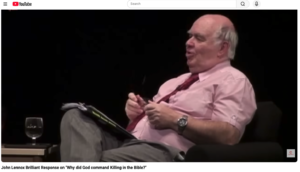
These were unique situations and not necessarily typical, as is evidenced by Deuteronomy 20:10-15.

Bear in mind that these were cities that were targeted and not whole people groups as can be seen by the fact that Uriah, one of David’s mighty men, was a Hittite (2 Sam 11:1-3).

God is both a God of Love, and a God of Law. Mercy is obtained through repentance, just like judgement is a consequence of rebellion.

Moabite were descendants of Moab, the result of an incestuous relationship between Lot and his daughter (Gen 19:36-38). Israel was subject Moab in Judges 3:14. Saul fought against them in 1 Samuel 14:47, and David went to war against them as well in 2 Samuel 8:2.

They were considered to be enemies. Yet, Ruth was a Moabite. She was also David’s great grandmother. Her initial marriage to an Israelite would’ve raised some concerns, given the way Moabites were not allowed into the assembly of the Lord – not even to the tenth generation (Dt 23:3).

But Ruth’s heritage was not as important as her commitment to God (Ruth 1:16), and that made all the difference. She would be referenced in the genealogy of Christ in. Matthew 1:5.

And that’s what makes Ruth’s situation both logical and inspiring. She wasn’t an “exception” to the rule, she was an example of God’s grace and an illustration of how God is both a God of Love and a God of Law.

Conclusion

Luke 13:28 describes hell as a place where there will be weeping and gnashing of teeth. “Gnashing of teeth” can refer to “seething anger.” It’s difficult to imagine someone having been confronted with the Reality and the Greatness of God to still be so indignant, that they would spend eternity despising their Creator and their Redeemer.

It’s not easy to distinguish the kind of unbeliever you’re interacting with in any given moment. Some of them are genuinely curious, others are simply looking for an opportunity to validate themselves by being critical.

You can’t “prove it” beyond a certain point. In the absence of footage and / or face to face interactions with Christ’s contemporaries, we’re limited by space and time to those things that have been documented and what we can discern from the testimony of creation (Rom, 1:20).

Still, the evidence is compelling and we want to be capable of explaining what we believe and why (1 Pet 3:15). While you’re not capable of changing someone’s heart (Jn 6:65), you can nevertheless be an effective witness and, from that standpoint, you can…

…prove it!

1. “Encyclopedia of Bible Difficulties”, Gleason Archer, Zondervan Publishing House, Grand Rapids, MI 1982, p11
2. “Hebrew for Christians”, “Introduction to the Hebrew Calendar”, https://www.hebrew4christians.com/Holidays/Calendar/calendar.html, accessed May 24, 2026
3. “Got Questions”, “Why do we need to confess our sins if they have already been forgiven (1 John 1:9)?”, https://www.gotquestions.org/confession-forgiveness.html, accessed May 24, 2026

Ten Questions Christians Can’t Answer | Part III

7) If you believe the creation account in Genesis is allegorical, they why don’t you treat Paul’s epistles in the same way since he references the creation account in Genesis as historical?
Paul uses the fact of creation throughout his epistles. Here are some examples:

For since the creation of the world God’s invisible qualities—his eternal power and divine nature—have been clearly seen, being understood from what has been made, so that people are without excuse. (Romans 1:20)

By faith we understand that the universe was formed at God’s command, so that what is seen was not made out of what was visible. (Heb 11;3)

Since the person posing the question in this instance isn’t specific about which verses he’s referencing, it’s difficult to know what exactly he’s referring to. Typically, however, the difficulty with the Creation account is whether or not God completed everything in six literal days. Did He create the heavens and the earth in less than a week, or is a “day” nothing more than a literary device describing a timeframe that may have been significantly longer than 24 hours?

Fact is, there’s a great deal of compelling evidence that suggests the earth is not as old as some in the scientific community would have you believe (click here for more reading on that topic). The bottom line is that carbon dating and other traditionally accepted methods of dating fossils etc. are based on the assumption that the observable conditions of the earth have remained unchanged since the very beginning of time. Indeed, the atmospheric conditions were not necessarily the same, which means that carbon dating is not necessarily absolute.

While some calibration can be made in order to accommodate the atmospheric anomalies that may have been present at the time, those kind of distinctions can only be identified by whatever may have been documented. In other words, outside the context of recorded history, you have a very subjective landscape to navigate when it comes to dating articles of antiquity beyond a certain point.

On the other hand, when you compare Genesis 1:27 which says that God created both Adam and Eve on the sixth day, to Genesis 2, it looks like the sixth day either had a great deal of activity packed into the daylight hours, or you have more time built into the term “day.”

Our culture is steeped in the notion that we inhabit a planet that is billions of years old. It’s a convenient thought in that you now have a theoretically comfortable timeframe to accommodate natural selection and the fortuitous evolution of life as we know it. While there is a fascinating amount of research that’s been done in terms of dating the earth according to a purely biblical model, which suggests that the earth is nowhere near as old as the champions of evolutionary theory would have our grade school classrooms believe, for the sake of this conversation the only pertinent Truth that needs to be affirmed is the fact that God did, in fact, create the universe.

However one wants to interpret Genesis and the age of the earth, the priority here, as far as the way in which Paul refers to creation, is to simply reinforce the fact that God was the Creative Force behind the origin of the cosmos and that is not allegory, that is the literal Truth.

8) How many donkeys did Jesus ride in His triumphal entry in Jerusalem? Was it one like Mark, Luke and John say, or was it two donkeys like Matthew says?

Matthew 21:2 says:

saying to them, “Go to the village ahead of you, and at once you will find a donkey tied there, with her colt by her. Untie them and bring them to me.

Mark 11:2, Luke 28:30 and John 12:14-15 only mention one donkey. Jesus wasn’t straddling two donkeys as much as it was Matthew simply mentioning what constituted a complete picture of the prophecy articulated in Zechariah 9:9:

Rejoice greatly, Daughter Zion!  Shout, Daughter Jerusalem! See, your king comes to you, righteous and victorious, lowly and riding on a donkey, on a colt, the foal of a donkey. (Zec 9:9)

Chances are excellent since the foal had never been ridden before, let alone paraded around in front a large and noisy crowd, having the mother lead the foal for the sake of psychological support would’ve been a logical move. Dr. Gleason Archer says as much:

The Zechariah passage does not actually specify that the parent donkey would figure in the triumphal entrance; it simply describes the foal as “the son of a she-ass” by way of poetic parallelism. But Matthew contributes the eyewitness observation (and quite possibly neither Mark nor Luke were eyewitnesses as Matthew was) that the mother actually preceded Jesus in that procession that took Jesus into the Holy City. Here agin, then, there is no real contradiction between the synoptic account but only added detail on the part of Matthew as on who viewed the event while it was happening.1

So, the gospel writers do not conflict with one another as much as Matthew is simply providing more detail.

9) Based on the genealogies for Matthew and Luke, who was Joseph’s father?

Luke follows the genealogy of Mary whereas Matthew follows the genealogy of Joseph. Jesus was the legal descendant of Solomon (Matthew’s genealogy [Joseph]) and a blood relative of Nathan (Luke’s genealogy [Mary]). The confusion is clarified when you take the verbiage of Luke 3:23 into consideration.

Now Jesus himself was about thirty years old when he began his ministry. He was the son, so it was thought, of Joseph, the son of Heli, (Lk 3:23)

Luke is qualifying the list he’s getting ready to enumerate by stating up front that, while it was customary to trace a person’s lineage through the line of the father, the virgin birth represents a special situation. Hence the emphasis on Mary. That fact is further reinforced when you consider the original Greek and notice how Luke doesn’t say that Heil “begat” Joseph. Rather, he was Joseph’s father in law.

Joseph was begotten by Jacob, and was his natural son (Matt 1:16). He could be the legal son of Heli, therefore, only by marriage with Heil’s daughter (Mary) and be reckoned so according to law. It does not say “begat” in the case of Heli.2

10) Was Jesus crucified on the first day of Passover, like the gospel of John says? Or the next day like the other three gospels say?

The confusion stems from John 19:14 where it says:

Now it was the day of preparation for the Passover; it was about the sixth hour. And he *said to the Jews, “Behold, your King!”  (Jn 19:14 [NASB][emphasis added]) 

Matthew 27:62-63 says:

The next day, the one after Preparation Day, the chief priests and the Pharisees went to Pilate. “Sir, ” they said, “we remember that while he was still alive that deceiver said, ‘After three days I will rise again.’ (Matt 27:62-63)

Mark 15:42-43 says:

It was Preparation Day (that is, the day before the Sabbath). So as evening approached, Joseph of Arimathea, a prominent member of the Council, who was himself waiting for the kingdom of God, went boldly to Pilate and asked for Jesus’ body. (Mark 15:42-43)

Luke refers to the day that Jesus died in the 24th chapter when he says:

It was Preparation Day, and the Sabbath was about to begin. (Lk 23:54)

“Preparation Day” was the day before the Sabbath, which was a Saturday. The Feast of Unleavened Bread was often  referred to as “Passover” because of the way the Passover meal served as the opening ceremony for the Feast.3 So, when John uses the term “day of preparation for the Passover,” he’s not referring to the day before the Passover meal, he’s referring to the day before the Sabbath of Passover week (Feast of Unleavened Bread). The NCV rendering of the verse makes that fact more evident:

14It was about noon on Preparation Day of Passover week. Pilate said to the crowd, “Here is your king!” (Jn 19:14 [NCV][emphasis added])

In addition, John uses the Greek word “paraskeue” to define the day, which by that point was a technical term that referred to the “day of preparation” for the Sabbath.4 Remember, the Sabbath for the Jew is Saturday and not Sunday. Sunday would later be embraced as the “Lord’s Day” in that it was the day Jesus rose from the grave. So, given everything we’ve now considered, John’s account is consistent with all of the other gospel writers. Jesus was crucified on a Friday and the Last Supper happened on the evening before which was Thursday.

Conclusion

G.K. Chesterton once said, “Christianity has not been tried and found wanting; it has been found difficult and not tried.” Many of the critics that circulate their jabs at Christianity on the internet occupy a philosophical position that refuses to concede the Reality of a Power and an Intellect that they cannot understand and / or agree with.  Their attacks are necessary in order to maintain a distance between themselves and a worshipful demeanor which they refuse to buy into. They have found it “difficult” and decided to deny its substance. It’s healthy to be able to respond to questions and attacks, but the nature of these kind of conversations goes beyond a mere intellectual exchange. It is a spiritual contest that has to be engaged in a way that’s consistent with Scripture:

The weapons we fight with are not the weapons of the world. On the contrary, they have divine power to demolish strongholds. (2 Cor 10:4)

Know what you believe and why you believe it. Pop the hood on the Word of God and be capable of defending it (1 Pet 3:15). And remember too, that oftentimes there’s a bigger picture that you want to expose. Squabbling over the number and the identity of the women who were at the tomb on the morning of Christ’s resurrection is subordinate to the fact that the tomb was empty. Arguing over the amount of time it took for God to create the heavens and the earth is secondary to the fact that God did, in fact, create the heavens and the earth. Dismissing the whole of Scripture because Matthew references both the donkey and its foal, whereas the other gospel writers mention only the foal, is like arguing over whether or not someone paid a ten dollar invoice using exact change or a twenty dollar bill.

The fact is, the debt was paid.

The details of Scripture are important, but you don’t ever want to become so absorbed in the minutia of the gospel that you overlook the fact that there’s a tomb out there that was occupied at one point that is now empty. And that empty grave is the Signature of One Who didn’t claim to be a mere messenger of God, but God Incarnate.

There will always be a critic and there will always be a situation where, regardless of how sound your reasoning may be, the spiritual elements that are involved will always see to it that “revelation” will remain seemingly inconsistent with logic (1 Cor 2:12). That’s not a cue to be less than compelling with your argument. But it’s not an argument that will influence a soul, it’s only the Power and the grace of God that makes the difference (John 6:65; 1 Cor 1:18).

Again, you don’t want to hide behind a “faith based perspective” that comes across as a decision made despite the facts, but rather as a decision made in light of the facts. Be ready to either answer the question being posed, or be ready to direct them to the myriad of resources that provide the science and the literary tools that address their quandary. But be sensitive to the fact that the moment the Name of Jesus is spoken, you’re no longer contending with purely academic themes. The parameters have been expanded and the stakes have been dramatically increased. You can be as compelling and as accurate as you want and still be found wanting. Not because of the substance of your argument, but because of the implications represented by your argument.

Should God be perceived as credible, it’s no longer a debate. Now it’s a soul-altering encounter and the forces referenced in Ephesians 6:12 will do everything they can to prevent that kind of dynamic.

So, be ready, but be wise and not just smart. It’s the Power of God in you that makes the difference and ensures that the outcome of your exchange is not just a willingness to agree with what’s in the Bible, but a desire to submit to the One Who authored it.

1. “Encyclopedia of Bible Difficulties”, Zondervan Publishing House, Grand Rapids, MI 1982, p334
2. “The Companion Bible”, E.W. Bullinger, http://www.heavendwellers.com/38%20Luke%201427-1509.pdf, accessed on May 19, 2015
3. Feast of Unleavened Bread..Passover. “Passover” was used in two different different ways: (1) a specific meal begun at twilight on the 14th of Nisan (Lev 23:4-5), and (2) the week following the Passover meal (Eze 45:21), otherwise know as the Feast of Unleavened Bread, a week in which no leaven was allowed (Ex 12:15-20; 13:3-7). By NT times the two names for  the week-long festival were vitally interchangeable. (NIV Text Note: “NIV Study Bible”, Zondervan Publishing House, Grand Rapids, MI, 1985, p1582)
4. “Encyclopedia of Bible Difficulties”, Zondervan Publishing House, Grand Rapids, MI 1982, p375

Ten Questions Christians Can’t Answer | Part II

This is Part II of “Ten Questions Christians Can’t Answer” – a response to a video on youtube that suggests that the questions being posed can’t be adequately responded to by believers. What follows demonstrates that such is not the case.

Here we go…!

6) When Jesus rose for the grave, how many women went to the tomb and which ones?

The gospel writers reference several women, both at the tomb as well as at the foot of the cross. Matthew 27:55 says that there were “many women” standing at a distance from the cross as Jesus was dying. Luke doesn’t ever name any of the women, he just refers to them as “the women” (Lk 23:49, 55). And with the exception of Mary Magdalene, Matthew, Mark and John reference either different women or use different descriptions to identify those who were there.

If Matthew’s “mother of James and Joses” is John’s “wife of Clopas” and the woman John describes as “Mary’s sister” is the woman Mark calls “Salome,” you’ve got a total of four women and it looks like this:

 The Women at the Cross (each color represents one particular woman that’s described differently by the gospel writers)
verse Mary (Jesus’ mother) Mary Magdalene Mary, wife of Clopas Mary, mother of James and Joses Mary’s sister mother of Zebedee’s sons Salome
Matt 27:56
Mk 15:40
Jn 19:25

While you have four different accounts, at no time does Matthew or John state that the women they reference were the only ones present, they simply chose to acknowledge a particular person or persons. Same thing with Mark. He only lists three, but he doesn’t qualify his trio to the point where he rules out the possible presence of other women.

Bottom line is we don’t know for certain who all was there, all we can do is connect the dots as they appear in Scripture. We can be confident that Mary’s mother was there along with Mary Magdalene. As far as the other two Mary’s and Salome, all we do is speculate as to whether or not the wife of Clopas was the mother of James and Joses and Salome was Mary’s sister.

You’ve got the same kind of dynamic at the empty tomb. Again, Luke refers to them as “the women” (Lk 24:1). Matthew, Mark and John again highlight certain personalities that were present:

 The Women at the Empty Tomb
verse Mary Magdalene Mary, the mother of James the other Mary Salome
Matt 28:1
Mk 16:1
Jn 20:1

Thanks to having looked at the way the same writers referred to “the women” at the foot of the cross, it’s not unreasonable to speculate that Matthew’s “other Mary” is the woman he described as “Mary, the mother of James and Joses” in chapter 27. That means that he and Mark are probably referring to the same woman in their respective accounts, as far as the “other Mary.” Matthew doesn’t mention Salome and John only references Mary Magdalene. So, of “the women” that were present, we know of three for certain, although there might’ve been others. Mary Magdalene is a definite as well as “the other Mary” and another woman named Salome.

Over the years, several great minds have tried to more specifically identify the players that were present. Again, we’re looking at a situation where the Bible doesn’t clarify things as well as we might like, but there are two things we want to avoid in these kinds of situations:

#1 – fail to appreciate the big picture
#2 – attempt to edit Scripture in order to manufacture a scenario that’s easier to process

Dr. James D Tabor does a great job of presenting a case for Mary, the wife of Clopas, to being the mother of Jesus based on the fact that Joseph, Jesus’ father, is conspicuously absent from the New Testament shortly after his having brought his young family back to Nazareth from Egypt (Matt 2:19-23). It would’ve been customary for the brother of the deceased husband to marry the widow based on Jewish law. When you couple that with the fact that Clopas was the father of James and Joses and Jesus had two brothers named James and Joses, it becomes fairly obvious that Mary, the mother of Jesus and Mary, the mother of James and Joses (wife of Clopas) are actually the same person. Should that prove to be accurate, the women at the tomb, based on Dr. Tabor’s theory and a comprehensive snapshot of Scripture would be:

  • Mary Magdalene
  • Mary – the mother of Jesus, James and Joses
  • Salome

That sounds downright compelling right up to the point where he suggests that the book of John has been edited.1 Regardless of how “logical” a particular explanation may be, if it involves having to change the content of the Bible in order for it to work, at that point the Bible is no longer inerrant and you no longer have the Word of God, rather  you have a flawed text.

Granted, what we have with the gospel writers is not conclusive in terms of the women that were there at the empty tomb. It’s not that they contradict one another as much as their decision to reference certain women in lieu of others results in a list of characters that’s speculative. But it’s not who was at the tomb, it was the fact that no one was in the tomb – that’s the point the gospel writers are making.

It could very well be that there was a whole congregation of women at the tomb which would mean that neither Matthew nor Mark nor John chose to document everyone that was present. But that doesn’t mean that their respective accounts are contradictory, nor should it distract from the fact that Christ had risen from the grave.

So, the short answer to our critic’s question is three, based on what we have in Scripture coupled with some speculation. But in the end, the emphasis should not be on who was not AT the tomb, rather the issue is Who was not IN the tomb!

Click here to read Part III!

1. “Something seems to be going on here. John knows something that either he, or those who later edited his gospel, chose to veil.” This is a portion of the post made by Dr. James D. Tabor entitled “Sorting Out the Jesus Family: Mother, Fathers, Brothers and Sisters at http://jamestabor.com/2012/12/27/sorting-out-the-jesus-family-mother-fathers-brothers-sisters/, accessed May 31, 2015

Ten Questions Christians Can’t Answer | Part I

Popping the Hood on Scripture

The critic bangs his hand on the desk and insists that unless he can break down the Word of God to the point where it can fit comfortably within the boundaries of his intellectual preferences, his skepticism will remain intact and the condescending tone he uses when he addresses believers in Christ will also remain decidedly sarcastic.

When confronted with a situation in Scripture that doesn’t make sense, the believer responds as a diligent student does when they are challenged by something in the classroom they don’t understand. They don’t accuse the professor as being flawed, nor do they doubt the integrity of the curriculum. Rather, they proceed as someone who needs to learn as opposed to someone who wants to critique. It’s the philosophical starting point that distinguishes the cynic from his Christian counterpart. The atheist needs to keep the Reality of God at an arm’s distance and therefore keeps the curtains drawn in order to maintain the illusion that man’s ability to reason is subordinate to the One Who gave him that ability to begin with. The Christ-follower, on the other hand, recognizes the limitations of the human perspective and, in the face of something seemingly illogical, labors to understand in the light of God’s Identity and Authority.

Still, you can’t simply say “If the Bible says it, then I believe it” and not come across as academically anemic. The passages cited by critics as evidence that the Bible is less than credible, can be resolved, you just have to be willing to pop the hood on Scripture and do some digging.

Dr Gleason Archer
The problems and questions dealt with in this volume have been directed to me during the past thirty years of teaching on the graduate seminary level in the field of biblical criticism.As an undergraduate at Harvard, I was fascinated by apologetics and biblical evidences; so I labored to obtain a knowledge of the languages and cultures that have any bearing on biblical scholarship. As a classics major in college, I received training in Latin and Greek, also in French and German. At seminary I majored in Hebrew, Aramaic, and Arabic; and in post-graduate years I became involved in Syriac and Akkadian, to the extent of teaching elective courses in each of these subjects. Earlier, during my final two years of high school, I had acquired a special interest in Middle Kingdom Egyptian studies, which was furthered as I later taught courses in this field. At the Oriental Institute in Chicago, I did specialized study in Eighteenth Dynasty historical records and also studied Coptic and Sumuerian.Combined with this work in ancient languages was a full course of training at law school, after which I was admitted to the Massachusetts Bar in 1939. This gave me a thorough grounding in the field of legal evidences. Additionally, I spent three years in Beruit, Lebanon, in specialized study of modern literary Arabic. This was followed by a month in the Holy Land, where I visited most of the important archaeological sites.1

Dr. Gleason Archer (see call out to the right) says as much in the preface to his book “Encyclopedia of Bible Difficulties.”

As I have dealt with one apparent discrepancy after another and have studied the alleged contradictions between the biblical record and the evidence of linguistics, archaeology, or science, my confidence in the trustworthiness of Scripture has been repeatedly verified and strengthened by the discovery that almost every problem in Scripture that has ever been discovered by man, from ancient times until now, has been dealt with in a completely satisfactory manner by the biblical text itself – or else by objective archaeological information.2

And when it comes to one’s approach to apparent discrepancies in Scripture, he says:

Be fully prepared in your own mind that an adequate explanation exists, even though you have not yet found it. The aerodynamic engineer may not understand how a bumble bee can fly; yet he trusts that there must be an adequate explanation for its fine performance since, as a matter of fact, it does fly! Even so we may have complete confidence that the divine Author preserved the human author of each book of the Bible from error or mistake as he wrote down the original manuscript of the sacred text.3

At the end of the day, it’s not just what the Bible says, it’s what the Bible is. That’s what makes this exchange both significant and distinctive. We’re not merely gauging the authenticity of an ancient text. The question on the table is whether or not God exists and is the Word of God, in fact, His Message to us?

Or, is it merely a religious comic book without the pictures?

The critic needs it to be the latter in order for their worldview to remain intact. But however fortified their defenses may be – regardless of the rapid abundance that characterizes their rhetoric – their stance needs to be countered with something compelling and in a way that points them to the Truth (Jn 14:6).

The following ten questions are posed in a video on youtube entitled Ten Questions Christians Can’t Answer.” The questions are not the sort that break new ground as far as Bible difficulties are concerned and like the objections that have been raised in the past, there are rebuttals and explanations, it’s just a matter of referencing books like Dr Gleason’s “Encyclopedia” or any one of a number of other similar resources, not to mention Scripture itself.

The final frame of the video states that the “silence is deafening.” We want to make sure we can break that silence with something that not only addresses the questions, but more importantly provides an approach to God and the Message of that gospel that’s intellectually sound – unobstructed by questions that seemingly have no answer. In that way, it’s not only their intellect that’s satisfied, it’s their soul as well.

Here we go…

1) When Noah’s ark landed, how did the Kangaroos make it back to Australia?

There’s an article you can access by clicking here that elaborates on a time when the continents as we know them today were actually one solid land mass. That would give both animals and people the ability to migrate without having to contend with the insurmountable obstacle of an ocean between them and where they would ultimately make their home.

2) If the ark was covered in pitch, it also made it air tight. How did they survive for 40 days and 40 nights since Noah couldn’t open the window?

Probably because the areas that were covered in pitch were those that came in direct contact with the water as opposed to the airtight coffin you interpret the ark to be.

3) Why were Adam and Eve punished for eating from the Tree of the Knowledge of Good and Evil when they didn’t / couldn’t understand what they were doing?

They did understand what they were doing in that they had been told not to eat from that particular tree (Gen 2:17).

4) Why would God place the Tree of the Knowledge of Good and Evil so close to His innocent creation, then allow Satan to tempt them and all the while stand back and do nothing?

Love and obedience go hand in hand (Jn 14:21) and love isn’t love unless its voluntary. In the absence of a choice, you don’t have love as much as you have a calculated reaction.

Dr Ravi Zacharias explains it this way:

What would it take to create a loving world void of evil? A world in which love is capable of meaningful expression and experience would also imply a world in which there is choice. If someone tells you that they love you, those words mean something because they are freely given. If you learned that someone had told you they loved you but that they had been forced to say it, their words would not mean very much. Thus, if we want to speak of a loving world, we must also speak of a world in which choices are exercised. And in such a world, there is also the possibility of choosing a course of action that is not loving, i.e. evil.

5) When the women went to Jesus’ empty tomb, was the stone already rolled away, or did an angel roll it away after the women got there?

When looking at the four gospel accounts, Matthew 28:2 is worded in a way that’s distinct from Mark 16:1-5, Luke 24:1-2 and John 20:1. Matthew reports the scene of the empty tomb in a manner that makes it sound as though the stone was rolled away upon the arrival of the women that had come to care for Jesus’ body as opposed to it happening prior to their arrival. The NIV Text Note elaborates on the Greek verbiage used in the text as being past tense so there’s no inconsistency between the four accounts, even though there might appear to be.4 See also James 1:13.

To continue on to Part II, click here.

1. “Encyclopedia of Bible Difficulties”, Zondervan Publishing House, Grand Rapids, MI 1982, p11
2. Ibid, p12
3. Ibid, p14
4. There was. The sense is “Now there had been.” It is clear from the parallel accounts (Mk 16:2-6; Lk 24:1-7; Jn 20:1) that the events of vv. 2-4 occurred before the women actually arrived at the tomb (NIV Text Note on Matthew 28:2) NIV Study Bible, Zondervan Publishing House, Grand Rapids, MI 1985. p1489

Prove It! | Part V: Science and History

This is Part V of a 6 part series where we’re looking to “prove it!” We’re rehearsing some of the evidence that validates the authenticity of the Christian doctrine.

In this installment, we’re looking at the fingerprint of God as it shows up in Science and History.

Science

When you ponder the Reality of God in the context of creation, the most obvious indicator of His involvement is the elegant intricacy of the universe.

While there are any one of a number of examples that demonstrate the complex nature of the cosmos (see sidebar), let’s consider some of the more compelling anomalies that leave a person both awestruck and inspired.

Cosmological Constant

The cosmological constant is a mathematical value assigned to what astronomers call “dark energy.” When you look at the universe, you see things moving in a way that doesn’t make sense in that they’re things are being pushed and pulled around despite the fact that there is nothing around them. In other words, when you see a moon orbiting a planet, that makes sense because the planet has a gravitational pull that maintains that moon’s trajectory. But there are objects in space that are moving as though they’re being influenced by a gravitational force, yet there’s nothing visible to provide that force. Hence the term “dark energy” was coined to describe the obvious force being exerted upon these objects by seemingly invisible entities.

Where Did God Come From?

Dr. Kent Hovind is an educator and apologist who is known for being both articulate and compelling when it comes to a biblical explanation for the universe.

In a debate with Reinhold Schlieter of the Embry Riddle Aeronautical University, Hovind was asked, “Where does God come from?” Here’s his response:

Your question, where does God come from assumes that you are thinking, obviously displays, that you are thinking of the wrong god. Because the God of the Bible is not affected by time, space or matter. If He is affected by time, space or matter, He is not God. Time, space and matter, what we call a continuum, would have to come into existence at the same instance. Because if you had matter and no space, where would you put i? If there was matter and space but no time, when would you put it? You cannot have time, space or matter independently, they have to come into existence simultaneously.

The Bible answers that in 10 words: In the beginning, (there’s time), God created the heavens (there’s space), and the earth (there’s matter). So you have time, space, matter, the trinity of trinities: Time – has past, present, future. Space – has breadth, length , height. Matter has solid, liquid, gas. We have a trinity of trinities created instantaneously, and the God who created them has to be outside of them.

If He is limited by time, He is not God. The God who created this computer is not in the computer. He is not running around changing the numbers on the screen. The God who created this universe is outside the universe. He is above it, beyond it, in it, He is not affected by it.

So [if you have] the concept that a spiritual force cannot have an effect on a material body, then you have to explain to me why there are emotions, and love, and hatred, and envy, and jealousy and rationality – I mean, if your brain is a collection of chemicals formed by chance over billions of years, how on earth can you trust your own reasoning process and the thoughts that you think?

Your question, where does God come from, is assuming a limited God. And that is your problem. The God that I worship is not limited by time, space or matter. If I could fit the infinite God into my 3-pound brain, He would not be worthy worshiping, that is for certain. So, that is the God I worship.

Fact is, this dark energy accounts for over 70% of our universe. And what makes that significant is that if this dark energy was characterized by a gravitational dynamic that was pulling everything in, then the universe would ultimately collapse on itself and life in general would cease to exist. If, on the other hand, this dark energy wielded a gravitational force that was too weak to temper the way in which our universe is expanding, then our solar system would unravel as would the entire cosmos.

This, then, is the cosmological constant: The value assigned to this force that continues to allow the universe to expand and therefore not collapse on itself, yet not spin out of control.

Initially, astronomers believed that the cosmological constant was very large. After all, you’re going to need a big broom to move planets around. But that is not the case. The cosmological constant is actually very small.

How small?

One part in a hundred million billion billion billion billion billion. That’s a ten followed by fifty three zeroes. Contemplate the precision of that number. And if you move the dial or change the settings in even the most incremental way, the end result is something that no longer sustains life because of the way the universe would either collapse or unravel.1

Water

Water is one of the few known substances that are less dense as a solid than as a liquid. This is significant because if it wasn’t all aquatic life would by crushed beneath the weight of the ice that would form in the winter.

Here again you see something that is far too intentional to be written off as a lucky accident. In other words, the intent and design of a Creator.

Cambrian Explosion / Fossils

The Cambrian Explosion refers to a layer of rock where you find a sudden abundance of fossils. In other words, you don’t seem to have much life in layers of rock further down, like Evolution would like to suggest. Evolutionary theory proposes a lengthy process where simpler life forms became more complex over time. That geological record doesn’t exist. Instead, you have an abrupt presence of life with no apparent precursor.

Evolution can’t explain this, but a global flood can.

If logic is the theme of our discussion, then it would “logical” to go with what represents the most obvious explanation, which would be a worldwide catastrophe that instantly destroyed and buried multitudes of organisms instantaneously.

For more reading about Creation and the Theory of Evolution, refer to the articles listed to the right.

History

Jesus isn’t just a religious figurehead. There was a point where you could’ve shaken His Hand.

Max Lucado in his book, “When God Came Near” does a great job of capturing the “feeling” that you might’ve experienced interacting with Jesus, knowing Who He was by listing a series of questions for Mary…

When God Came Near

1. What was it like watching him pray?

2. How did he respond when he saw other kids giggling during the service at the synagogue?

3. When he saw a rainbow, did he ever mention a flood?

4. Did you ever feel awkward teaching him how he created the world?

5. When he saw a lamb being led to the slaughter, did he act differently?

6. Did you ever see him with a distant look on his face as if he were listening to someone you couldn’t hear?

7. How did he act at funerals?

8. Did the thought ever occur to you that the God to whom you were praying was asleep under your own roof?

9. Did you ever try to count the stars with him….and succeed?

10. Did he ever come home with a black eye?

11. How did he act when he got his first haircut?

12. Did he have any friend by the name of Judas?

13. Did he do well in school?

14. Did you ever scold him?

15. Did he ever have to ask a question about Scripture?

16. What do you think he thought when he saw a prostitute offering to the highest bidder the body he made?

17. Did he ever get angry when someone was dishonest with him?

18. Did you ever catch him pensively looking at the flesh on his own arm while holding a clod of dirt?

19. Did he ever wake up afraid?

20. Who was his best friend?

21. When someone referred to Satan, how did he act?

22. Did you ever accidentally call him Father?

23. What did he and his cousin John talk about as kids?

24. Did his brothers and sisters understand what was happening?

25. Did you ever think, That’s God eating my soup?

Archaeology offers a powerful testament to the historical integrity of Scripture. Nelson Glueck, the renowned Jewish archaeologist, wrote: “It may be stated categorically that no archaeological discovery has ever controverted a biblical reference.” He continued his assertion of “the almost incredibly accurate historical memory of the Bible, and particularly so when it is fortified by archaeological fact.”

Here are some examples:

Scripture and Archaeology

Sergius Paulus Inscriptions

In Acts 13, we read of how Saul and Barnabas set off on a missionary journey to the Island of Cyprus. Upon arriving at Paphos, they meet the proconsul, Sergius Paulus, leading him to faith in Christ. Luke describes him as “a man of intelligence” (Acts 13:7). This is true as Sergius Paulus was also a first-century author and is one of the authorities referenced by Pliny the Elder in his classic, Naturalis Historia.Numerous inscriptions have been discovered that may refer to Sergius Paulus; the Sergii Paulii’s seem to have bene a prominent family in the Roman Empire. In 1877, an inscription was discovered at Soli, not far from Paphos that references, “the proconsul Paulus.” Another inscription from Rome, dating to the mid-40’s, names Lucius Sergius Paulus as one of the curators of the Tiber River under the Emperor Claudius. Finally, numerous inscriptions, most famous of which names a “L. Sergius Paulus” have been discovered near Pisidian Antioch. (Bible Archaeology Report)

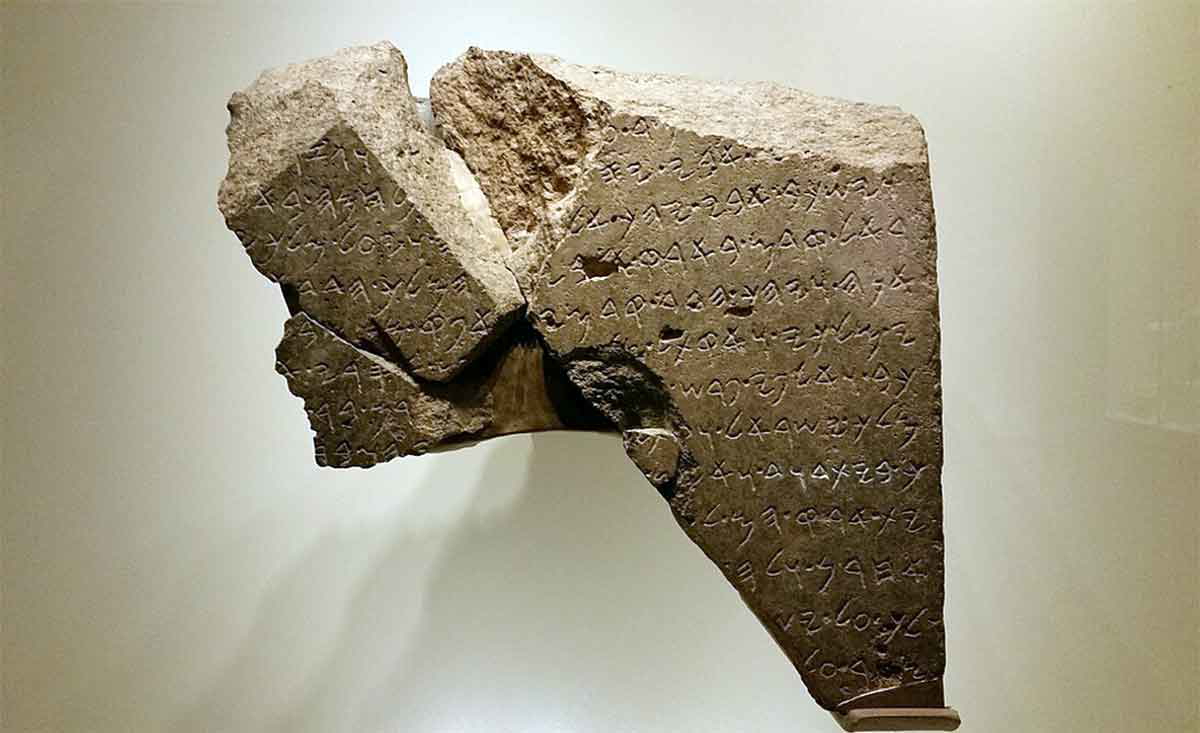
The Tel Dan Inscription

The lack of reference to King David in the historical record once gave rise to the idea that no such king existed, or that he was merely a local, tribal chieftain of no real significance. The Tel Dan Inscription, discovered in 1993–94 during excavations at Tel Dan in northern Israel, proved the contrary. The inscription consists of several fragments of an Aramaic victory stele erected by an Aramean king, most likely Hazael or his son Bar-Hadad II.

The inscription references the “House of David,” which scholars believe refers to the dynasty of King David from the Bible. This inscription is the first extra-biblical mention of King David. The term “House of David” indicates that he was the first of a line of kings, which confirms the biblical account of the reign of David, his son, grandson, and so forth.

The Tel Dan Inscription dates to the 9th century BCE and aligns with biblical accounts of geopolitical conflicts and Israel’s interactions with neighboring nations during the same period. The inscription also refers to the House of Israel, further supporting the Bible narrative. (The Collector)

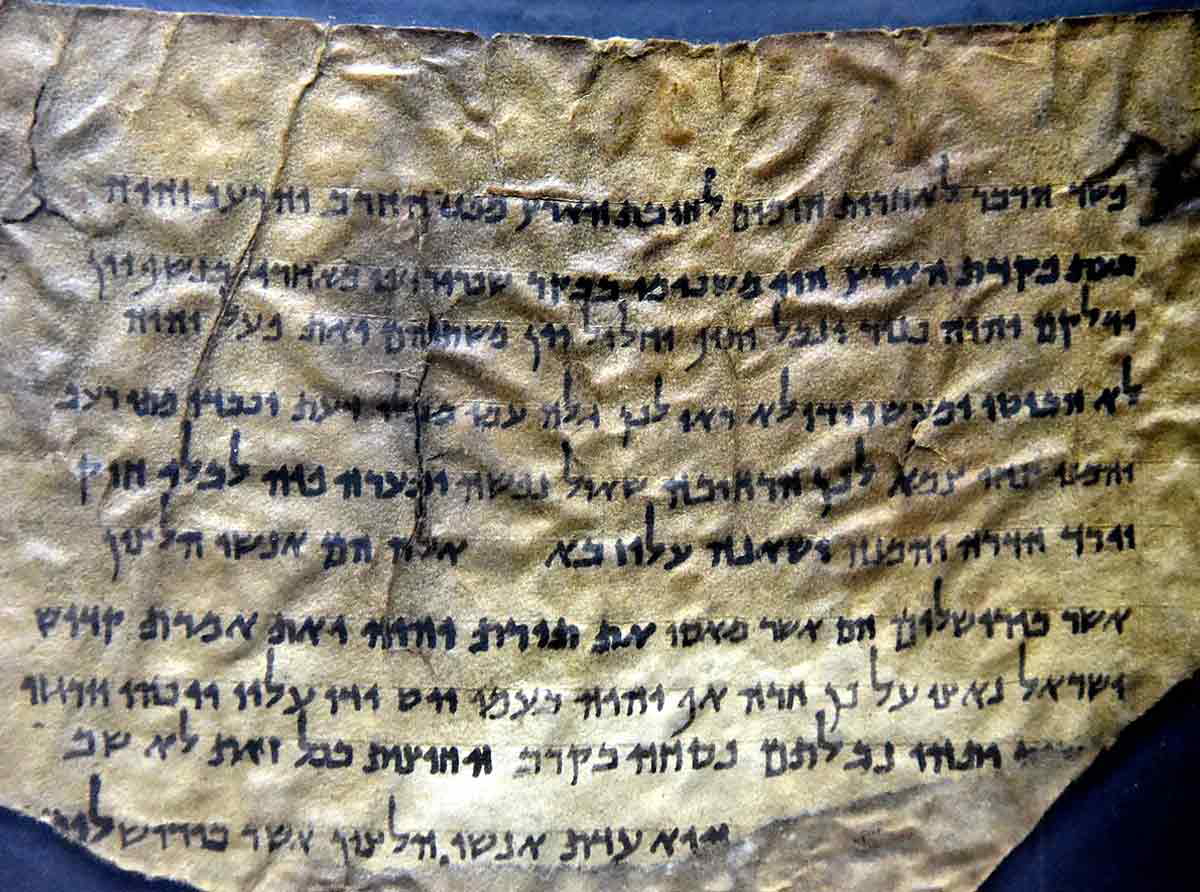
The Dead Sea Scrolls

The Dead Sea Scrolls found at Qumran in 1947 contain fragments of every book in the Old Testament except for the Book of Esther. Some of these manuscripts date to the third century BCE. What is significant about this discovery is that it proves how little manuscripts have changed since the time of Christ. The narrative that changes, omissions, and additions over time had a corrupting effect on the Bible manuscripts, was proven incorrect. (The Collector)

Shishak’s Invasion

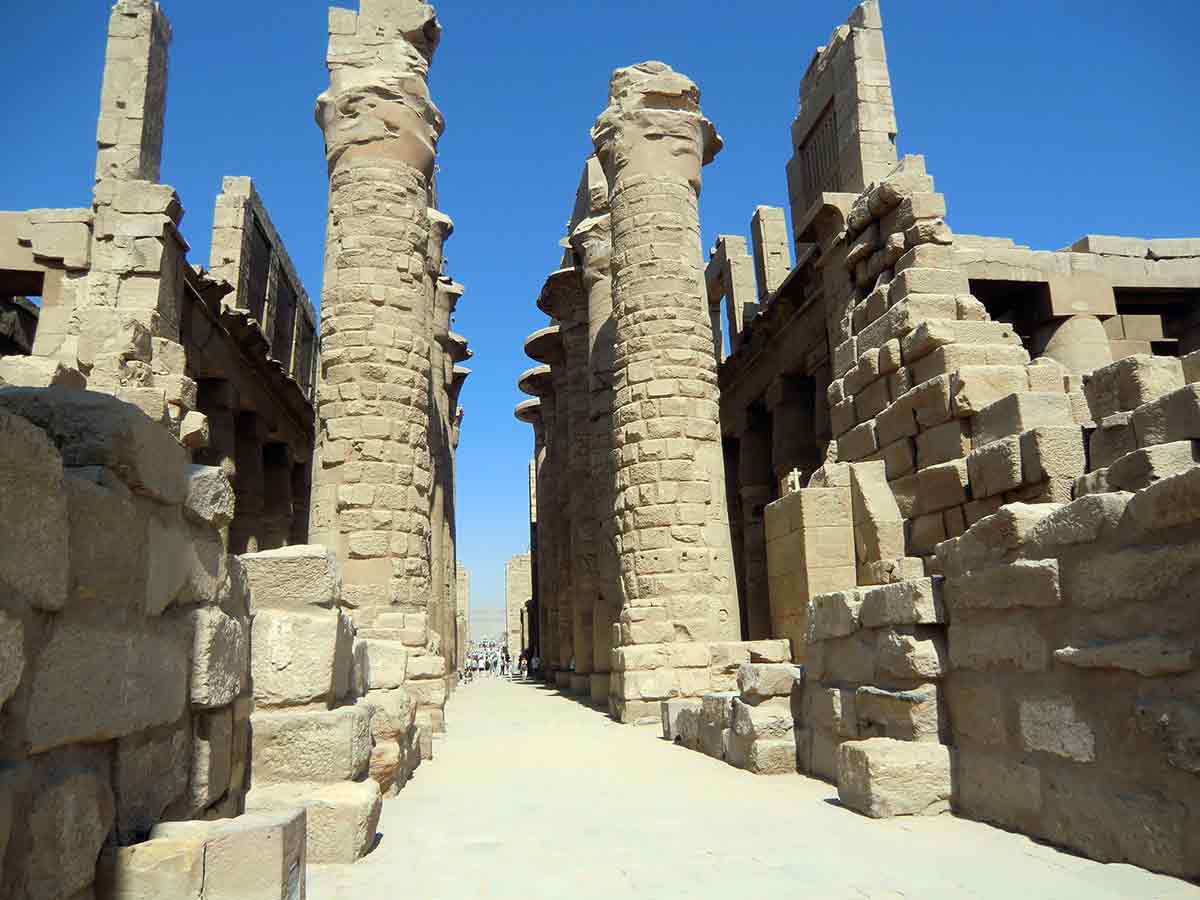
The Bible mentions the Egyptian king Shishak invading Judah and plundering the Temple in 1 Kings 14:25-26 and 2 Chronicles 12:2-9. Some inscriptions and reliefs in Egypt, particularly at Karnak Temple in Thebes (Luxor), provide corroborating evidence of the military campaign by Shishak into Judah and neighboring areas. The place names correlate with Biblical names and places, confirming the narrative.

The list of the spoils of war brought back to Karnak Temple corroborates the biblical account of the seizure of wealth from the Temple by Shishak. This archaeological evidence validates the historical accuracy of the biblical description of Shishak’s actions during his campaign against Judah. (The Collector)

Caiaphas Ossuary

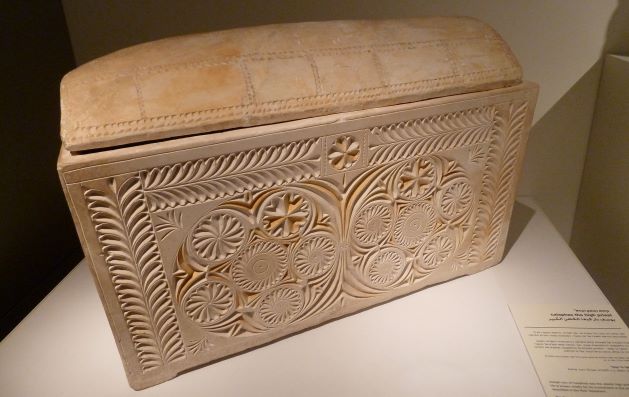
In 1990, a construction team was building a water park near Jerusalem when their bulldozer plowed through a the roof of a first-century tomb. Archaeologists were called in and discovered a variety of ossuaries (bone boxes used in the first-century), including an ornate one that was inscribed with the name “Joseph son of Caiaphas.” Inside were the bones six people, including those of a 60-year old man which scholars believe are the remains of Caiaphas himself.

Caiaphas was the high priest who presided over the trial of Jesus according to the gospels (Mt 26:3, 57; Lk 3:2; Jn 11:49). The ancient historian, Josephus, records that Caiaphas’s full name was Joseph Caiaphas and that he held this role from AD 18-36 (Jewish Antiquities, 18:35 & 18:95). It appears that he was widely known by his surname/family name, Caiaphas, in the same way that many of the sons of Herod were simply known as Herod (ie. Herod Antipas, Herod Archelaus, etc).

Many scholars are convinced that this is the ossuary of the high priest who played a prominent role in the trial of Jesus. His ossuary and physical remains provide archaeological evidence confirming the existence of a prominent person in the New Testament. The Caiaphas ossuary is currently on display in the Israel Museum in Jerusalem. (Bible Archaeology Report)

Ruins in the City of Jericho

Archaeological discoveries in Jericho support the Bible’s story about the destruction and burning of the city. Excavations at Jericho have revealed evidence of a fortified city with massive walls dating to the Late Bronze Age (around 1550–1200 BCE). These dates correspond to the biblical time frame of the Israelite conquest. Archaeologists have identified layers of destruction within the city’s ruins, indicating that Jericho experienced violent destruction around the time traditionally associated with Joshua’s conquest.

Archaeological findings suggest that the city’s walls did collapse outward, matching the description in Joshua 6:20: “The wall collapsed, so that every man charged straight in, and they took the city.” This collapse aligns with the biblical account of the Israelites’ marching around the city, sounding trumpets and shouting. In addition, evidence of extensive burning within the city is consistent with the biblical narrative that the Israelites burned Jericho after its conquest (Joshua 6:24).

Following its destruction, Jericho remained uninhabited for several centuries, as evidenced by the absence of significant occupation layers in the archaeological record. This matches the biblical account, which describes Jericho as being placed under a curse, with Joshua declaring, “Cursed before the Lord be the man who rises up and rebuilds this city, Jericho” (Joshua 6:26).(The Collector)

Pool of Siloam

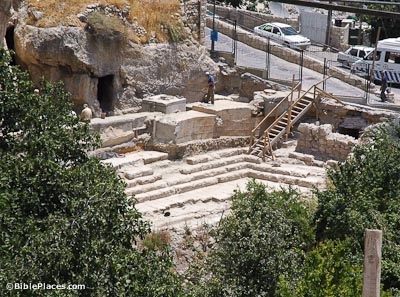
In John 9, Jesus heals a blind many by making a mud poultice and applying it to his eyes, and then telling him to go and wash in the Pool of Siloam. Visitors to Jerusalem have long visited a 5th-century Byzantine “Pool of Siloam” that had been built by Empress Eudocia to commemorate this miracle. The Byzantine pool is at the end of Hezekiah’s Tunnel, the aqueduct that brings water from the Gihon Spring into the city. The exact location of the Pool of Siloam of Jesus’ day remained a mystery until its discovery in 2004.

In the summer of that year, repairs were being made to a drainage system when two ancient steps were uncovered. Archaeologists were called in and when the excavations were complete, a large pool was uncovered. In all at least 20 steps leading down from the street level into the pool were revealed. Pottery from one end of the pool was used to date it to the First-Century AD, while at the southern end, a large wall and section of the pool dating to the Old Testament period was discovered.

Given that it was in the exact location that scholars had long believed the actual Pool of Siloam to be – only 70 meters from the Byzantine pool – and that it dated to the time of Jesus, it was identified as the actual Pool of Siloam where the blind man had washed to receive healing. (Bible Archaeology Report)

Conclusion

Dr. James Allan Francis penned the following words which very effectively sum up the life of Christ…

“Here is a man who was born in an obscure village, the child of a peasant woman. He grew up in another village. He worked in a carpenter shop until He was thirty. Then for three years He was an itinerant preacher.

“He never owned a home. He never wrote a book. He never held an office. He never had a family. He never went to college. He never put His foot inside a big city. He never traveled two hundred miles from the place He was born. He never did one of the things that usually accompany greatness. He had no credentials but Himself. . . .

“While still a young man, the tide of popular opinion turned against Him. His friends ran away. One of them denied Him. He was turned over to His enemies. He went through the mockery of a trial. He was nailed upon a cross between two thieves. While He was dying His executioners gambled for the only piece of property He had on earth—His coat. When He was dead, He was laid in a borrowed grave through the pity of a friend.

“Nineteen long centuries have come and gone, and today He is a centerpiece of the human race and leader of the column of progress.

“I am far within the mark when I say that all the armies that ever marched, all the navies that were ever built; all the parliaments that ever sat and all the kings that ever reigned, put together, have not affected the life of man upon this earth as powerfully as has that one solitary life.”2

Wilbur Smith, a respected Bible scholar, once wrote, “The latest edition of the Encyclopedia Britannica gives twenty thousand words to this person, Jesus, and does not even hint that He did not exist—more words, by the way, than are given to Aristotle, Alexander, Cicero, Julius Caesar, or Napoleon Bonaparte.”3

George Buttrick, recognized as one of the ten greatest preachers of the twentieth century, wrote: “Jesus gave history a new beginning. In every land he is at home. . . . His birthday is kept across the world. His death-day set a gallows against every skyline.”4

Even Napoleon himself admitted, “I know men and I tell you that Jesus Christ was not a man. Superficial minds see a resemblance between Christ and the founders of empires, and the gods of other religions. That resemblance does not exist. There is between Christianity and whatever other religions the distance of infinity…

“Everything in Christ astonishes me, His spirit overawes me, and His will confounds me. Between Him and whoever else in the world, there is no possible term of comparison. He is truly a being by Himself. His ideas and sentiments, the truth which He announces, His manner of convincing, are not explained either by human organization or by the nature of things…

“The nearer I approach, the more carefully I examine, everything is above me everything remains grand, of a grandeur which overpowers. His religion is a revelation from an intelligence which certainly is not that of man…

“One can absolutely find nowhere, but in Him alone, the imitation or the example of His life…

“I search in vain in history to find the similar to Jesus Christ, or anything which can approach the gospel. Neither history, nor humanity, nor the ages, nor nature, offer me anything with which I am able to compare it or to explain it. Here everything is extraordinary. “5

There is almost an element of bravado when you look at some of what Paul wrote when he talked about that which validates the authenticity of Christianity when he said in Romans:

For since the creation of the world God’s invisible qualities—his eternal power and divine nature—have been clearly seen, being understood from what has been made, so that people are without excuse. (Rom 1:20)

He said that if Christ hadn’t rose, than Christians are to be pitied…

For if the dead are not raised, then Christ has not been raised either. 17 And if Christ has not been raised, your faith is futile; you are still in your sins. 18 Then those also who have fallen asleep in Christ are lost. 19 If only for this life we have hope in Christ, we are of all people most to be pitied. (1 Cor 15:16-19)

Even Peter says, “We didn’t make this stuff up…”

For we did not follow cleverly devised stories when we told you about the coming of our Lord Jesus Christ in power, but we were eyewitnesses of his majesty. (2 Pet 1:16)

We have available to us more than what we need to know that ours is an intelligent faith, based on evidence and not just charisma.

It happened…

Let’s act like it!

Therefore, since we are surrounded by such a great cloud of witnesses, let us throw off everything that hinders and the sin that so easily entangles. And let us run with perseverance the race marked out for us, fixing our eyes on Jesus, the pioneer and perfecter of faith. (Heb 12:1)

1. “The Case for a Creator”, Zondervan, Grand Rapids, MI, 2004, p139-141
2. “Who was the real historical Jesus?”, gotquestions.org, https://www.gotquestions.org/real-historical-Jesus.html, accessed May 14, 2026
3. Ibid
4. Ibid
5.“Evidence That Demands a Verdict”, Josh McDowell, Here’s Life Publishers, San Bernardino, CA, 1972, p106

Prove It! | Part IV: The New Testament

Thus far in the “Prove It!” series, we’ve looked at:

In this segment, we’re going to look at the New Testament.

I) The New Testament
A) Content

It’s appropriate to rehearse what it is that we’re actually trying to deduce from the evidence that is available to us, as far as, not only the accuracy of Scripture, but the reasonableness of the Bible’s claim about itself to be the Word of God:

God is not human, that he should lie, not a human being, that he should change his mind. Does he speak and then not act? Does he promise and not fulfill? (Num 23:19)

As for God, his way is perfect: The Lord’s word is flawless; he shields all who take refuge in him. (2 Sam 22:31)

The law of the Lord is perfect, refreshing the soul. The statutes of the Lord are trustworthy, making wise the simple. (Ps 19:7)

Every word of God is flawless; he is a shield to those who take refuge in him. (Prov 30:5)

16 All Scripture is God-breathed and is useful for teaching, rebuking, correcting and training in righteousness, 17 so that the servant of God[a] may be thoroughly equipped for every good work. (2 Tim 3:16-17)

20 Above all, you must understand that no prophecy of Scripture came about by the prophet’s own interpretation of things. 21 For prophecy never had its origin in the human will, but prophets, though human, spoke from God as they were carried along by the Holy Spirit. (2 Pet 1:20-21 [2 Sam 23:2] )

Given Scripture’s Divine Audacity, as far as it refusing to accept the label of “accurate,” but instead insists on it being Inerrant, let’s start with the content of the New Testament and look at it in terms of being historically accurate.

1) Archaeology

Pontius Pilate Inscription

In 1961 the archaeological world was taken back to the first century Roman province of Judea. A group of archaeologists, led by Dr. Antonio Frova were excavating an ancient Roman theater near Caesarea Maritima. Caesarea was a leading city in the first century located on the Mediterranean Sea. A limestone block was found there with a surprising inscription. The inscription, on three lines, reads:

…]S TIBERIVM…PON]TIVS PILATVS…PRAEF]ECTVS IVDA[EA]

The inscription is believed to be part of a larger inscription dedicating a temple in Caesarea to the emperor Tiberius. The inscription clearly states, “Pontius Pilate, Prefect of Judea.”1

Heel of Yehohanan The practice of crucifixion in antiquity was brought to life as never before when the heel bones of a young man named Yehohanan were found in a Jerusalem tomb, pierced by an iron nail. The discovery shed new light on Roman crucifixion methods and began to rewrite the history of crucifixion in antiquity.2

siloam
“In the plaster of this pool were found coins that establish the date of the pool to the years before and after Jesus. There is little question that this is in fact the pool of Siloam, to which Jesus sent the blind man in John 9.”3

Pool of Siloam

In 2004, some repairs were being done on a large pipe in Jerusalem when engineers stumbled upon a series of steps that led to a first century pool. By the end of 2005, archaeologists were able to confirm that this was the Pool of Siloam referenced in John 9. Destruction of the Temple in 70 AD In the book of Matthew, not long before He was put to death, Jesus prophesied that the Temple would be destroyed:

Jesus left the temple and was walking away when his disciples came up to him to call his attention to its buildings. 2 “Do you see all these things?” he asked. “Truly I tell you, not one stone here will be left on another; every one will be thrown down.” (Matt 24:1-2)

Today you can look at an area in Jerusalem that was originally unearthed in the 1838. As the area was further excavated, you could see the massive stones that had at one point been part of the Temple’s structure that had been pushed over by the Romans when they destroyed in 70 AD.

To summarize, Nelson Glueck, the renowned Jewish archaeologist, wrote: “It may be stated categorically that no archaeological discovery has every controverted a biblical reference.” He continued his assertion of “the almost incredibly accurate historical memory of the Bible, and particular so when it is fortified by archaeological fact.”4

What makes the New Testament such a standout, however, is not so much the way in which it can be validated from an archaeological standpoint, as much as it’s the narrative of Christ’s death and resurrection.   

2) The Resurrection

We’ve already looked at how the Resurrection is the “archway” of the Christian faith. Without it, Scripture is a “cloud without rain (Prov 25:14).”

When you look at Paul’s commentary in 1 Corinthians, it’s obvious, even from the standpoint of those who had the most to lose, that the Resurrection was absolutely crucial to the Christian doctrine:

16 For if the dead are not raised, then Christ has not been raised either. 17 And if Christ has not been raised, your faith is futile; you are still in your sins. 18 Then those also who have fallen asleep in Christ are lost. 19 If only for this life we have hope in Christ, we are of all people most to be pitied. (1 Cor 15:16-19)

The reliability of the gospels is beyond reproach, which we’ll see in a moment. While we’ve already looked at some of the secular accounts that reference the Resurrection, not as a theological talking point, but as a historical reality, there’s also the account of the eclipse in Luke 23:44.

Given the obvious nature of an eclipse, you could rightfully assume that it would’ve been documented as a significant anomaly, regardless of one’s knowledge of it happening right when Jesus breathed His last.

Sure enough, it was recorded by Phlegon (FLAY-gohn), the Greek historian

Greek historian Phlegon wrote: “In the fourth year of the 202nd Olympiad, there was an eclipse of the Sun which was greater than any known before and in the sixth hour of the day it became night; so that stars appeared in the heaven; and a great Earthquake that broke out in Bithynia destroyed the greatest part of Nicaea.”1

Again, you have historical “dots” that can be connected that validate the reality of the Resurrection.

B) Construction
1) Apostolic Origin
Thallus is perhaps the earliest secular writer to mention Jesus and he is so ancient his writings don’t even exist anymore. But Julius Africanus, writing around 221AD does quote Thallus who previously tried to explain away the darkness occurring at Jesus’ crucifixion: “On the whole world there pressed a most fearful darkness; and the rocks were rent by an earthquake, and many places in Judea and other districts were thrown down. This darkness Thallus, in the third book of his History, calls, as appears to me without reason, an eclipse of the sun.” (Julius Africanus, Chronography, 18:1)

In the last session, we showed how some doubt the content of Scripture, believing it to be a patchwork of judiciously selected writings that happened to corroborate a message that could be used to manipulate the masses. But when you look at the criteria that was used to identify the books of the Bible, the end result is a very, very short list because of the required prophetic credential as well as the necessary fulfillment of any prophecy that was articulated.

The Old Testament is what it is, not because of preferences or subjective rulings, but because of the substance of the content and the proven credibility of the human author.

The New Testament is no different.

The criteria used to determine what book qualified as Scriptural was whether or not it was “apostolic” in origin. So, if the book in question was either written by an apostle or with the endorsement of an apostle, it was considered Authoritative. Otherwise, it was discarded.

An “apostle,” in the broadest sense of the word, is someone who had seen Christ alive after He had been crucified. That included more than the original Twelve. Paul had his encounter on the road to Damascus (Acts 9:1-19) and James, the brother of Jesus, saw Him alive according to 1 Corinthians 15:7.

Luke, John Mark and Barnabas were close associates of Paul and Jude, being the brother of Christ, while they weren’t apostles, because of their association with those who were, were recognized as credible representations of apostolic credibility. Given that dynamic, consider the books of the New Testament:

Book(s) / Author Bio
Matthew
Matthew One of the original 12 disciples (Lk 6:15)
Mark
John Mark Close associate of Peter and Paul (2 Tim 4:11)
Luke
Luke Paul’s associate & physician (Col 4:14; Phil 1:24)
John; 1-3 John; Revelation
John One of the original 12 disciples (Matt 10:2)
Acts
Luke Paul’s associate & physician (Col 4:14; Phil 1:24)
Romans; 1-2 Corinthians; Galatians; Ephesians; Philippians; Colossians; 1-2 Thessalonians; 1-2 Timothy; Titus; Philemon
Paul Paul encountered the risen Christ on the road to Damascus (Acts 9:1-19)
Hebrews
Barnabas Associate of Paul and cousin to John Mark (Acts 12:25; Col 4:10)3
James
James Brother of Christ and referred to as an apostle by Paul (Gal 1:19).
1-2 Peter
Peter One of the original 12 disciples (Matt 10:2)
Jude
 Jude Brother of Christ (Jude 1:7 [describes himself as a brother of James, which is most likely the author of the book of James)

In A.D. 393, a Church Council was convened called the “Synod of Hippo.” “Synod,” (pronounced “SIN-ed”) comes from a Greek word that means, “assembly.” Hippo is the city of Hippo Regius, which is the ancient name of the modern city of Annaba, in Algeria. Their purpose for meeting was to officially define the books of the New Testament. You can see how most of their work had already been done simply by filtering everything through the qualifier of “apostolic origin.” When we read the New Testament, we’re reading the Inspired words of God written by people who had either seen the risen Christ personally or were close associates of those who had. Bear in mind, too, that most gave their lives in defense of what they believed and what had been written through them. That’s strong!

2) Textual Criticism

The evidence to support the authenticity of the Scriptures, as far as them being an accurate rendering of what was originally written, is more than adequate. When evaluating works of antiquity from a textual perspective, you’re looking at two things:

  • How many original manuscripts (MSS) do we have today?
  • How long was it before the first copy and the initial writing of the text in question?

The Iliad, by Homer is considered to be classic and was a standard in intellectual circles for centuries. Look at how the two works compare with one another in terms of textual integrity:

Textual Integrity of the New Testament
work when written earliest copy time span # of copies
Homer (Iliad) 800-700 B.C. 415 B.C. 500 years 1900+
New Testament 40-100 A.D. 125 A.D. 25 years over 24,000*
* “Evidence That Demands a Verdict”, Josh McDowell, Sean McDowell, PhD, Thomas Nelson, Nashville, TN, 2017, p52, 56

Dr F.F Bruce was the Rylands Professor of Biblical Criticism at Manchester University after having served in various posts where he taught Greek after having served as head of the Department of Biblical History and Literature at the University of Sheffield in 1947.He says:

 “Scholars are satisfied that they possess substantially the true text of the principal Greek and Roman writers whose works have come down to us, of Sophocles, of Thucydides, of Cicero, of Virgil; yet our knowledge of their writings depends on a mere handful of manuscripts, whereas the manuscripts of the New Testament are counted by hundreds, and even thousands.2

 Dr. Dan Wallace is Senior Professor of New Testament Studies at Dallas Theological Seminary. He has written, co-authored, edited, or contributed to more than two dozen books and is internationally known as a Greek New Testament scholar. He says:

The wealth of material that is available for determining the wording of the original New Testament is staggering: more than fifty-seven hundred Greek New Testament manuscripts, as many as twenty thousand versions, and more than one million quotations by patristic writers. In comparison with the average ancient Greek author, the New Testament copies are well over a thousand times more plentiful. If the average-sized manuscript were two and one-half inches thick, all the copies of the works of an average Greek author would stack up four feet high, while the copies of the New Testament would stack up to over a mile high! This is indeed an embarrassment of riches.3

 II) Conclusion

The following quotes were referenced in Part I of this discussion, but they’re worth repeating:

You have searched the holy scriptures, which are true, which were given by the Holy Spirit; you know that nothing unrighteous or counterfeit is written in them. (Clement of Rome)4

The Scriptures are indeed perfect. (Iraneus)5

The Scriptures have never erred…The Scriptures cannot err. (Martin Luther)6

The statements of holy Scripture will never be discordant with truth. (Tertullian)7

The Scriptures are holy, they are truthful, they are blameless. (Augustine)8

If anyone preaches either concerning Christ or concerning his church or concerning any other matter which pertains to our faith and life; I will not say, if we, but what Paul adds, if an angel from heaven should preach to you anything besides what you have received in the Scriptures of the Law and of the Gospels, let him be anathema. (Augustine) 9

For I am sure that if I say anything which is undoubtedly contradictory to holy Scripture, it is wrong; and if I become aware of such a contradiction, I do not wish to hold that opinion. (Anselm of Canterbury)10

When one insists that the Bible is flawed, they don’t merely undermine contemporary scholarship, they refute the assertions of the early church fathers – some of whom gave their lives rather than recant their convictions.

There is no good reason to doubt the authenticity of God’s Word – specifically in the way it presents itself as the inerrant Word of God. Some will try to dismiss the testimony of Scripture when it comes to the way some will try to use the Bible as way to certify itself. They label it as a circular argument and therefore inadmissible in the court of public opinion. But the Bible is not merely one book, nor is it one voice. Yes, it is the Word of God, but it’s expressed through over 40 different authors writing over a 1,500 year time span and distributed over three different continents.

The Bible doesn’t represent one witness, but many witnesses scattered over several centuries. Dr. MacArthur highlights the importance of a healthy regard for Scripture by saying:

It was A.W. Tozer who famously stated, “What comes into our minds when we think about God is the most important thing about us.” The reason for this, Tozer went on to explain, is that deficient views of God are idolatrous and ultimately damning: “Low views of God destroy the gospel for all who hold them.” And again, “Perverse notions about God soon rot the religion in which they appear…the first step down for any church is taken when it surrenders its opinion of God.” As Tozer insightfully observed, the abandonment of a right view of God inevitably results in theological collapse and moral ruin.

Because God has made himself known in his Word, a commitment to a high view of Scripture is of paramount importance. The Bible both reflects and reveals the character of its Author. Consequently, those who deny its veracity do so at their peril. If the most important thing about us is how we think about God, then what we think about his self-revelation in Scripture is of the utmost consequence. Those who have a high view of Scripture will have a high view of God. And vice versa – those who treat the Word of God with disdain and contempt possess no real appreciation for the God of the Word. Put simply, it is impossible to accurately understand who God is while simultaneously rejecting the truthfulness of the Bible.11

Archeology, Science, Textual Attestation – it’s all there. There is no good reason to doubt the authenticity of the New Testament.

Still, to accept the Bible as Divine requires more than just what can be gauged by the senses. To embrace something as supernatural, you have to deploy the same kind of intellectual extrapolation that scientists do when confronted with things such as the boundary of the cosmos or the origin of gravity. Some things we are just not capable of quantifying simply because it lies beyond the human capacity to measure or observe.

That’s not to say we can’t make intelligent assessments, but there is, in some instances, an empirical certainty that exists beyond the limitations of the human paradigm. The empirical dots that can be connected are those that exist in terms of that which happened in the past. Our perspective is that of a rear view mirror. We can’t stop the car and witness those events in the present and build our convictions on having personally witnessed the parting of the Red Sea or the Resurrection. It’s in those moments when we have to place our trust in something we cannot see.

The Bible calls this faith. The Bible says in Hebrews 11:6 that without faith, it’s impossible to please God. Not because He expects you to disengage your intellect when surmising the evidence that validates His Identity and His Word, but because there are historical realities that cannot be observed today, only accepted as fact based on the evidence those events have left in their wake.

In other words, we have to be willing to go forward in our convictions based on what we cannot see. To embrace the Bible as nothing more than a fascinating text is to strip it of the Role it asserts as the Word of God. And it’s not just for the sake of information as much as it’s about the supernatural transformation that occurs when you realize that His Word is His Message to you personally (1 Cor 13:12; Jas 1:23).

God, through the Scriptures, requires a response beyond a positive intellectual endorsement. It asks for the kind of obedience that God Himself facilitates through you by His Spirit (Phil 2:13). You become the permanent home for His Holy Spirit by accepting the Message He proclaims in His Word (Rom 10:17) and that ultimately requires faith.

Consequently, faith comes from hearing the message, and the message is heard through the word about Christ. (Rom 10:17) Not a blind faith, but faith nonetheless. Faith in Him, what He can do and… …the Integrity, the Substance and the Truth of His Inerrant Word.

For even more information about the credibility of the Old Testament, click here

1. Astronomy Today, “Eclipses from Ancient Times – Part Three, http://www.astronomytoday.com/eclipses/ancient-part3.html, accessed April 23, 2017
2. “Evidence That Demands a Verdict”, Josh McDowell, Here’s Life Publishers, San Bernardino, CA, 1972, p45
3. “Jesus: How Contemporary Skeptics Miss the Real Jesus and Mislead Popular Culture”, J. Ed Komoszewski, M. James Sawyer, Daniel B. Wallace, Kregal Publications, Grand Rapids, MI, 2006 p82
4. “Do Historical Matters Matter to Faith?”, James K. Hoffmeier and Dennis R. Magary, Crossway, Wheaton, IL, 2007, p140
5. Christian Theology, Millard J. Erickson, Baker Academic, Grand Rapids, MI, 1998, p252
6. “Evangelical Lutheran Synod”, “Luther and the Word of God’, http://els.org/resources/document-archive/convention-essays/essay1964-kuster/, accessed April 25, 2017
7. “The Inerrant Word: Biblical, Historical, Theological and Pastoral Perspectives”, John MacArthur, Crossway, Wheaton, IL, 2016, p124
8. Ibid, p125
9. Ibid, p126
10. Ibid, p125
11. Ibid, p12

Prove It! | Part III: The Old Testament

Thus far in the “Prove It” conversation, we’ve looked at the practical reality of faith, how it’s something that we deploy in the context of our everyday living and it’s anything but a refusal to be rational as much as it’s just part of how you function as human being.

Then we looked at the Resurrection from the standpoint of someone who was needing some evidence apart from Scripture and we considered the secular writings that reference the Resurrection, not so much as a theological concept but as a historical reality.

In this segment, we’re going to look at the Old Testament and why we can be confident that we’re not just reading some pretty stories and wise words, but we’re hearing the Words of God Himself.

Archaeology

Josh McDowell’s book “Evidence That Demands a Verdict” devotes an entire section to Old Testament prophecy and it is a fascinating read. One prophecy that McDowell references is the prophecy made by Nahum pertaining to the city of Nineveh. Nineveh was the capital city of the Assyrian empire. It was an impregnable center of military might – the kind of stronghold you would expect to be the capital city of the most powerful empire in the ancient world at that time.

Nahum, in stark contrast, is a single individual belonging to a conquered people. For him to be proclaiming a message that translates to Nineveh’s ruin is ridiculous if not potentially lethal.

To give you an idea as to Nineveh’s size and overall presence, understand that the walls surrounding it were over a 100 feet high and wide enough to accommodate three chariots driving side by side. And this is just the first wall. You had two other walls reinforcing the first separated by a deep ditch. According to excavated remains, the distance from the inside of the inner wall to the inside of the outer wall was 2,007 feet or just under half a mile. Nahum declares that Nineveh would…

  • Be destroyed in a state of drunkenness (1:10)
  • Would be destroyed in “an overwhelming flood” (1:8; 2:6)
  • Would be burned (3:13)
  • Would be totally destroyed and become desolate (3:19)

Nineveh was attacked by a force consisting of Babylonians, Medes and Scythians. Here’s the account of the battle for Nineveh in the words of Lenormant and E. Chevallier in their book, “The Rise and Fall of Assyria:”

In 612 B.C. Nabopolassar united the Babylonian army with an army of Medes and Scythians and led a campaign which captured the Assyrian citadels in the North. The Babylonian army laid siege to Nineveh, but the walls of the city were too strong for battering rams, so they decided to try and starve the people out. A famous oracle had been given that “Nineveh should never be taken until the river became its enemy.” After a three month siege, “rain fell in such abundance that the waters of the Tigris inundated part of the city and overturned one of its walls for a distance of twenty stades. Then the King, convinced that the oracle was accomplished and despairing of any means of escape, to avoid falling alive into the enemy’s hands constructed in his palace an immense funeral pyre, placed on it his gold and silver and his royal robes, and then, shutting himself up with his wives and eunuchs in a chamber formed in the midst of the pile, disappeared in the flames. Nineveh opened its gates to the besiegers, but this tardy submission did not save the proud city. It was pillaged and burned, and then razed to the ground so completely as to evidence the implacable hatred enkindled in the minds of subject nations by the fierce and cruel Assyrian government.1

And in an account from “Diodorus of Sicily II,” we read of how the king of Assyria was overly confident in his city’s defenses, despite the presence of an enemy force camped just outside its walls. He began to indulge with his soldiers and in a feast that included a significant amount of food and alcohol. News of this reached the ears of Arbaces, the enemy general through deserts and a night attack was scheduled. Not long after, thanks to the walls that were now vulnerable as a result of the rain, Arbaces was able to take the city of Nineveh.2  

Science

2) Scientifically Validated
The Law
Sometimes the whole Hebrew Bible, or any part of it, is referred to as “the law.” In John 10:34 where Jesus is arguing with the Pharisees, He tells them that part of Psalm 82 is “written in your law.” In 1 Corinthians 14:21 there’s a quotation from Isaiah 28:11 that Paul describes as having been written “in the law.” And in Romans 3:10-19, there’s a chain of quotations from the Psalms and the book of Isaiah that is referenced as “whatever the law says.”

It wasn’t until the Enlightenment that the inerrant dynamic of Scripture was questioned.3 Independent thinking evolved into a scenario where the Authority of Scripture was cast off should its content prove to be inconsistent with current scientific trends or even personal preferences. Darwinism took it a step further by providing a scientific sounding platform that gave atheists more reason to dismiss God from their thinking as well as their lives. As has been mentioned earlier, Scripture doesn’t claim to merely accurate. Even in the Psalms, you hear David referring to the “law of the Lord” as perfect (Ps 19:7 [see sidebar]). That includes theological matters as well as scientific. Consider some of what the Bible has to say about the physical world:

ASTRONOMY: The Bible claims the universe had a beginning. Philosophers and scientists rejected that claim for over two thousand years, but now astronomers believe the universe had a beginning, the so-called big bang (though with a very different time frame).

ANTHROPOLOGY: The Bible claims that all humans are “one blood” descended from one man and one woman (Acts 17:26; 1 Corinthians 15:45; Genesis 3:20). Some nineteenth-century biologists argued that different races descended from lower animals, but today genetics has verified that there is only one human race.

BIOLOGY: The Bible claims that God created animals “after their kind.” Nineteenth-century biologists argued that animals evolved from other, very different animals, but today biology confirms that creatures reproduce within their own kind.

GEOLOGY: The Bible claims that God destroyed the earth and the creatures inhabiting it in the worldwide Flood. Nineteenth-century geologists argued that rock layers and the fossils found in them were formed as sediments were deposited slowly, but today geology confirms that many rock layers were deposited catastrophically, burying fossils within only minutes or hours.4

Accuracy

While the passion of the Talmudists and the Massoretes is admirable, it’s not necessarily conclusive as far as proving that what we have today is an accurate copy of the original given the fact that up until 1947, the oldest handwritten copy of the Old Testament was 900 A.D. When the Dead Sea Scrolls were discovered, experts and scholars were thrilled to learn that the scrolls had been dated to around 125 B.C.. When the two manuscripts were compared to one another, the consistency was nothing short of noteworthy. This is why the Dead Sea Scroll discovery is so significant – because of the way in which the Old Testament was validated by comparing two manuscripts that were written 1,000 years apart and still matched almost word or word. The discrepancies were differences in spelling and nothing more:

Gleason Archer (noted author and scholar) states that the Isaiah copies of the Qumran community “proved to be word for word identical with our standard Hebrew Bible in more than 95 percent of the text. The 5 percent of variation consisted chiefly of obvious slips of the pen and variations in spelling.5

Jesus

The table below represents 70 of the over 300 Old Testament references to Christ. Conservative estimates date these prophecies to be removed from their fulfillment by a period of at least 250 years!6

# Scripture Prophecy Fulfillment
1 Genesis 3:15 When sin first enters the world, God promises a savior — the Messiah — to resolve the problem of sin and reconcile people with God Galatians 4:4-5, Matthew 1:18
2 Genesis 3:15 The Messiah would be born of a woman — he would be a human, as opposed to an angel or other type of being Galatians 4:4-5, Matthew 1:18
3 Genesis 22:18 The Messiah would be a descendant of Abraham, because of Abraham’s great faith Matthew 1:1, Luke 3:34, Romans 4:13, Galatians 3:7
4 Genesis 26:1-5 The Messiah would be a descendant of Abraham’s son Isaac Romans 9:7, Hebrews 11:18, Matthew 1:2
5 Genesis 28:10-14 The Messiah would be a descendant of Abraham’s grandson Jacob (He would be an Israelite) Matthew 1:2, Luke 3:34
6 Genesis 49:10 The Messiah would be a descendant of Abraham’s great-grandson Judah (He would be a Jew) Matthew 1:3, Luke 3:33
7 Isaiah 11:1-10 The Messiah would be a descendant of Jesse, who is a descendant of Judah Matthew 1:6, Luke 3:32
8 2 Samuel 7:12-16 The Messiah would be a descendant of King David, who is a son of Jesse Matthew 1:6, Luke 3:31
9 Isaiah 11:1 The Messiah would appear after a great devastation for Jesse’s descendants (Babylonian conquest) Luke 3:1-23. History: The Babylonians destroyed the Kingdom of Judah and forced many Jews into exile and captivity (about 2,600 years ago).
10 Jeremiah 23:3-6 The Messiah would appear after the regathering of exiles Luke 3:1-23. History: Jews began returning to their homeland after the fall of the Neo-Babylonian Empire (about 2,500 years ago).
11 Daniel 9:24-26 The Messiah would appear after the rebuilding of Jerusalem Luke 3:1-23. History: Jerusalem was fully rebuilt when Jesus arrived as the Messiah about 2,000 years ago.
12 Genesis 49:10 The Messiah would appear after a succession of rulers from the Tribe of Judah Matthew 2. History: Herod the Great became the first foreigner to reign from Jerusalem as king over the Jews in Israel. Jesus was born during his reign.
13 Ezekiel 21:26-27 The Messiah would appear after a disruption to the succession of Davidic kings, who were members of the Tribe of Judah Matthew 2. History: Zedekiah, who lived during the time of Ezekiel, was the last Davidic king until Jesus was born.
14 Micah 5:1-2 The Messiah would be born in Bethlehem Matthew 2:1-12, Luke 2:1-21
15 Genesis 17:15-21 The predicted miraculous birth of Isaac foreshadows the predicted miraculous birth of Jesus Matthew 1:18-25, Luke 1:26-38. Both births were the result of miracles and the fulfillment of prophecy.
16 Isaiah 7:13-14 Isaiah foretold the miraculous virgin birth of Jesus and The original Christmas story Matthew 1:18-25, Luke 1:26-38
17 Isaiah 7:14 The Messiah would be called Immanuel (God with us) Matthew 1:23
18 Daniel 9:26 The Messiah would arrive before the (Roman) destruction of Jerusalem Luke 3:1-23. History: The Romans destroyed Jerusalem in AD 70. Jesus appeared as the Messiah in about AD 30.
19 Malachi 3:1 The Messiah would arrive at a time when there was a Temple in Jerusalem Matthew 21:12. History: The Temple was destroyed AD 70, about 2,000 years ago, and has never been rebuilt.
20 Isaiah 40:1-9 The Messiah would be preceded by a forerunner Matthew 3:1-4
21 Malachi 3:1 A messenger would prepare the way for the Lord Mark 1:1-11
22 Daniel 9:24-27 The Messiah would arrive 483 years after a call to restore and to build Jerusalem John 1:29-34. History: Artaxerxes began giving permission to restore and rebuild Jerusalem in 457 BC. Jesus began his public ministy in AD 26.
23 Isaiah 61:1-2 The public ministry of Jesus is foreshadowed by Isaiah Luke 4:14-30
24 Isaiah 9:1-2 The Messiah would have a ministry in Galilee and be a light to Gentiles Matthew 4:12-17
25 Isaiah 35:4-6 The Messiah would perform miracles Matthew 4:23-25. Jesus performed miracles on 50 occasions, according to Jesus the Miracle Worker
26 Psalm 78:1-2 The Messiah would teach in parables Matthew 13:3, 13-15
27 Deuteronomy 18:15-18 The Messiah would be like Moses, who was a prophet, leader, intermediary, deliverer and miracle worker John 5:45-47, 6:14
28 Isaiah 42:1-9 The Messiah would be humble and meek Matthew 11:28-30
29 Psalm 2:1-12 The Messiah would have a father-son relationship with God Matthew 14:33
30 Isaiah 9:6-7 The Messiah would be a son who would be called Mighty God Matthew 1:23, John 10:30, 20:27-29
31 Zechariah 9:9 He would humbly announce himself publicly as the Messiah by riding a lowly donkey into Jerusalem Matthew 21:6-9
32 Jeremiah 31:31-34 The Messiah would be associated with a “new covenant” involving forgiveness of sin Hebrews 8
33 Psalm 41 Psalm 41 foreshadowed the betrayal of Jesus John 13:18
34 Psalm 22:6 The Messiah would be despised Luke 23:21-23
35 Psalm 118:22-24 The Messiah would be rejected even though he is the cornerstone of a plan from God Matthew 21:42-43
36 Isaiah 53:1-3 The Messiah would be despised and rejected Matthew 27:21-23
37 Daniel 9:24-26 Daniel predicted the timing of when the Messiah would be rejected Mark 15:1-15
38 Isaiah 53:7 The Messiah would be persecuted Matthew 27:27-31
39 Isaiah 53:7 The Messiah would be silent before his accusers Matthew 27:12-14
40 Isaiah 50:6-7 The Messiah would be spat upon and beaten Matthew 26:67, 27:30
41 Psalm 35:19, 69:4 The Messiah would be hated without reason or cause John 15:25
42 Isaiah 53:12 The Messiah would be ‘numbered with the transgressors’ Luke 22:37, 23:32
43 Isaiah 50:4-10 The Messiah would serve God with perfect obedience Matthew 26:39, John 8:28
44 Isaiah 50:4-10 The Messiah would willingly submit to the will of God and the abuse of people Matthew 26:47-56
45 Genesis 22:1-18 The near-sacrifice of Isaac foreshadows the sacrifice of Jesus John 19:1-37
46 Psalm 22 Psalm 22 foreshadows the crucifixion of Jesus Matthew 27:32-44, John 19:1-37, 20:27
47 Psalm 22:8 The Messiah would be mocked for his faith in God Matthew 27:39, 27:43
48 Psalm 22:17-18 The Messiah would be stripped of his clothing Luke 23:34-35
49 Psalm 22:18 Onlookers would cast lots for his clothing Matthew 27:35, Luke 23:34, John 19:23
50 Psalm 22:16 The Messiah’s hands and feet would be pierced John 19:37, 20:27
51 Psalm 22:15 The Messiah’s suffering would include thirst John 19:28
52 Psalm 22:1 The Messiah would cry out to God Matthew 27:46
53 Zechariah 12:10 Zechariah foreshadows the piercing of Jesus John 19:34-37
54 Isaiah 53:12 The Messiah would intercede for sinners Matthew 10:32, Luke 23:34, Romans 8:34
55 Isaiah 53:4-9 The Messiah would suffer and die for the sins of others John 19:1-37, 2 Corinthians 5:21, 1 John 4:10
56 Isaiah 53:8-9 The Messiah would be “cut off out of the land of the living” (executed) John 19:1-37
57 Daniel 9:26 The Messiah would be “cut off” (executed) John 19:1-37
58 Daniel 9:24 The Messiah’s sacrificial death would bring an end to the problem of sin Galatians 1:3-5
59 Genesis 3:15 The Messiah would defeat evil at his own expense John 19:1-37, 2 Corinthians 5:21, 1 John 4:10
60 Isaiah 53:9 The Messiah would be buried in a rich man’s grave Matthew 27:57-61
61 Psalm 16:8-11 God’s holy one (the Messiah) would be resurrected John 20:1-18; Acts 2:29-32, 13:32-37, 1 Corinthians 15
62 Isaiah 53:10-12 The Messiah would be resurrected and see the results of his atoning death John 20:1-18, Acts 1:8
63 Psalm 110 The Messiah would be seated at the right hand of God the Father, meaning he would ascend into heaven Matthew 26:64, Luke 24:50-53, John 20:17, Acts 1:1-12. Jesus ascended 40 days after his resurrection.
64 Isaiah 11:10 The Messiah would appeal to Gentiles Acts 1:8, 13:47-48. History: Christianity is the world’s largest religion.
65 Isaiah 42:1-4 The Messiah would affect people throughout the world Matthew 28:19-20, John 12:18-21
66 Isaiah 42:6 The Messiah would be a light to people around the world Luke 2:22-40
67 Zechariah 9:9-11 The Messiah would have a worldwide impact Acts 1:8, 13:47-48.
68 Isaiah 49:6 The Messiah would bring salvation to the ends of the earth Acts 13:47-48. History: Christianity is the world’s most widespread religion.
69 Psalm 110 The Messiah will return to preside over Judgment Day Daniel 7:13-14, 12:1-2. To be fulfilled in the future when Jesus returns.
70 Daniel 7:13-14 The Messiah will reign eternally over the Kingdom of God, also known as the Kingdom of Heaven Luke 1:31-33
this content comes from about-jesus.org
Dr. Peter Stoner

Peter Stoner (June 16, 1888 – March 21, 1980)[1][2] was a Christian writer and Chairman of the departments of mathematics and astronomy at Pasadena City College until 1953; Chairman of the science division, Westmont College, 1953–57; Professor Emeritus of Science, Westmont College; and Professor Emeritus of Mathematics and Astronomy, Pasadena City College. (Wikipedia).

His book “Science Speaks” is considered to be a classic in the context of Apologetics.

In his book, “Science Speaks,” the author, Dr. Peter Stoner, looked at 8 prophecies and then calculated the chances of one man in history fulfilling all of them.

1) “But thou, Bethlehem Ephratah, though thou be little among the thousands of Judah, yet out of thee shall he come forth unto me that is to be ruler in Israel; whose goings forth have been from of old, from everlasting” (Micah 5:2).

2) “Behold, I will send my messenger, and he shall prepare the way before me” (Mal. 3:1).

3. “Rejoice greatly, O daughter of Zion; shout, O daughter of Jerusalem: behold, thy King cometh unto thee: he is just, and having salvation: lowly, and riding upon … a colt the foal of an ass” (Zech. 9:9).

4. “And one shall say unto him, What are these wounds in thine hands? Then he shall answer, Those with which I was wounded in the house of my friends”(Zech. 13:6).

5. “And I said unto them, If ye think good, give me my price; and if not, forbear. So they weighed for my price thirty pieces of silver” (Zech. 11:12).

6. “And the Lord said unto me, Cast it unto the potter: a goodly price that I was prized at of them. And I took the thirty pieces of silver, and cast them to the potter in the house of the Lord” (Zech. 11:13).

7. “He was oppressed, and he was afflicted, yet he opened not his mouth: he is brought as a lamb to the slaughter, and as a sheep before her shearers is dumb, so he openeth not his mouth” (Isa. 53:7).

8. “For dogs have compassed me: the assembly of the wicked have inclosed me: they pierced my hands and my feet”(Ps. 22:16).

Let us try to visualize this chance. If you mark one of ten tickets, and place all of the tickets in a hat, and thoroughly stir them, and then ask a blindfolded man to draw one, his chance of getting the right ticket is one in ten. Suppose that we take 1017 silver dollars and lay them on the face of Texas. They will cover all of the state two feet deep. Now mark one of these silver dollars and stir the whole mass thoroughly, all over the state. Blindfold a man and tell him that he can travel as far s he wishes, but he must pick up one silver dollar and say that this is the right one. What chance would he have of getting the right one? Just the same chance that the prophets would have had of writing these eight prophecies and having them all come true in any one man, from their day to the present time, providing they wrote using their own wisdom. (Science Speaks)
Every Book of the Bible is About Jesus

In Genesis, I was the Word of God, creating the heavens and the earth.
In Exodus, I was the Passover Lamb, whose blood was sprinkled on the doorposts of your heart so that you could escape the bonds of slavery.
In Leviticus, I was the temple, the holy place where you met with God.
In Numbers, I was your ever-present guide, your pillar of cloud by day and pillar of fire by night.
In Deuteronomy, I was the prophet coming who is greater than Moses.

In Joshua, I was the conquering warrior leading you into the Promised Land.
In Judges, I was the broken Savior rising up to rescue you.
In Ruth, I was your kinsman-redeemer.
In 1&2 Samuel, I was the pure-hearted shepherd king, who rushed out to face your giants all alone.
In 1&2 Kings, I was the righteous ruler.

In 1&2 Chronicles, I was the restorer of the kingdom.
In Ezra, the faithful scribe.
In Nehemiah, the rebuilder of the walls.
In Esther, I was your advocate, risking my life to restore you to royalty.

In Job, I was your living Redeemer.
In the Psalms, I was the one who hears your cries.
In Proverbs, I am wisdom personified.
In Ecclesiastes, I am the meaning that lets you escape the madness.
In the Song of Solomon, I am your lover and your bridegroom.

In Isaiah, I was the Wonderful Counselor, Mighty God, Everlasting Father, Prince of Peace, wounded for your transgressions and bruised for your iniquities.
In Jeremiah, I am the Spirit that writes God’s laws on your hearts.
In Lamentations, I was the weeping prophet.
In Ezekiel, I was the river of life bringing healing to the nations.
In Daniel, the fourth man in the fire.
In Hosea, I was the ever-faithful husband pursuing my unfaithful bride.
In Joel, I was the restorer of all that the locusts have eaten.

In Amos, I was your burden bearer.
In Obadiah, the judge of all the earth.
In Jonah, the prophet cast out into the storm so that you could be brought in.
In Micah, the everlasting ruler born to us in Bethlehem.

In Nahum, the Avenger of God’s elect.
In Habakkuk, your reason to rejoice even when our fields are empty.
In Zephaniah, I am the great Reformer.
In Haggai, the cleansing fountain.
In Zechariah, the pierced Son whom every eye on earth will one day behold.
And in Malachi, I am the Sun of Righteousness rising with healing in my wings.


In Matthew, he’s the King of the Jews.
In Mark, he’s the Son of God.
In Luke, he’s the Savior born to us in the city of David, Christ the Lord.
In John, he’s the Word become flesh, dwelling among us.
In Acts, he is Christ the risen Lord, proclaiming salvation to the nations.
In Romans, he’s the Justifier.
In 1&2 Corinthians, the Spirit at work in the churches.
In Galatians, he is the righteousness imputed to us by faith.
In Ephesians, our righteous armor.
In Philippians, the God who meets our every need.
In Colossians, the firstborn of all creation.

In 1&2 Thessalonians, he’s descending from heaving with a shout, coming to meet us together in the clouds.
In 1&2 Timothy, the one mediator between God and man.
In Titus, our faithful pastor.
In Philemon, our Redeemer, restoring us to service.
In Hebrews, our great high priest.

In James, the life at work in our faith.
In 1&2 Peter, our living cornerstone.
In 1, 2, and 3 John, our advocate, pleading his righteousness in our place.
In Jude, he’s God our Savior, the one who keeps us from stumbling and presents us blameless in his presence with great joy.

And in Revelation, he’s the Alpha and the Omega, the beginning and the end, the Lamb slain before the foundation of the world, the King of kings and the Lord of lords.
(J.D. Greear Ministries)

Bottom line: The Old Testament provides a very specific historical address for Jesus. Everything from His lineage, the place of His birth, His crucifixion, how He would be introduced by John the Baptist, the way in which He would be betrayed…It’s an amazing list of details, some of which pertained to things that weren’t even in existence at the time the prophecy was first documented.

For example, crucifixion. While impalement is referenced in Genesis 40:19, it’s specifically referenced in Deuteronomy 21:23 as being indicative of God’s curse being on the person being impaled (see also Gal 3:13).

But it’s in Isaiah 53, where you encounter specific references to the way Christ was going to be “pierced…”

But he was pierced for our transgressions, he was crushed for our iniquities; the punishment that brought us peace was on him, and by his wounds we are healed. (Is 53:5 [see also Ps 22:16])

It’s here where you see a picture of a criminal having been nailed to a pole or a tree, which matches the image of crucifixion – a practice that was virtually unknown until the time of the Romans.

The history of crucifixion as a mode of punishment for cime must be studies as a part of the Roman system of jurisprudence…The Hebrews, for example, adopted or accepted it only under Roman compulsion: under their own system, before Palestine became Roman territory, they inflicted the death penalty by stoning.

…In 63 B.C., Pompey’s legions cut their way into the Judean capital. Palestine became a Roman province, though nominally a puppet Jewish dynasty survived.

Thus, the type of death picture in Isaiah 53 and Psalms 22 did not come into practice under the Jewish system until hundreds of years after the account was written.7

Conclusion

In addition to the way in which the credibility of the Old Testament can be validated from an academic standpoint, it’s the way it so vividly describes Christ that demonstrates its True reliability. You could argue that every book in the Bible references the Son of God in some way, shape, or form (see sidebar).

From that perspective, yes, the text of the OT can be trusted, but it is the Message that needs to be embraced and believed.

For even more information about the credibility of the Old Testament, click here

1. The Rise and Fall of Assyria”, Lenormant and E. Chevallier, LM Publishers
2. “Evidence That Demands a Verdict”, Josh McDowell, Thomas Nelson Publishers, Nashville, TN, 1979, p299
3. Stanford Encyclopedia of Philosophy, “Enlightenment” https://plato.stanford.edu/entries/enlightenment/, accessed April 8, 2017
4. AnswersInGenesis, “Scientific Accuracy”, https://answersingenesis.org/is-the-bible-true/5-scientific-accuracy/, accessed April 8, 2017
5. “Evidence That Demands a Verdict”, Josh McDowell, Thomas Nelson Publishers, Nashville, TN, 1979, p58
6. Josh McDowell, Evidence That Demands a Verdict (San Bernardino, CA: Here’s Life Publishers, Inc, 1972, 1979, p144
7. Ibid, p161, 162

Why Can’t I Share My Opinion?

On occasion, I’ll see a question posted in Quora and I’ll feel compelled to respond, just because the comments and responses are often devoid of any real attempt to push back against what amounts to a bogus conclusion.

Here’s an example…


Why can’t I share my opinion as a Christian about your sin when it is what I believe?

That was the question. Here’s one of the answers that got a number of positive “upvotes…”

No one is stopping you. Now lets talk about your sin. Yup we can do that.

Your problem is that you believe as a Christian you get to lecture other people and no one can respond in kind. Sorry it doesn’t work that way.

I would add sin is a religious concept, I don’t believe in religious concepts and I sure as heck am not required to follow your faiths views.


My response…

This, right here…

“I would add sin is a religious concept, I don’t believe in religious concepts and I sure as heck am not required to follow your faiths views.”

And what makes you think that I need to dismiss every historical reference to Christ, God, Providence, and the Supreme Judge of the Universe just because you want to be your own bottom line and you’re offended by the prospect of being accountable to something greater than yourself?

Anytime you hear someone say, “You can’t force your beliefs on me…” you’re hearing someone who wants to pretend that the world is nothing more than a collection of personal preferences and truth is whatever it is you want to believe.

Is the tomb empty?

If it isn’t, than it doesn’t matter. But if it is…

Then nothing else matters.

All your whinin’ about Christians being hypocrites – they didn’t die for your sins.

And stop looking at distortions of Christianity and labeling them expressions of Christ when you know that they’re not.

And drop that garbage about all religions being the same. They’re not. Every religion gives you the ability to earn your “salvation,” however you want to define it. Christianity says you’re a spiritual corpse and the only thing you contribute to your salvation is the sin that makes it necessary.

And stop thinking you’re making your point by being vulgar or sarcastic. Look, however the Resurrection resonates with you, you need to remember that when you sneer at it, you’re not just rolling your eyes at the church down the street or some posts you saw on social media. You’re spitting on the single greatest act of compassion in human history – God loving you so much that they actually invented a word to capture the physical, emotional, and psychological agony of the cross – excruciating (literally “of the cross”).

That’s what He did for you.

If you want to believe yourself to be a lucky accident just so you make up your own rules and insist that you’re a victim of a totalitarian system anytime someone points to the Bible or the Declaration of Independence or the motto on the back of our currency – that’s your baggage.

You’re not looking for the Truth, you’re looking for an excuse. And remember this: Anytime you say something stupid like, “What’s true for you isn’t true for me,” if that’s the case, according to your own logic, I can call you a liar and not be wrong.

Bottom line: In your mind, truth is what you want to believe, no one can force their beliefs on you, and you don’t want people to be fair, you want them to be quiet.

But…

That’s not the way the universe works, that’s not the testimony of history, and you don’t have a point, you have a problem.

The God Delusion vs The God Conclusion | Part One: FIT

Facts

There are three kinds of “data.” “Facts” “Facts” are accurate statements. Think of them as headlines. For example:

  • Headline #1: Jesus Rises From the Grave
  • Headline #2: Pharisees Accuse Christ Followers of Stealing Corpse of Christ

Both of these statements are accurate. While we know Christ did, in fact, rise, the Pharisees also paid the guards that were guarding the tomb a large sum of money to back up the story that the disciples had stolen the body (Matt 28:11-15).

What’s significant is that for someone who’s just glossing over the headlines, the verbiage, albeit very brief, can still shape conclusions for those who don’t take the time to consider the full account.

That leads us to the second category:

Information

“Information” is the “facts” in the context of a limited perspective. A journalist could build a compelling yet misleading article by strategically citing the chief priests, the guards who had been bribed and any one of a number of like minded people.

Can you see the article in your mind’s eye (click here to read “Experts Doubt the Resurrection of Christ” to see an example)?

By steering clear of any testimony that differs from the accounts of the judiciously selected individuals compiled by the hypothetical journalist, you’ve got an article that’s legitimately accurate (facts) and informative (limited perspective). But because the perspective of the article is limited, while there’s nothing directly stated, there is nevertheless an implication that says Christ is dead and unless the reader is inspired to seek out a more comprehensive perspective, assuming he’s even aware that one is available, he’s waking around sporting a very cynical outlook on the first Easter morning.

Information.

Limited perspective.

Finally, the last category of “data” is…

Truth

Truth is an accurate statement that’s been elaborated on in the context of a full perspective. This is the well you want to be drawing your conclusions from. Here is where the right questions are being asked and full disclosure is the norm.

In the absence of “truth,” you risk formulating convictions that are fundamentally flawed. This is why you want to ensure that you’re aggressively and intentionally seeking out the “truth,” and not just the “facts.” You don’t even want to be content with “additional information.” The truth, the whole truth and nothing but the truth.

The Treaty of Tripoli

If you’re familiar with the words of the “Marines Hymn,” then you’re familiar with the phrase, “…the shores of Tripoli.” That phrase refers to the “War with the Barbary Pirates” where Lieutenant Presley O’Bannon lead an exceptionally daring assault as part of the Battle of Dema. Prior to that war President John Adams issued a statement in an effort to assure the radical Muslims that comprised the Barbary Pirates that our country should not be perceived by them as a religious target in that we were not a Christian theocracy. He said:

Art. 11. As the Government of the United States of America is not, in any sense, founded on the Christian religion; as it has in itself no character of enmity against the laws, religion, or tranquility, of Mussulmen (Muslims); and as the said States never entered into any war or act of hostility against any Mahometan (Mohammedan) nation, it is declared by the parties that no pretext arising from religious opinions shall ever produce an interruption of the harmony existing between the two countries (Treaty of Tripoli).

Most of those who try to take Adams words to mean that he was declaring that the United States was not based on Christian principles are required to leave out some context that is both obvious and crucial. But that is nevertheless the methodology that is often used by the person who has something to hide more so than they have something to say.

Thomas Essel, despite being among those who seemingly do not see God as central to our nation’s founding, wrote a great piece in 2016 entitled, “Secularists, Please Stop Quoting the Treaty of Tripoli” that elaborates on how citing that statement is irresponsible both academically and practically.

Consider this quote from John Adams:

“This would be the best of all worlds if there were no religion in it!”

On the surface, you have, what appears to be, a very valid piece of evidence that says our nation’s second President and a founding father was an atheist. Or, at least, a very cynical individual when it came to religion.

John Adams did say it. It’s part of a letter he wrote to Thomas Jefferson. When you consider the statement in its proper context, you arrive at a much different conclusion:

“Twenty times in the course of my late readings, I have been on the point of breaking out, ‘This would be the best of all worlds if there were no religion in it!’ But in this exclamation I should have been as fanatical as [Adams’ former pastor Lemuel] Bryant or [his former teacher Joseph] Cleverly. Without religion, this world would be something not fit to be mentioned in polite company — I mean hell.”

In other words, Adams is exasperated when he ponders the way in which organized religion has resulted in so much tension. He says, tongue in cheek, that the world would be better without any “religion” in it. But then he’s very quick to say that the world would be, literally, hell on earth. Hardly the musings of a man who views religion with a contemptuous sneer.

Yet, this is the way in which atheists and progressives sometimes frame their “facts” and “information” when it comes to the religious disposition of America’s founding fathers (see also “The Treaty of Tripoli” on sidebar).

Richard Dawkins categorizes John Adams as a cynical deist, to the point of him being used by Dawkins as evidence of a collective disdain for religion shared by virtually all the founding fathers. He quotes Adams as saying:

As I understand the Christian religion, it was, and is, a revelation. But how has it happened that millions of fables, tales, legends, have been blended with both Jewish and Christian revelation that have made them the most bloody religion that ever existed?”1

But he fails to reference another statement made by Adams:

The Christian religion is, above all the Religions that ever prevailed or existed in ancient or modern Times, the Religion of Wisdom, Virtue, Equity, and humanity, let the Blackguard [Thomas] Paine say what he will; it is Resignation to God, it is Goodness itself to Man.2

Facts.

Information.

Truth. You want to know the truth, you want to be aware of the facts, but more than anything else, you want to understand the truth.

A Toddler and a 285 Pound Benchpress

As a quick aside, don’t allow yourself to think that being obedient to God’s commands is a laborious drudgery.

It’s not.
When you’ve got the Holy Spirit living in and through you, you’re not flying solo when you’re confronted with a temptation to make compromises (1 Cor 10:13). When the lights aren’t on (aka, the Holy Spirit is not living in you), you’re approaching temptation the same way a toddler approaches a 285 pound bench press. It’s not going to end well.
But when it’s God’s Strength and His Truth that is allowed to animate your actions and your outlook, you now have more than you need to successfully negotiate the challenge that lies before you.

Bear in mind, it’s a choice. You can run the red light and plow head on into traffic if you want and God grants you the freedom to make those decisions (Josh 24:2, 15; Rom 8:12-13). As someone who doesn’t have a relationship with Christ, you don’t have the Spirit of God living in you (Rom 8:9), you’re on your own and you’re that overwhelmed toddler.
But when it’s God’s Spirit being deployed in the context of those situations, it’s one victory after another.

The Book of Proverbs

Scripture admonishes us to do as much. Proverbs 4:7 says:

Wisdom is supreme; therefore get wisdom. Though it cost all you have, get understanding. (Prove 4:7)

And wisdom begins with a reverence for God. That’s the top button.

The fear of the Lord is the beginning of wisdom, and knowledge of the Holy One is understanding. (Prov 9:10)

Understand that wisdom, from a biblical standpoint, is more than just knowledge. It’s the “ability to judge correctly and to follow the best course of action, based on knowledge and understanding.”3

While this “ability” is based in part on one’s discipline in the context of academic pursuits, it derives it’s true accuracy and application from an intentional pursuit of God’s Power and Perspective. In short, it’s a Divine Perspective properly applied (1 Cor 2:16; Col 1:29; Jas 1:5-8.

Here, then, is where you see the real distinction between having access to the directions and actually following the directions –  the difference between Facts, Information and Truth.  Anytime you buy something that requires some assembly, you can gloss over the instructions, believing that your intuition can more than make up for a careful study of the manufacturer’s counsel. More often than not, however, those instructions prove invaluable in being able to put your new resource together correctly. And however prudent it may be to follow the instructions in the assembly of your nephew’s new swing set, it’s absolutely crucial that you follow God’s Instructions when it comes to the whole of life (Jn 14:21; Rom 8:11).

And when you’re listening to people like Richard Dawkins, or people who think like him, use the same technique. Recognize the difference between Facts, Information and Truth.

Don’t let a carefully crafted platform based on an intentionally watered down perspective replace the full perspective and the truly accurate convictions that flow from that approach.

Click here to read “The God Delusion vs The God Conclusion | Part Two: What About Prayer?”

1. “The God Delusion”, Richard Dawkins, Bantam Press, Great Britain, 2006, p65
2. John Adams, The Diary and Autobiography of John Adams, ed. L.H. Butterfield (Cambridge, MA: The Belknap Press of Harvard University Press, 1962), 3:233-34
3. Nelson’s Illustrated Bible Dictionary, Thomas Nelson Publishers, 1986, Nashville, TN

A Time to Speak

I’m seeing several posts coming from well meaning people saying that we need to just love everybody and avoid any kind of confrontation.

Last year, President Trump narrowly missed being assassinated. This after several years of his opponents calling him a Nazi, a fascist, and a threat to democracy.

We need to just pray and not argue…

Where in Scripture does God tell us to be quiet and remain in our prayer closet while everyone else is voting, debating, knocking on doors, and basically pushing back against the narrative that says there is no absolute save the person who stares back at you in the mirror every morning?

This is the time to speak!

Here’s what I see:

First of all, to process Christ’s approach to the cross as our template for the way we confront evil is to forget that Jesus at one point said,

Every day I was with you in the temple courts, and you did not lay a hand on me. But this is your hour—when darkness reigns. (Lk 22:53).

Jesus’ willingness to be crucified was not meant to be an example for the way we resist evil and fight back against corruption. He had to go to the cross in order for the Scriptures to be fulfilled and to pay our debt (Matt 26:54). While there may be a time when Christ asks you to sacrifice yourself, simply laying down and doing nothing in the face of being attacked or not standing up for what’s right, believing that you’re an example of piety, is not an accurate interpretation of the whole of God’s Word.

John the Baptist wound up in prison for rightfully confronting the current administration and calling out Herod as being an immoral dirtbag. Jesus said that no human being was greater than John (Matt 11:9-11; Lk 3:19-20).

How many times in the Old Testament did a prophet confront a king or an entire nation and tell them that they were godless and offensive in the sight of God? Was Nathan vague in the way he spoke to David (2 Sam 12:7)? Did Elisha mince words when he told the king of Israel what was going to happen to him and his wife as a result of doing evil in the sight of God (1 Kings 21:21-24)?

Did David give Goliath a brochure? Did Paul try to be extra sensitive when he spoke to King Agrippa (Acts 26:24-29)?

There’s a difference between righteous indignation and the kind of rage that springs from thinking of no one other than yourself. Ephesians 4:26 says to not let your anger provoke you to the point where you do something wrong. That’s obviously something you want to avoid. Simply exchanging insults on social media is not accomplishing anything.

But at one point, David said…

Do I not hate those who hate you, and abhor those who are in rebellion against you? I have nothing but hatred for them; I count them my enemies. (Ps 139:21)

What David is saying is that he hates the work of sinners, and for good reason. Nothing good comes from those who intentionally try to do the wrong thing. And when you consider the pain and the problems that come from doing the wrong thing, you have every reason to detest that kind of mindset.

But, how do you respond to the “wrong thing?”

Have nothing to do with the fruitless deeds of darkness, but rather expose them. (Eph 5:11)

Expose them!

The person who doesn’t want to be “exposed” is not going to want to listen to you, nor do they want others to listen to you. They will be antagonistic and that kind of reaction is difficult to endure, which is why it’s so important to know what you believe and why you believe it so when it’s time to “expose them,” you sound like you have a point.

It also takes courage. For those who cringe at the thought of being criticized, it’s easy and convenient to retreat behind a biblical sounding excuse to not say or do anything.

That’s not discipleship, that’s cowardice.

What would’ve happened had our founding fathers not stood up to King George?

On one hand, they could’ve referred to Christ’s command to render to Caesar what is Caesar’s as well as the biblical admonishment to obey those in authority (Matt 22:21; Rom 13:1).

But rather than base their perspective on a mere portion of Scripture, they looked at God’s Word as a whole and were able to justify separating from England due to the fact that we are to obey God rather than man (Acts 5:29).

They stood up and they spoke out.

Your witness means very little if you smile at the things that send a person to hell and endorse the things that put Christ on the cross.

David didn’t just sing, Paul didn’t just write, and Jesus didn’t just pray.

There’s a time to be silent and there’s a time to speak.

This is the time to speak.