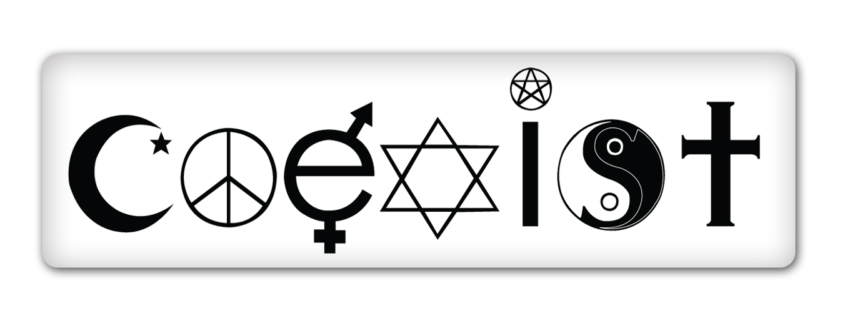
 COEXIST. It sounds great and it’s a necessary and healthy thing to get peoples of different faiths to cooperate and to peaceably live alongside with one another and respect each other’s convictions. As an organization, it’s a powerful force for good. But there’s an underlying message being promoted that says every religion is fundamentally the same and we’re all just travelers opting for different paths to a common destination.
That’s not true.
And while those differences don’t have to be processed as justifications to war with one another, it is important to recognize the essence of each religious school of thought, especially in those instances where the creed in question is being used to support acts of violence and terror.
I) We’re All Different
Here’s the thing: Not everybody thinks the same way. Two well read and educated individuals can look at the same issue and come up with two completely different viewpoints. We are all different. Those differences can, and should, create a dynamic where, because we’re working together, our distinctive perspectives can compliment one another and the resulting effort is far more comprehensive and effective than it would be otherwise.
That’s the premise behind the “COEXIST” organization that you can read more about at coexist.org. You’ve probably seen the bumper sticker they publish and it truly is a noble effort. There’s one particular story about how one community, racked by violence as a result of religious differences, came together in the context of a cooperative effort to produce coffee. It’s hard to argue with success, it really is. A neighborhood, that was nothing short of a war zone, has been transformed into a situation where people of different faiths are working side by side and creating a successful product.
II) Slander No One
From a Christian’s perspective, this resonates with Titus 3. The idea is that we’ve got a great Truth that we want to communicate to people and we do that by living lives that draw people in. It says in verse 2 “…to slander no one, to be peaceable and considerate, and to show true humility toward all men.”
The process of going from a spiritual corpse to someone with a spiritual pulse is not going to be facilitated through an argument or the tip of a sword. It’s God Who does that and our role is to be a witness to all that Solution entails and not a mere protester of all that is bad in the world. That’s not to say there isn’t a time to take up arms and defend what is right (Ecc 3:8; Lk 22:36-38; Rom 13:4), but when it comes to championing the gospel, that’s a spiritual war and we’re obligated to use spiritual weapons if we want to be both obedient and effective (2 Cor 10:3-5).
III) Be Vigilant
The fact that it’s a spiritual battle is a cue to be that much more vigilant, as far as popping the hood on spiritual issues and ensuring that what may appear harmless and even noble, doesn’t have a sinister dynamic as its basis. That’s not being overly critical or even pessimistic, rather it’s being wise (Matt 7:15; 1 Pet 5:8). The notion of being able to peaceably coexist with people of other faiths is biblical and therefore entirely appropriate, as seen in Titus 3. But many perceive the “coexist”campaign as an encouragement to process all faiths as fundamentally the same and that’s where you get into things that are not appropriate, let alone logical.
Let’s take a look at that for a minute.
IV) The Symbols of COEXIST
 |
The “C” in COEXIST is the crescent moon that represents Islam. According to islam.about.com, the crescent moon was actually a symbol that had been adopted by the emperor of Constantinople to represent his empire. When the Seljuk Turks conquered the city in 1453, they adopted the city’s existing flag and symbol and, over time, the crescent moon became the symbol of Islam. |
   |
The “O” represents “peace.” In 1958, Gerald Holtom designed a symbol that was to be used as part of a march organized for the purpose of promoting nuclear disarmament. The letters “N” and “D,” which stood for “nuclear disarmament,” were superimposed on top of one another in the context of semaphore symbols. Holtom’s design would later be adopted by the anti-war movement and by the end of sixties, the “peace sign” had crossed several cultural and international boundaries and was widely recognized as an icon that stood for the promotion of a non-violent approach to conflict. |
  |
The “E” is an artistic embellishment of the letter “e” with the symbols that represent male and female. To the left, the first symbol is the female symbol which is derived from the astrological sign that represents Venus. Below that is the male symbol which, again derives from the astrological community. In this instance, it is the sign for Mars. This element symbolizes cooperation and peace between the sexes. |
 |
The “X” is the “Star of David” which represents “Judaism” The “Star of David” is not referenced in the Bible or any authoritative Jewish religious resource. But while its origins are unclear, it has been in use for centuries. Some were not especially keen on it being representative of Israel, let alone the Jewish faith, because of the way its shape has been associated with pagan religions. But its use has become cemented as a result of the things such as the Holocaust when Jews were required by their Nazi counterparts to wear a Star of David that identified them as Jews as well as the Zionist movement that established the design of the Israeli flag to be blue and white with the Star of David positioned in the middle. |
 |
The “I” is dotted with a pentagram which represents witchcraft. While the pentagram is used to represent more than just witchcraft (it’s also used as a symbol in Mormonism and the Bahai’ faith), it’s traditionally associated with magic and the occult. The five points of the star represent the five classical elements in Wicca; earth, wind, fire, air and spirit. |
 |
The “S” is the “yin-yang” symbol which comes from Chinese Philosophy that states that the universe consists of opposites that interact and compliment one another. This as opposed to the more base perception that says opposites conflict with one another. The symbol itself is difficult to define in terms of its origins in that no one has ever claimed to be the sole author. Still, there is substantial evidence that points to a classical approach to Chinese Philosophy that strove to create visual representations of fundamental patterns that govern the phenomena of the universe. It was this 15th century effort that produced the graphic that we now know as the “yin yang” symbol. |
 |
The “T” is the cross of Christ which represents Christianity. Because the cross was recognized as a gruesome form of execution and not the the sort of visual symbol that inspired pleasant thoughts, there was a fair amount of hesitation on the part of early Christians to adopt the crucifix as an icon. But by the second century the symbol of the cross was so associated with followers of Christ that Clement of Alexandria, an early Christian theologian, could use the phrase “the sign of the cross” without fear of ambiguity. |
The “O,” the “E” and the “S” are not necessarily religions per se. While Chinese Philosophy does include Buddhism, the “yin-yang” dynamic isn’t really emphasized as something that is central to their doctrine. So, for the most part, those three letters are symbolic of different types of cooperation and coexisting peaceably. Islam, Judaism, Witchcraft and Christianity, however, are religions and when you pop the hood on these three doctrines you have three very different ideologies serving as the foundation for each of these creeds. Getting the followers of these different religious schools of thought to cooperate with one another is one thing, but it’s another thing entirely to suggest that the fundamentals of what they believe are the same.
V) Islam
A) Unstable Eternity – the Nature of Allah
What separates these three religions right away is the nature of the “god” that serves as the principle deity. At the core of Islam is the doctrine of tawhid. It is documented in Quran 112:1-4 and basically means that Allah is one. He is one, central god that cannot be known and is completely distinct from all that’s been created. That in and of itself is distinct from Christianity where God is a personal God and desires a personal relationship with His creation (Is 43:1; Rev 3:20).
Allah is just (Quran 4:40) but it’s here where things get a little confusing. While Allah is just and is therefore obligated to punish all sin, he is also forgiving, but his forgiveness is reserved for those who ask (Quran 4:110). On the surface that doesn’t sound so bad, but should you die before you’ve sought forgiveness for all your sins, you have a potential problem on your hands. In addition, Christianity doesn’t simply advocate an increased effort being put forth on the part of the believer in order to avoid wrongful behavior. Instead, God offers His Holy Spirit to teach and to guide (Jn 14:26). You are made new when you accept His gift of Redemption and it is through the Strength He provides that you’re able to think and perform in a manner that’s pleasing to Him (Jn 14:26; 2 Cor 5:17; Phil 2:13)
In short, your status in the eyes of Allah fluctuates according to your behavior. You’re responsible for seeking the grace of Allah. Should you have anything outstanding at the moment of your death, your eternal security is unstable. In addition, your earthly existence is unassisted. It’s not Allah working in and through you, as is the case with a follower of Christ. Rather, it’s you laboring to please Allah according to your own sense of resolve and discipline.
B) Who is Christ?
A good Muslim is going to discipline himself to be moral by keeping the Quran on his lips and and his behavior in check. It’s entirely up to him, as far as how he appears before Allah. Christianity, on the other hand, is based on God sending His Son to atone for the shortcomings of humanity and making available His Holy Spirit to strengthen an otherwise weak and uninformed resolve (Is 41:10; Jn 14:26; Phil 4:13; 2 Tim 1:7; 1 Jn 4:4).
It’s not so much you working to get to God, rather it’s God pursing you and equipping you with what you need to access Him. This is all represented in the Person and the Ministry of Christ. It is the Identity of Christ that defines Christianity and if any religion claims to be similar than it will follow that their regard for Jesus will be the same. If, on the other hand, they deny Christ as being God Incarnate, than you have all that you need in order to conclude that their doctrine is distinct from a Christian creed (1 Jn 4:3).
Islam regards Jesus as a good Muslim and nothing more. The Qur’an doesn’t record the words of acts of Christ, it simply attempts to assert that Scripture is corrupted by saying that: Jesus was never crucified…
And [for] their saying, “Indeed, we have killed the Messiah, Jesus, the son of Mary, the messenger of Allah.” And they did not kill him, nor did they crucify him; but [another] was made to resemble him to them. And indeed, those who differ over it are in doubt about it. They have no knowledge of it except the following of assumption. And they did not kill him, for certain. (sura 4:157)
Jesus was / is not the Son of God…
The Messiah, son of Mary, was not but a messenger; [other] messengers have passed on before him. And his mother was a supporter of truth. They both used to eat food. Look how We make clear to them the signs; then look how they are deluded. (sura 5:75)
The Jews call ‘Uzair a son of Allah, and the Christians call Christ the son of Allah. That is a saying from their mouth; (in this) they but imitate what the unbelievers of old used to say. Allah’s curse be on them: how they are deluded away from the Truth! (sura 9:30)
The Identity of Christ, as far as Him being the Son of God, is central to the Christian faith and it is the resurrection that Christ Himself identified as proof of Who He was.
He answered, “A wicked and adulterous generation asks for a miraculous sign! But none will be given it except the sign of the prophet Jonah. For as Jonah was three days and three nights in the belly of a huge fish, so the Son of Man will be three days and three nights in the heart of the earth. (Matt 12:39-41)
H.P. Liddon, an accomplished British theologian who lived during the 19th century said:
Faith in the resurrection is the very keystone of the arch of Christian faith, and, when it is removed, all must inevitably crumble into ruin.1
Should you deny the resurrection, then you’re denying the fact of Christ’s deity and you’re reducing Him to a mere teacher that died a tragic death. By doing so, you categorize yourself under the heading of 1 John 2:22 where the apostle John says:
Who is the liar? It is whoever denies that Jesus is the Christ. Such a person is the antichrist—denying the Father and the Son. (1 Jn 2:22)
In other words, you can’t be more at odds with the Christian doctrine than by declaring that Jesus didn’t rise from the grave. It’s not a matter of simply questioning a historical occurrence as much as it’s denouncing His being God Incarnate.
VI) Judaism
While Jews and Christians share a great deal in terms of the Old Testament, the similarities cease after the book of Malachi. The deal breaking issue is the Identity of Jesus as being the Messiah. Jews do not subscribe to the Truth that Christ is the “Anointed One.”
The reasons behind the Jewish platform for not believing in Jesus as the Son of God are varied, but the one thing they conveniently sidestep is the Resurrection of Christ. This is, and always will be, the bottom line as far as whether or not Christ was all that He claimed to be.
Paul says in 1 Corinthians 15:19-20:
If we hoped in Messiah in this life only, we are of all men most to be pitied. But now Messiah has been raised from the dead, the first fruits of those who are asleep. (1 Cor 15:19-20)
In effect, what he’s saying is that if Christ didn’t rise from the grave, all Christians are pathetically deluded and are clinging to a school of thought that’s more trouble than it’s worth.
Jews and Christians have disagreed since the very beginning, starting with Christ Himself who infuriated the Jewish religions authorities with His claim to be God Incarnate (Jn 10:33). In Acts 4, Peter and John are brought before some of the same authorities that had condemned Christ to death (Annas and Caiaphas [Matt:26:57; John 18:13; | Acts 4:5-6]) and with several threats demanded that they stop speaking about Jesus despite the fact that they themselves could not deny that Jesus had risen from the grave (Acts 4:16).
The resolve of the Hebrew nation continues to this day, as far as insisting that the Messiah has yet to arrive. It’s because of their unwillingness to accept Jesus as the Son of God that they fall under the heading of 1 John 2:22 and their doctrine is totally different from that of the Christian creed where it matters most.
VII) Wicca
Thus far we’ve been able to determine that, despite some harmless sounding similarities, Islam and Judaism differs dramatically from Christianity in that their view of Christ falls short of His being Divine.
The same thing applies with Wicca. While Wicca doesn’t claim to be a religion, it references religious ceremonies in its “13 Principles of Wiccan Belief.” Their ceremonies and rites involve a poly-theistic approach in that there’s not one God, but rather multiple gods.
Portraying them as sinister looking people dressed in black clothing with pointy hats is neither appropriate nor accurate. Their “Rule of Three” encourages the idea of reciprocity. In other words, what you contribute, be it positive or negative, will be returned to you three fold. Hence, being kind and friendly is encouraged.
Where Wicca differs from Christianity is in the way Jesus is marginalized as a great teacher and an extraordinary human being. He is not the “Son of God” and any notion that He represents the only way to God is dismissed as absolutely wrong.
Here again, you see a dramatic fork in the road as far as two religions being revealed as very distinct from one another. While you can compare and contrast the details of Christianity with different religions to the point of mental exhaustion, the bottom line is and always will be, “Who is Jesus?” If the answer to that question is anything other than God Incarnate, you’ve got something that is totally distinct from the Christian doctrine.
VIII) Sanctified Violence?
Depending on what resource you reference, Islam is touted as being the fastest growing religion in the USA. Given the Islamic foundation for the acts of terror that have been perpetuated around the world for last three decades, it’s difficult to understand how a creed that is apparently so supportive of violence against “infidels” can resonate so strongly among so many.
A) Is Islam a Peaceful Religion? Yes?
Some will say that Islam is generally a peaceful religion that doesn’t seek to promote violence and they’re correct as long as they restrict their intake of the Quran to specific verses, such as:
There shall be no compulsion in [acceptance of] the religion. The right course has become clear from the wrong. So whoever disbelieves in Taghut and believes in Allah has grasped the most trustworthy handhold with no break in it. And Allah is Hearing and Knowing. (sura 2:256)
…and sura 15:94:
Then declare what you are commanded and turn away from the polytheists. (sura 15:94)
B) Is Islam a Peaceful Religion? Not So Much…
The problem is that these verses were written before other texts which, in the minds of some Muslims, nullify their relevance. In other words, the texts you need to revere are the ones that were “revealed” most recently. That being the case, you how have a different approach to violence as seen in verses from the Quran such as:
And kill them wherever you overtake them and expel them from wherever they have expelled you, and fitnah is worse than killing. And do not fight them at al-Masjid al- Haram until they fight you there. But if they fight you, then kill them. Such is the recompense of the disbelievers. (sura 2:191)
and..
And fight them on until there is no more tumult or oppression, and there prevail justice and Faith in Allah; but if they cease, let there be no hostility except to those who practise oppression. (sura 2:193)
So while some Muslims can accurately say that Islam is a religion of peace, they can only say that if they ignore other verses in the Quran which are passionately embraced as justification for the outrageous acts of terror perpetuated by organizations such as Al Qaeda and ISIS (Islamic State of Iraq and Syria).
These organizations are not having to engage in a series of theological calisthenics in order to arrive at a “holy” foundation upon which to build their zeal and depravity.
C) The Reality of “Abrogation”
Muhammad ash-Shawkani was a respected Islamic cleric who lived from 1759 to 1834 who is considered an authority on Islamic doctrine and law. Among his writings is a book entitled, “Alsaylu Jarar” which states:
Islam is unanimous about fighting the unbelievers and forcing them to Islam or submitting and paying Jiziah (special tax paid only by Christians or Jews) or being killed. [The verses] about forgiving them are abrogated unanimously by the obligation of fighting in any case. (“Beyond Jihad: Critical Voices from Inside Islam” [p63])
Jihad Against Jews and Crusader
World Islamic Front Statement
February 28, 1998
The ruling to kill the Americans and their allies — civilians and military — is an individual duty for every Muslim who can do it in any country in which it is possible to do it, in order to liberate the al-Aqsa Mosque and the holy mosque [Mecca] from their grip, and in order for their armies to move out of all the lands of Islam, defeated and unable to threaten any Muslim. This is in accordance with the words of Almighty Allah, “and fight the pagans all together as they fight you all together,” and “fight them until there is no more tumult or oppression, and there prevail justice and faith in Allah.” (click
here to view entire text)v
Given that sort of disposition, the directive authored by Osama bin Laden and endorsed by five Islamic caliphates which ordered the killing of all Americans, is not a nonsensical interpretation of Islamic thought. It’s simply a practical application of the Quran.
D) The Violence of Christianity
Some critics will assert that Christianity is just as violent as Islam as demonstrated by the Crusades and the military campaigns of Charlemagne.
Rome was not very accommodating when it came to Christianity prior to February 313 when Emperor Constantine issued the “Edict of Milan” which ordered all of Rome to treat Christians benevolently. Up to that point, Christians were viewed as enemies of the state because of the way their creed directed worship towards God as opposed to Caesar. Under Constantine, that dynamic was eliminated and while it allowed Christians to practice their faith without fear of persecution, it introduced the idea that heads of state were also leaders in the church and were responsible for the spiritual health of their subjects.
1) Wealth and Power Over Truth and Worship
This deteriorated into a situation where an accurate interpretation of Christian doctrine gave way to political agendas and economic strategies. In 392 Emperor Theodosius I made Christianity the only “legal” religion. In 785, Charlemagne issued a decree that dealt with the way in which his administration was to handle the conquered Saxons by saying:
If any one of the race of the Saxons hereafter concealed among them shall have wished to hide himself unbaptized, and shall have scorned to come to baptism and shall have wished to remain a pagan, let him be punished by death.2
And then of course, was the Crusades. The thing that’s significant about the Crusades is that while you had knights brandishing shields emblazoned with the symbol of the cross, it’s wrong to assume that their inspiration was nothing other than the liberation of the Holy Land in that it ignores the fact that the Muslims had occupied Jerusalem for almost 400 years prior to the first Crusade.
Consider this: In 638, Omar took Jerusalem from the Jews. It wouldn’t be until 1096 that the Pope would call upon the people of Europe to liberate the Holy Land. If it was the Islamic control of Jerusalem that was the central reason behind the Crusades, then it follows that a military effort would’ve been launched well before Urban II declared that Christ had commanded it. But the Muslims’ control of the Holy Land was never an issue to the Pope until the Seljuk Turks made it clear that they were planning on expanding their influence to include Constantinople. At that point, Alexis I, the emperor of the Byzantine Empire humbled himself before the Pope and offers him the opportunity to assume control over the Greek Orthodox Church (the respective popes of the Roman Catholic church and the Eastern Greek Orthodox church had excommunicated each other).3
This was an unprecedented act of submission and demonstrates the sense of urgency Alexis I felt as he looked over the horizon and saw the coming of the Turks. But it was the way they threatened his kingdom and not his worship that drove him to seek help from Rome, and it was Pope Urban’s quest for power that drove him to respond to Alexis’ request for a band of mercenaries with an immense host of European soldiers.
The Babylonian Talmud
I, or rather the Lord, beseech you as Christ’s heralds to publish this everywhere and to perse all people of whatever rank, foot-soldiers and knights, poor and rich, to carry aid promptly to those Christians and to destroy that vile race from the lands of our friends. I say this to those who are present, it is meant also for those who are absent. Moreover, Christ commands it.
(Fulcher of Chartres recollection of Pope Urban II’s call to arms)
In order to accurately determine what the true Christian disposition is towards combat, it’s not the way Scripture has been abused that needs to be considered as much as it’s Scripture itself. In other words, before you take up arms against an enemy because a church leader states that “Christ commands it,” you need to be able to locate the verse in the Bible that says as much.
The Old Testament contains a number of military campaigns, the most notable being the conquest of the Promised Land and the battles fought by King David. The question on the table is whether or not these scenarios constitute a biblical justification for the way in which certain historical figures have exacted acts of violence on their fellow man. The short answer is “No.” Whether the personality in question is Charlemagne, Pope Urban II, Alexis the First or Emperor Theodosius, the common denominator is a quest for control and power. The wars fought in Scripture were founded on God’s Purpose and were manifestations of His Justice.
2) The Difference Between a Cause and an Excuse
The land of Canaan was promised to Abraham in Genesis 17:8. The Canaanites were a vile people and engaged in the kind of idolatry that was nothing short of heinous and profoundly offensive in the eyes of God (Dt 18:9-12). It was because of the Canaanites’ outrageous immorality that they were singled out for punishment and it was that verdict that translated to the Israelites being empowered to utterly destroy them (Dt 9:5).
David’s exploits were similar. In his day, it was the Philistines that represented Israel’s most significant threat. The Philistines were descendants of Ham, one of Noah’s three sons who distinguished himself by being especially disgraceful (Gen 9:18-25). Throughout the Philistines’ history, they were enemies of Israel and thus enemies of God. Jeremiah 47 details God’s final interaction with them in the form of total and complete destruction. David’s successes were not merely the triumphs of a military tactitian. Rather, they were the manifestation of God’s Justice facilitated through a man who was humble and courageous enough to be obedient in the face of overwhelming odds (1 Sam 17:45-47; 23:1-6).
2 Samuel 8:6 sums it up best by saying “The Lord gave David victory wherever he went.” The point is that the victories that the Israelites won were not merely military triumphs as much as they were Divine Judgments exacted on those who chose to oppose God. That is the litmus test for truly sanctified violence and unless an individual’s or a nation’s actions can line up with said test, theirs is an enterprise that cannot be categorized as holy let alone right.
And that is the difference between a legitimate cause worth fighting for as opposed to a mere excuse to justify a violent pursuit of a self-serving agenda. So, all that to say, that a proper interpretation of God’s Word does not result in a creed that’s even remotely similar to the Islamic deployment of violence and prejudice. Islam is very distinct in that way and while it is our Christian duty to accommodate those of differing beliefs as articulated in Titus 3, it is just as important to be discerning and recognize what is true as opposed to what is false (1 Chron 12:32; 2 Pet 5:8; 1 Jn 4:1).
IX) Conclusion: The Bottom Line
Coexist? Absolutely! But do so beneath the umbrella of Truth. Otherwise, it’s not coexisting as much as it’s compromising things that cannot and should not be ignored let alone diluted.
1. “Evidence That Demands a Verdict”, Here’s Life Publishers, San Bernardino, CA, 1972 1979, Josh McDowell, p181
2. Munro, Dana Carleton (Trans.) (2004). Selections from the Laws of Charles the Great
3. Williams, Paul (2002), Idiot’s Guide to the Crusades (Kindle DX Version) retrieved from amazon.com


 Jesus wasn’t a Socialist.
 A question on


 Did He Say That?


