Prove It! | Part VI: Bible Difficulties

Not an Option
On occasion, you’ll run into passages of Scripture that either don’t make sense or they appear contradictory.
Critics love to seize on these apparent “errors,” and use them to justify their resolve to dismiss the Bible as flawed and therefore irrelevant.
Even those that believe the resurrection of Christ will sometime side with those that process the Bible as corrupted in light of what appear to be passages that seem nonsensical.
However logical it may be to acknowledge the capacity of human beings to make mistakes, when evaluating the Word of God, you want to be sensitive to the fact that you’re not merely inspecting the accuracy of a human effort as much as you’re criticizing God’s Ability to maintain the integrity of His Word.
Consider these verses:
“Is not my word like fire,” declares the Lord, “and like a hammer that breaks a rock in pieces? (Jer 23:29)
For truly I tell you, until heaven and earth disappear, not the smallest letter, not the least stroke of a pen, will by any means disappear from the Law until everything is accomplished. (Matt 5:18)
16 All Scripture is God-breathed and is useful for teaching, rebuking, correcting and training in righteousness, 17 so that the servant of God[a] may be thoroughly equipped for every good work. (2 Tim 3:16-17)
For prophecy never had its origin in the human will, but prophets, though human, spoke from God as they were carried along by the Holy Spirit. (2 Pet 1:21)
The Bible doesn’t allow itself to be anything less than inerrant. And it makes sense because to regard anything that resonates as “incorrect” as a legitimate discrepancy that simply has to be accepted and / or overlooked, is to call into question the substance of the gospel, the Reality of the empty tomb, and even the existence of God Himself. Your skepticism can’t remain specific to one particular verse. If it can be proven that one particular passage has been contaminated, there’s nothing to prevent foundational Scriptures from being corrupted as well.
Bear in mind, we’re not talking about “differences,” as much as we’re talking about discrepancies. Just because a different word is used to communicate a particular idea when comparing different versions and translations to one another, doesn’t alter the fundamental meaning of the text. For more information about the authenticity of the New Testament, click here.
That said, there are passages that seem problematic and that’s what we’re talking about in this final installment of the “Prove It!” series.
Three Days and Three Nights
For as Jonah was three days and three nights in the belly of a huge fish, so the Son of Man will be three days and three nights in the heart of the earth. (Matt 12:40)
According to Luke 23:44, Jesus died at 3:00 PM on a Friday. If that’s the case, according to what Jesus said in the book of Matthew, His Resurrection should’ve occurred on Monday, or perhaps Tuesday, if you’re assuming that a day is a full 24 hour period.
Jesus is not mistaken, nor is there an error in what Matthew wrote or what has since been passed down through the centuries.
Hebrews reckoned a day as beginning at 6:00 PM…
The Hebrew day (yom) begins at sundown, when three stars become visible in the sky (the rabbis reasoned that the day begins at sunset based on the description of God’s activity in creation, “and the evening and the morning were the first day,” Genesis 1:5). Evening is sometimes defined as the late afternoon, that is, between 3:00 pm to sundown.2
Not everyone in the ancient world documented time in the same way, certainly not the Romans who defined 12:00 AM as the beginning of the new day.
Consequently, according to ancient parlance, in order to refer to three separate twenty-four hour timeframes, you would say, “Three days and three nights” – even though only a portion fo the first and third days might be involved. Refer to the diagram below to better visualize the way dates and times were processed back then.

The Potter’s Field
9 Then what was spoken by Jeremiah the prophet was fulfilled: “They took the thirty pieces of silver, the price set on him by the people of Israel, 10 and they used them to buy the potter’s field, as the Lord commanded me.” (Matt 27:9-10)
This passage refers to the money that was originally paid to Judas for betraying Jesus who, upon recognizing his treachery, returned the money to the Pharisees and the proceeded to hang himself (Matt 27:5).
The Pharisees then took the money and purchased the “potter’s field,” which is referenced in the book of Zechariah.
And the Lord said to me, “Throw it to the potter”—the handsome price at which they valued me! So I took the thirty pieces of silver and threw them to the potter at the house of the Lord. (Zec 11:12-13)
And yet, Matthew cites Jeremiah as the source of the quotation. At first glance, this looks like an error right up until the time you consider Jeremiah 32:6-9:
6 Jeremiah said, “The word of the Lord came to me: 7 Hanamel son of Shallum your uncle is going to come to you and say, ‘Buy my field at Anathoth, because as nearest relative it is your right and duty to buy it.’
8 “Then, just as the Lord had said, my cousin Hanamel came to me in the courtyard of the guard and said, ‘Buy my field at Anathoth in the territory of Benjamin. Since it is your right to redeem it and possess it, buy it for yourself.’
“I knew that this was the word of the Lord; 9 so I bought the field at Anathoth from my cousin Hanamel and weighed out for him seventeen shekels[a] of silver. (Jer 32:6-9)
So, it would appear that Matthew is correct in referring to Jeremiah as being the prophecy being fulfilled in the context of the money Judas gave back to the Pharisees, but it’s there’s actually several things happening simultaneously that makes this scenario especially meaningful.
What you have here is a composite of two prophecies; one from Jeremiah and one from Zechariah, with Zechariah referring to what Jeremiah had previously said.
Look at this:
| Jeremiah & Zechariah | |
| Jeremiah 18-19 | Chapter 18 has God telling Jeremiah to go to a nearby potter’s house and recognize how God is similar to the potter in the way he can shape the course of nations, just as a potter can shape, destroy, and remake a piece of pottery.
In chapter 19, God instructs Jeremiah to use a piece of pottery to describe to the kings of Judah and the people of Jerusalem how God was getting ready to, “…bring disaster on this place.” In the same chapter, God says the the Valley of Ben Hinnom would come to be referred to as the “Valley of Slaughter.” |
| Zechariah 11:12-13 | Here you have a dollar amount of thirty pieces of silver being “thrown to the potter.” Given the way the “potter” had been used by Jeremiah, you now have a common thread running through those two passages. |
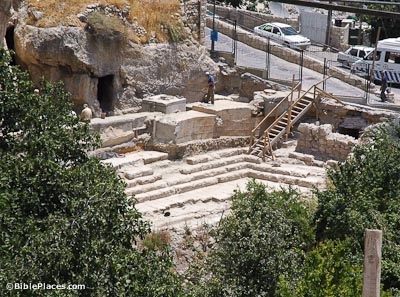
| Acts 1:19 | Here, Luke names the area that the Pharisees purchased which was referred to as the “potter’s field” in the book of Matthew as “Akeldama,” which is located in…the Valley of Hinnom. |
So, between these two passages, you have
|
|
You Won’t be Forgiven?
Matthew 6:15 says:
But if you do not forgive others their sins, your Father will not forgive your sins. (Matt 6:15)
On the surface, it’s tempting to think that this verse is implying that your eternal security is at risk if you refuse to forgive others of the things they have done to you.
That’s not the case.
Our salvation is secured by the death and resurrection of Christ. There’s nothing we can do to earn it or sustain it:
8 For it is by grace you have been saved, through faith—and this is not from yourselves, it is the gift of God— 9 not by works, so that no one can boast. (Eph 2:8-9)
No one will be able to stand before God and insist that they be forgiven of their sins because they showed grace to another human being.
There is, however, a “tension” that can be established between you and your Heavenly Father as a result of disobedience. You see that explained in this commentary from gotquestions.org:
The difference between Ephesians 1:6-8 and 1 John 1:9 is that John is dealing with what we call “relational,” or “familial,” forgiveness—like that of a father and a son. For example, if a son does something wrong to his father—falling short of his expectations or rules—the son has hindered his fellowship with his father. He remains the son of his father, but the relationship suffers. Their fellowship will be hindered until the son admits to his father that he has done wrong. It works the same way with God; our fellowship with Him is hindered until we confess our sin. When we confess our sin to God, the fellowship is restored. This is relational forgiveness.3
It’s that relational forgiveness that’s being withheld, and not the forgiveness that characterizes you identity in Christ.
Law or Love?
It’s hard to reconcile the idea of a loving God when you look at the Conquest of the Promised Land.
You must destroy all the peoples the Lord give over to you. (Dt 7:16)
10 When you march up to attack a city, make its people an offer of peace. 11 If they accept and open their gates, all the people in it shall be subject to forced labor and shall work for you. 12 If they refuse to make peace and they engage you in battle, lay siege to that city. 13 When the Lord your God delivers it into your hand, put to the sword all the men in it. 14 As for the women, the children, the livestock and everything else in the city, you may take these as plunder for yourselves. And you may use the plunder the Lord your God gives you from your enemies. 15 This is how you are to treat all the cities that are at a distance from you and do not belong to the nations nearby.
16 However, in the cities of the nations the Lord your God is giving you as an inheritance, do not leave alive anything that breathes. 17 Completely destroy[a] them—the Hittites, Amorites, Canaanites, Perizzites, Hivites and Jebusites—as the Lord your God has commanded you. 18 Otherwise, they will teach you to follow all the detestable things they do in worshiping their gods, and you will sin against the Lord your God.
19 When you lay siege to a city for a long time, fighting against it to capture it, do not destroy its trees by putting an ax to them, because you can eat their fruit. Do not cut them down. Are the trees people, that you should besiege them?[b] 20 However, you may cut down trees that you know are not fruit trees and use them to build siege works until the city at war with you falls. (Dt 20:10-20)
It’s important to realize that the depravity of the cities that had been singled out for destruction had been engaged in their rebellion for centuries. The Conquest of the Prom ised Land coincided with when the sin of these people groups had reached their full measure (see Gen 15:16 [see Dr. John Lennox’ explanation by clicking on the image to the right]).
These were unique situations and not necessarily typical, as is evidenced by Deuteronomy 20:10-15.
Bear in mind that these were cities that were targeted and not whole people groups as can be seen by the fact that Uriah, one of David’s mighty men, was a Hittite (2 Sam 11:1-3).
God is both a God of Love, and a God of Law. Mercy is obtained through repentance, just like judgement is a consequence of rebellion.
Moabite were descendants of Moab, the result of an incestuous relationship between Lot and his daughter (Gen 19:36-38). Israel was subject Moab in Judges 3:14. Saul fought against them in 1 Samuel 14:47, and David went to war against them as well in 2 Samuel 8:2.
They were considered to be enemies. Yet, Ruth was a Moabite. She was also David’s great grandmother. Her initial marriage to an Israelite would’ve raised some concerns, given the way Moabites were not allowed into the assembly of the Lord – not even to the tenth generation (Dt 23:3).
But Ruth’s heritage was not as important as her commitment to God (Ruth 1:16), and that made all the difference. She would be referenced in the genealogy of Christ in. Matthew 1:5.
And that’s what makes Ruth’s situation both logical and inspiring. She wasn’t an “exception” to the rule, she was an example of God’s grace and an illustration of how God is both a God of Love and a God of Law.
Conclusion
Luke 13:28 describes hell as a place where there will be weeping and gnashing of teeth. “Gnashing of teeth” can refer to “seething anger.” It’s difficult to imagine someone having been confronted with the Reality and the Greatness of God to still be so indignant, that they would spend eternity despising their Creator and their Redeemer.
It’s not easy to distinguish the kind of unbeliever you’re interacting with in any given moment. Some of them are genuinely curious, others are simply looking for an opportunity to validate themselves by being critical.
You can’t “prove it” beyond a certain point. In the absence of footage and / or face to face interactions with Christ’s contemporaries, we’re limited by space and time to those things that have been documented and what we can discern from the testimony of creation (Rom, 1:20).
Still, the evidence is compelling and we want to be capable of explaining what we believe and why (1 Pet 3:15). While you’re not capable of changing someone’s heart (Jn 6:65), you can nevertheless be an effective witness and, from that standpoint, you can…
…prove it!
1. “Encyclopedia of Bible Difficulties”, Gleason Archer, Zondervan Publishing House, Grand Rapids, MI 1982, p11
2. “Hebrew for Christians”, “Introduction to the Hebrew Calendar”, https://www.hebrew4christians.com/Holidays/Calendar/calendar.html, accessed May 24, 2026
3. “Got Questions”, “Why do we need to confess our sins if they have already been forgiven (1 John 1:9)?”, https://www.gotquestions.org/confession-forgiveness.html, accessed May 24, 2026
Discussion Questions
Based on the way Hebrews reckoned a day, yet living in a Roman culture, what day would it be if it was Thursday, and someone referred to a timeframe in the future by saying “three days and three nights?”
What does it feel like when you’ve got “unconfessed sin” in your heart? How does that impact your relationship with God (Ps 66:18)?
How has God redeemed a bad situation in your life and turned it into something good?
How do you know God is real? How do you “prove it” in your own mind?
What is it about a Christian that should “prove” the Reality of God?

 7) If you believe the creation account in Genesis is allegorical, they why don’t you treat Paul’s epistles in the same way since he references the creation account in Genesis as historical?
 When God draws a line, it’s tempting sometimes to get as close as you can to that boundary without actually crossing over into forbidden territory.