“Pure Christianity” is never exercised in the absence of wisdom (Prov 9:10; Jas 1:5). Dressing up whatever policy or conviction you in the guise of “compassion” or “Christian charity” – if it doesn’t pass the litmus test of a comprehensive perspective on Scripture (2 Tim 3:16-17) – you’re simply attempting to give your flawed opinions the look of a Biblically based disposition, the result being neither healthy nor wise.
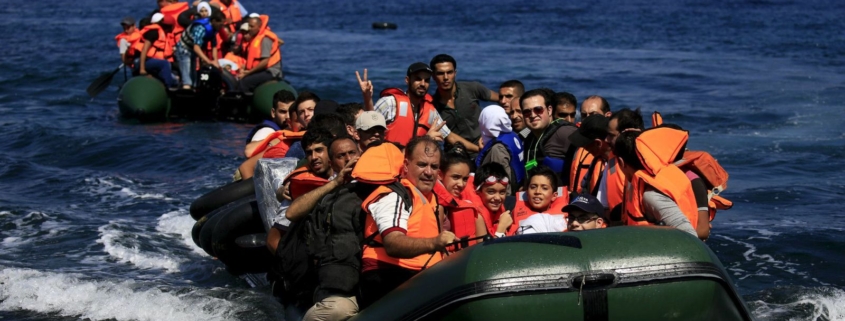
The question on the table is “Does denying Syrian refugees into the US run contrary to the commandment to love your enemies and to be loving and charitable to all people?”
90% of Syria
90% of Syria is Muslim. When you scan the headlines, you find differing stories as to whether or not you can accept these people as legitimate refugees or you need to at least consider the fact that they pose a potential threat given their creed as well as the history of the way terrorists have infiltrated those areas they define as targets. Given the question marks surrounding the true nature and agenda of these people, a vetting process has been established, but, according to some, it’s been diluted to the point of becoming almost non-existent in order to accommodate President Obama’s commitment to welcome 10,000 refugees by September of 2016.
Many believe that this is a logical response to a problem that doesn’t really exist, others see it as an irresponsible mindset that could case the country harm. There are several “bullet points” that emerge in the context of this debate, and while some appear both credible and compelling, there’s a warning represented by the aforementioned statistics thast need to be acknowledged in order to arrive at a conclusion that is taking into consideration all of the facts.
- Do Muslims represent a real threat?
- Are the Syrian refugees devoid of any possible terrorist element?
- What is the appropriate Christian response?
Are Muslims a Threat?
The struggle that’s going on in Syria right now is being described as one of the bloodiest conflicts in the 21st century. What began as an uprising fueled by economic and political unrest has become a struggle that’s drawn according to sectarian lines. In other words, it’s become a religious battle between the Suni’s and the Shiite’s. The struggle between Suni’s and Shiites goes back to the beginning of Islam as far as who is the true successor to Mohammed.
But there are nevertheless some common denominators between the two factions, one being their mutual hatred and resolve to destroy the United States. Some will argue that this is not the tenor of most Muslims and is therefore illogical and unfair to be hesitant when labeling Muslims in general as being a threat to national security. But here’s the problem:
The moment you put that uniform on – the moment you align yourself with Islamic teachings – you are subscribing to a creed that includes a divine endorsement for murder in the name of Allah. Not all Muslims are radical, but the more orthodox your interpretation of the Quran, the more militant you become.
Furthermore, there are 1.2 billion Muslims in the world. The radicals are estimated to be between 16% and 25% according to most of the intelligence around the world. That means you have between 180 and 300 million people dedicated to the destruction of Western civilization. Just to give you some perspective, the number of people in the US is 320 million. Connect the dots and you have the equivalent to an entire nation determined to see the US cease to exist. That by itself should be enough to give decision makers pause.

The Problem of Abrogation
While the Bill of Rights gives everyone the opportunity to practice their religion without any kind of governmental limitation, the Supreme Court in 1878 appropriately ruled that the practice of one’s religion does not serve as a defense to a criminal indictment. In other words, should your religion be used as a way to justify murder, then your religious beliefs no longer fall beneath the umbrella of the First Amendment.
Because of the way in which our nation’s 200 year history has been consistently punctuated with acts of terror prosecuted by individuals who claim a commitment to Allah as being their inspiration, being a Muslim, by default, puts you in a position where your voluntary ties to these acts defines you as a potential threat to the general welfare and not as a mere religious pilgrim.
That may sound harsh and even inaccurate, given the way many Muslims appear to be kind and more than gracious, and they may very well be. But it’s imperative to realize that those who are “moderate” are viewed by their more orthodox counterparts as “Uncle Tom’s” and not followers of the true faith. And it’s also important to realize that the Qur’an insists on the destruction of the infidel. It’s not a question of how you interpret the Qur’an, rather it’s your personal disposition as to which passages you embrace and which ones you do not.
The contention is that the most recent revelations of Mohamad are the ones that you obey. Should any of those contradict what had been documented in the past, you are to ignore anything that was previously stated and instead obey the newest admonishments. This anomaly is called “abrogation” and it’s most threatening manifestation is in the context of jihad:
During the lifetime of Muhammad, the Islamic community passed through three stages. In the beginning from 610 until 622, God commanded restraint. As the Muslims relocated to Medina (623-26), God permitted Muslims only to fight in a defensive war. However, in the last six years of Muhammad’s life (626-32), God permitted Muslims to fight an aggressive war first against polytheists,[52] and later against monotheists like the Jews of Khaybar.[53] Once Muhammad was given permission to kill in the name of God, he instigated battle.
Chapter 9 of the Qur’an, in English called “Ultimatum,” is the most important concerning the issues of abrogation and jihad against unbelievers. It is the only chapter that does not begin “in the name of God, most benevolent, ever-merciful.”[54] Commentators agree that Muhammad received this revelation in 631, the year before his death, when he had returned to Mecca and was at his strongest.[55] Muhammad bin Ismail al-Bukhari (810-70), compiler of one of the most authoritative collections of the hadith, said that “Ultimatum” was the last chapter revealed to Muhammad[56] although others suggest it might have been penultimate. Regardless, coming at or near the very end of Muhammad’s life, “Ultimatum” trumps earlier revelations. 1
This is why any Muslim who is “peaceful” is nevertheless conflicted in that they are hard pressed to condemn their more militant counterparts. After all, the terrorists are simply obeying what is in the Quran. For example:
But when the forbidden months are past, then fight and slay the pagans wherever you find them, and seize them, beleaguer them, and lie in wait for them, in every stratagem of war. (sura 9:5)
Islamic researchers are agreed that what the West and its followers call “moderate Islam” and “moderate Muslims” is simply a slur against Islam and Muslims, a distortion of Islam, a rift among Muslims, a spark to ignite war among them. They also see that the division of Islam into “moderate Islam” and “radical Islam” has no basis in Islam—neither in its doctrines and rulings, nor in its understandings or reality. (“
Radical vs Moderate Islam: A Muslim View“)
And kill them wherever you overtake them and expel them from wherever they have expelled you, and fitnah is worse than killing. And do not fight them at al-Masjid al- Haram until they fight you there. But if they fight you, then kill them. Such is the recompense of the disbelievers. (sura 2:191)
Fight those who believe not in Allah nor the Last Day. (sura 9:29)
What About Christianity?
Some will argue that Christianity has fueled may of the conflicts that have plagued the human existence, yet the Gospel of Jesus Christ isn’t being categorized as a threat. “Why not?” they ask.
First and foremost, just because you carry a Bible doesn’t make you a believer any more than brandishing a cross on your shield qualifies you as a Christian soldier. That’s not to say that there’s no such thing as a truly “righteous” cause that merits the use of force. But there’s a difference between what’s right from a Biblical standpoint and what’s merely profitable.
The Crusades are often viewed as a Christian enterprise that illustrates how people who are supposedly Christ followers can be just as violent as their Islamic counterparts thus giving the impression there is no distinction between one “religious” group over another.
But the Crusades were not fought for sake of advancing the gospel as much as it was for the sake of protecting the interests of Alexis I, the emperor of Constantinople and promoting the influence of Pope Urban II. The Jews surrendered their home to the Muslims in 638. It wasn’t until 1096 that the first Crusade was initiated. If it was a purely Christian impetus that inspired the Crusades, why did it take over 400 years for any kind of military campaign to be launched? Fact is, the Muslims’ control of the Holy Land was never an issue to the Pope until the Seljuk Turks made it clear that they were planning on expanding their territory to include Constantinople. Only then did Alexis I reach out to the Pope who was only too happy to seize the opportunity to extend his authority into what was previously an exclusively Greek Orthodox dynamic. Bottom line: The Crusades were about wealth and power and not the cause of Christ.
That’s not to say that providing aid to Alexis the First would’ve been an inappropriate gesture. But to offer forgiveness of one’s sin in exchange for taking up arms against the Turks…
“All who die by the way, whether by land or by sea, or in battle against the pagans, shall have immediate remission of sins.” (portion of Pope Urban II’s speech at Council of Clermont, 1095)
…is not even remotely biblical let alone a “holy” war.
And as far as the kind of violence the you do see in Scripture, there’s a fundamental difference there as well.
War in the Bible versus Jihad
Dr. Emir Caner grew up as a Muslim and later, along with his brother, converted to Christianity. Part of what makes his story so compelling is that his father was a devout Muslim. According to the Hadith, you are to be put to death if you renounce your faith in Allah. Rather than following the Qur’an to the letter, their father chose instead to disown them and they never saw their father again until he was on their deathbed. He’s currently president of Truett McConnell College in Cleveland, Georgia.
He explains the difference between war from a biblical standpoint and the way it’s promoted in the Qur’an:
…war, in Christian thought has the express purpose of securing peace (see Timothy 2:2) and removing those who oppress and act wickedly (see Romans 13:1-7). But war in Islam is different both in its scope and purpose. The latter half of sura 9:5 commands, “But if they repent and establish worship and pat the poor-due, then leave their way free. Lo! Allah is Forgiving, Merciful.”
As a result, Muslim armies must not put down their swords until the time their opposition submits to Islam or Islamic law – that is, until unbelievers either worship or pay a special protection tax and acquiesce to an Islamic political system. For the devout Muslim, war has a divine purpose and a divine outcome – securing the territory in the name of Allah, to whom all must bow.
After the enemy submits, the surrender is considered forever binding. If at any time, years or even centuries after the treaty was accepted, a conquered party breaks it, war is to be waged until such time Islamic law is fully reestablished. The Qur’an decrees…
And if they break their pledges after their treaty (hath been made with you) and assail your religion, then fight the heads of disbelief – Lo! They have no binding oaths – in order that they may desist (sura 9:12).2
God and Allah
And it’s not just the difference in what prompts war. It comes down to the fundamental difference between God and Allah. Dr. Emir Caner is joined by his brother in the book, “Unveiling Islam.” Together they explain that:
The greatest difference between Jesus Christ as God and Savior and Muhammad as prophet of Allah, comes at this point. Jesus Christ shed His own blood on the cross so that people could come go to God. Muhammad shed other people’s blood so that his constituents could have political power throughout the Arabian Peninsula. Further, since Muhammad is held to be the “excellent exemplar for him who hopes in Allah and the Final Day” (sura 33:21), we need to look no righter for explanation of violent acts with Islam than at the character of its founder. Was Muhammad a man of peace who shed other people’s blood only as a last resort? When he killed others, were his acts part of war or for personal vengeance? The answers to such questions tarnish the ethical integrity of the Islamic worldview.3
Allah’s heart is set against the infidel (kafir). He has no love for the unbeliever, nor is it the task of the Muslim to “evangelize” the unbelieving world. Allah is to be worshiped, period. Any who will not do so must be defeated, silenced, or expelled. The theme is conquest, not conversion, of the unbelieving world. Allah has called the Muslim to make the name of Allah alone to be worshiped. 4
At the end of the day, Christianity and Islam represent two vastly different paradigms, both in the natures of God and Allah as well as in the way they are to be championed and proliferated. A very short and succinct way of expressing the differences would be to simply reflect on how Allah invites his followers to die for him, whereas God says, “No, I’ll die for you.” But what about the way in which you are to treat your enemy from a Christian standpoint? Does Christian charity not demand that we as a nation welcome anyone within our borders, regardless of their intent?
Senior Intelligence Community officials assess the greatest international terrorist threats currently facing the United States come from violent extremists inspired by al-Qa‘ida, including its allies and affiliates, who are committed to conducting attacks inside the United States and abroad.
Loving Your Enemy versus Enabling Them
Here’s the thing: There’s a difference between loving your enemy and enabling them. In 2 Kings 6, the Arameans were at war with Israel and had surrounded the city of Dothan in an effort to capture the prophet Elisha. Elisha prayed that God would strike the army with blindness and God honored Elisha’s request. Elisha then led the army into Samaria, at which point the eyes of the Aramean army were opened. Rather than destroying them, Israel fed them and sent them away. Afterwhich the king of Aram ceased to war with Israel. But that peace didn’t last. In the very next chapter, the nation of Aram is once again attacking Israel.
The point is, chapter six illustrates how a Christian is to deal with their enemy – with compassion. That isn’t to say that there are no casualties in the kind of warfare prosecuted by believers (2 Kings 18:8). The Arameans were no strangers to Israel. You see them throughout the Old Testament. Indeed, in 2 Samuel 8, King David killed 22,000 of them in a battle where they had tried to defeat Israel by fighting alongside the Zobahites.
But war in general is fought either as a last resort to subordinate a wicked ideology and ensure a lasting peace, or it is engaged for the sake of promoting a wicked ideology and advancing a quest for power. War is never choreographed nor is it scripted. By the time the situation has deteriorated to that point, horrific scenes are commonplace and those who survive that value life will carry with them scars and psychological wounds that they will bear for the rest of their lives. Individuals such as Hitler, however, had no problem sleeping at night because the presence of a breathing Jew – or any who would offer them sanctuary- was nothing more than an obstacle to overcome. A Hebrew was not a soul that Christ had died for. They were a social poison that was therefore unworthy of the dignity that every human being would otherwise rate when viewed through the lens of a Christian paradigm. Death and suffering were merely processes by which the Nazi archetype would be established.
10 When you march up to attack a city, make its people an offer of peace. 11 If they accept and open their gates, all the people in it shall be subject to forced labor and shall work for you. 12If they refuse to make peace and they engage you in battle, lay siege to that city. 13 When the Lord your God delivers it into your hand, put to the sword all the men in it. 14 As for the women, the children, the livestock and everything else in the city, you may take these as plunder for yourselves. And you may use the plunder the Lord your God gives you from your enemies. 15 This is how you are to treat all the cities that are at a distance from you and do not belong to the nations nearby. (Dt 20:10-15 [see also
Lev 19:33])
That’s the distinction between war waged as a form of conquest and war waged in the name of justice. In both situations you have an enemy, but in the context of conquest, you have a nameless entity that needs to be eliminated. When the cause is just, on the other hand, the enemy is a human opponent that merits the consideration due a person that God valued enough to redeem.
But that doesn’t mean you hesitate to do whatever is required to subdue them should they attack (Num 21:1-3). Nor does it mean that you allow them to keep a sword in their hands as long as they remain a threat (see sidebar [Dt 20:10-11]).
When Israel went to war with neighboring nations, they were instructed to first make an offer of peace. It would be in the context of that offer that Israel’s enemy could demonstrate that they were no longer an enemy, but merely a foreigner that was now entitled to the same rights and privileges of an Israelite.
Take for example Uriah the Hittite. The Hittites were among those that Israel fought as part of the conquest of the Promised Land (Dt 20:17). Yet, Uriah is listed among David’s personal bodyguard (2 Sam 23:39). Uriah literally means, “My light is the Lord.” So, here’s an example of someone who’s lineage included a people group that had at one point been at war with Israel, but had since adopted the Israelite faith and proven his worth and integrity to the point where he was now serving in a prestigious, military position.
While we don’t have video footage of the feast the Jews held for their enemies, no doubt the mood of the Arameans was that of a conquered opponent. The reason the gesture resonated the way that it did was because it was deployed from a position of strength. It’s one thing to impress your enemy with a noble surrender, but when you have the higher ground, the impression you’re making by being compassionate can be even more powerful.
It’s Not a Courtroom, it’s Combat
In warfare, your enemy is not a mere criminal in that their agenda is not that of a common thief or a murderer. Rather, it’s the demise of the ideals that serve as the philosophical foundation upon which your nation is based.
That is their target.
When contending with an enemy soldier, it’s not a criminal attack that you’re trying, it’s a military attack that you’re combating. Hence, any kindness must be executed in a manner that prevents them for shaking hands with one hand and delivering a lethal blow with the other. It’s only when your foe is having to admit defeat or, at the very least, the very real likelihood of being overwhelmed, that your hospitality compels them to reevaluate their hatred for you and the value system you represent.
It should be noted as well that any pagan foreigner who chose to live among the Israelites was expected to obey the same laws that had been prescribed for the Jews (Num 15:16). The worship of Jehovah was not dictated (Ex 12:48) and the Israelites were commanded not to oppress or mistreat any foreigner (Ex 23:9). But as far as moral and criminal statutes – those laws were expected to be upheld.
In some instances, that might seem like a violation of one’s civil liberties – especially from today’s point of view. But you have to realize that it was the foreigner’s reverence for their pagan deities that served as the basis for their determination to destroy Israel. Committing to a new moral / legal code was not an infringement of their rights as much as it was a necessary pledge of allegiance to the general welfare of the Hebrew nation as opposed to its demise.
In Conclusion
Using Scripture as a template for the way in which the US is to approach the admission of 10,000 Muslims into our cities has to go beyond a hippie-like dismissal of evil based on a solitary Bible verse. Rather, it must be a comprehensive perspective of the Bible which includes the reason you are to love your enemies and the manner in which you are to make that love apparent.
Those who sneer at military action or condemn the use of deadly force forget that the opponent whose sole objective is power process their offer of peace as them simply removing themselves from the battlefield and exchanging the indignity of violence for the certainty of being destroyed.
- Pacifism is not an application of of the Bible, it’s a distortion of it.
- Socialism is not a system illustrated by the life of Christ, it’s a humanistic attempt to solve the problem of greed.
- Loving your enemy is not about making yourself vulnerable to attack as much as it’s a victor’s kindness extended to their foe as an encouragement to change.
Unless it can be determined conclusively that a Syrian refugee is not inclined to embrace those portions of the Qur’an that condemn the infidel to death, you are welcoming into your neighborhood a potential threat. Offering aid and assistance is one thing, handing over the keys to your home is another. That’s not being disobedient to the Word of God, that’s an application of the wisdom contained within it.
1. “Middle East Forum”, “Peace or Jihad: Abrogation in Islam”, David Bukay, 2007, http://www.meforum.org/1754/peace-or-jihad-abrogation-in-islam, accessed June 20, 2016)
2. “The Truth About Islam and Jihad”, John Ankerberg and Emir Caner, Harvest House Publishers, Eugene, Oregon, 2009, p19
3. “Unveiling Islam”, Ergun Mehmet Caner, Emir Fethi Caner, Kregel Publications, Grand Rapids, MI, 2002, 2009, p20
4. Ibid, p90


 Intro
Intro