Posts

Prove It! | Part VI: Bible Difficulties

Not an Option

On occasion, you’ll run into passages of Scripture that either don’t make sense or they appear contradictory.

Critics love to seize on these apparent “errors,” and use them to justify their resolve to dismiss the Bible as flawed and therefore irrelevant.

Even those that believe the resurrection of Christ will sometime side with those that process the Bible as corrupted in light of what appear to be passages that seem nonsensical.

However logical it may be to acknowledge the capacity of human beings to make mistakes, when evaluating the Word of God, you want to be sensitive to the fact that you’re not merely inspecting the accuracy of a human effort as much as you’re criticizing God’s Ability to maintain the integrity of His Word.

Dr Gleason Archer
The problems and questions dealt with in this volume have been directed to me during the past thirty years of teaching on the graduate seminary level in the field of biblical criticism.As an undergraduate at Harvard, I was fascinated by apologetics and biblical evidences; so I labored to obtain a knowledge of the languages and cultures that have any bearing on biblical scholarship. As a classics major in college, I received training in Latin and Greek, also in French and German. At seminary I majored in Hebrew, Aramaic, and Arabic; and in post-graduate years I became involved in Syriac and Akkadian, to the extent of teaching elective courses in each of these subjects. Earlier, during my final two years of high school, I had acquired a special interest in Middle Kingdom Egyptian studies, which was furthered as I later taught courses in this field. At the Oriental Institute in Chicago, I did specialized study in Eighteenth Dynasty historical records and also studied Coptic and Sumuerian.Combined with this work in ancient languages was a full course of training at law school, after which I was admitted to the Massachusetts Bar in 1939. This gave me a thorough grounding in the field of legal evidences. Additionally, I spent three years in Beruit, Lebanon, in specialized study of modern literary Arabic. This was followed by a month in the Holy Land, where I visited most of the important archaeological sites.1

Consider these verses:

“Is not my word like fire,” declares the Lord, “and like a hammer that breaks a rock in pieces? (Jer 23:29)

For truly I tell you, until heaven and earth disappear, not the smallest letter, not the least stroke of a pen, will by any means disappear from the Law until everything is accomplished. (Matt 5:18)

16 All Scripture is God-breathed and is useful for teaching, rebuking, correcting and training in righteousness, 17 so that the servant of God[a] may be thoroughly equipped for every good work. (2 Tim 3:16-17)

For prophecy never had its origin in the human will, but prophets, though human, spoke from God as they were carried along by the Holy Spirit. (2 Pet 1:21)

The Bible doesn’t allow itself to be anything less than inerrant. And it makes sense because to regard anything that resonates as “incorrect” as a legitimate discrepancy that simply has to be accepted and / or overlooked, is to call into question the substance of the gospel, the Reality of the empty tomb, and even the existence of God Himself. Your skepticism can’t remain specific to one particular verse. If it can be proven that one particular passage has been contaminated, there’s nothing to prevent foundational Scriptures from being corrupted as well.

Bear in mind, we’re not talking about “differences,” as much as we’re talking about discrepancies. Just because a different word is used to communicate a particular idea when comparing different versions and translations to one another, doesn’t alter the fundamental meaning of the text. For more information about the authenticity of the New Testament, click here.

That said, there are passages that seem problematic and that’s what we’re talking about in this final installment of the “Prove It!” series.

Three Days and Three Nights

For as Jonah was three days and three nights in the belly of a huge fish, so the Son of Man will be three days and three nights in the heart of the earth. (Matt 12:40)

According to Luke 23:44, Jesus died at 3:00 PM on a Friday. If that’s the case, according to what Jesus said in the book of Matthew, His Resurrection should’ve occurred on Monday, or perhaps Tuesday, if you’re assuming that a day is a full 24 hour period.

Jesus is not mistaken, nor is there an error in what Matthew wrote or what has since been passed down through the centuries.

Hebrews reckoned a day as beginning at 6:00 PM…

The Hebrew day (yom) begins at sundown, when three stars become visible in the sky (the rabbis reasoned that the day begins at sunset based on the description of God’s activity in creation, “and the evening and the morning were the first day,” Genesis 1:5). Evening is sometimes defined as the late afternoon, that is, between 3:00 pm to sundown.2

Not everyone in the ancient world documented time in the same way, certainly not the Romans who defined 12:00 AM as the beginning of the new day.

Consequently, according to ancient parlance, in order to refer to three separate twenty-four hour timeframes, you would say, “Three days and three nights” – even though only a portion fo the first and third days might be involved. Refer to the diagram below to better visualize the way dates and times were processed back then.

The Potter’s Field

9 Then what was spoken by Jeremiah the prophet was fulfilled: “They took the thirty pieces of silver, the price set on him by the people of Israel, 10 and they used them to buy the potter’s field, as the Lord commanded me.” (Matt 27:9-10)

This passage refers to the money that was originally paid to Judas for betraying Jesus who, upon recognizing his treachery, returned the money to the Pharisees and the proceeded to hang himself (Matt 27:5).

The Pharisees then took the money and purchased the “potter’s field,” which is referenced in the book of Zechariah.

And the Lord said to me, “Throw it to the potter”—the handsome price at which they valued me! So I took the thirty pieces of silver and threw them to the potter at the house of the Lord. (Zec 11:12-13)

And yet, Matthew cites Jeremiah as the source of the quotation. At first glance, this looks like an error right up until the time you consider Jeremiah 32:6-9:

6 Jeremiah said, “The word of the Lord came to me: 7 Hanamel son of Shallum your uncle is going to come to you and say, ‘Buy my field at Anathoth, because as nearest relative it is your right and duty to buy it.’

8 “Then, just as the Lord had said, my cousin Hanamel came to me in the courtyard of the guard and said, ‘Buy my field at Anathoth in the territory of Benjamin. Since it is your right to redeem it and possess it, buy it for yourself.’

“I knew that this was the word of the Lord; 9 so I bought the field at Anathoth from my cousin Hanamel and weighed out for him seventeen shekels[a] of silver. (Jer 32:6-9)

So, it would appear that Matthew is correct in referring to Jeremiah as being the prophecy being fulfilled in the context of the money Judas gave back to the Pharisees, but it’s there’s actually several things happening simultaneously that makes this scenario especially meaningful.

What you have here is a composite of two prophecies; one from Jeremiah and one from Zechariah, with Zechariah referring to what Jeremiah had previously said.

Look at this:

Jeremiah & Zechariah
Jeremiah 18-19 Chapter 18 has God telling Jeremiah to go to a nearby potter’s house and recognize how God is similar to the potter in the way he can shape the course of nations, just as a potter can shape, destroy, and remake a piece of pottery.

In chapter 19, God instructs Jeremiah to use a piece of pottery to describe to the kings of Judah and the people of Jerusalem how God was getting ready to, “…bring disaster on this place.” In the same chapter, God says the the Valley of Ben Hinnom would come to be referred to as the “Valley of Slaughter.”

Zechariah 11:12-13 Here you have a dollar amount of thirty pieces of silver being “thrown to the potter.” Given the way the “potter” had been used by Jeremiah, you now have a common thread running through those two passages.
Acts 1:19 Here, Luke names the area that the Pharisees purchased which was referred to as the “potter’s field” in the book of Matthew as “Akeldama,” which is located in…the Valley of Hinnom.
So, between these two passages, you have

  • a dollar amount
  • a piece of property
  • …and an ancient stigma attached to the very place where Judas would hang himself and the Pharisees would engage in a transaction that had been prophesied 600 years beforehand.

You Won’t be Forgiven?

Matthew 6:15 says:

But if you do not forgive others their sins, your Father will not forgive your sins. (Matt 6:15)

On the surface, it’s tempting to think that this verse is implying that your eternal security is at risk if you refuse to forgive others of the things they have done to you.

That’s not the case.

Our salvation is secured by the death and resurrection of Christ. There’s nothing we can do to earn it or sustain it:

8 For it is by grace you have been saved, through faith—and this is not from yourselves, it is the gift of God— 9 not by works, so that no one can boast. (Eph 2:8-9)

No one will be able to stand before God and insist that they be forgiven of their sins because they showed grace to another human being.

There is, however, a “tension” that can be established between you and your Heavenly Father as a result of disobedience. You see that explained in this commentary from gotquestions.org:

The difference between Ephesians 1:6-8 and 1 John 1:9 is that John is dealing with what we call “relational,” or “familial,” forgiveness—like that of a father and a son. For example, if a son does something wrong to his father—falling short of his expectations or rules—the son has hindered his fellowship with his father. He remains the son of his father, but the relationship suffers. Their fellowship will be hindered until the son admits to his father that he has done wrong. It works the same way with God; our fellowship with Him is hindered until we confess our sin. When we confess our sin to God, the fellowship is restored. This is relational forgiveness.3

It’s that relational forgiveness that’s being withheld, and not the forgiveness that characterizes you identity in Christ.

Law or Love?

It’s hard to reconcile the idea of a loving God when you look at the Conquest of the Promised Land.

You must destroy all the peoples the Lord give over to you. (Dt 7:16)

10 When you march up to attack a city, make its people an offer of peace. 11 If they accept and open their gates, all the people in it shall be subject to forced labor and shall work for you. 12 If they refuse to make peace and they engage you in battle, lay siege to that city. 13 When the Lord your God delivers it into your hand, put to the sword all the men in it. 14 As for the women, the children, the livestock and everything else in the city, you may take these as plunder for yourselves. And you may use the plunder the Lord your God gives you from your enemies. 15 This is how you are to treat all the cities that are at a distance from you and do not belong to the nations nearby.

16 However, in the cities of the nations the Lord your God is giving you as an inheritance, do not leave alive anything that breathes. 17 Completely destroy[a] them—the Hittites, Amorites, Canaanites, Perizzites, Hivites and Jebusites—as the Lord your God has commanded you. 18 Otherwise, they will teach you to follow all the detestable things they do in worshiping their gods, and you will sin against the Lord your God.

19 When you lay siege to a city for a long time, fighting against it to capture it, do not destroy its trees by putting an ax to them, because you can eat their fruit. Do not cut them down. Are the trees people, that you should besiege them?[b] 20 However, you may cut down trees that you know are not fruit trees and use them to build siege works until the city at war with you falls. (Dt 20:10-20)

It’s important to realize that the depravity of the cities that had been singled out for destruction had been engaged in their rebellion for centuries. The Conquest of the Promised Land coincided with when the sin of these people groups had reached their full measure (see Gen 15:16 [see Dr. John Lennox’ explanation by clicking on the image above]).
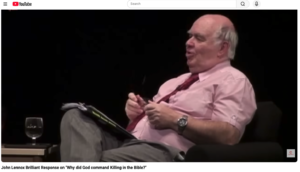
These were unique situations and not necessarily typical, as is evidenced by Deuteronomy 20:10-15.

Bear in mind that these were cities that were targeted and not whole people groups as can be seen by the fact that Uriah, one of David’s mighty men, was a Hittite (2 Sam 11:1-3).

God is both a God of Love, and a God of Law. Mercy is obtained through repentance, just like judgement is a consequence of rebellion.

Moabite were descendants of Moab, the result of an incestuous relationship between Lot and his daughter (Gen 19:36-38). Israel was subject Moab in Judges 3:14. Saul fought against them in 1 Samuel 14:47, and David went to war against them as well in 2 Samuel 8:2.

They were considered to be enemies. Yet, Ruth was a Moabite. She was also David’s great grandmother. Her initial marriage to an Israelite would’ve raised some concerns, given the way Moabites were not allowed into the assembly of the Lord – not even to the tenth generation (Dt 23:3).

But Ruth’s heritage was not as important as her commitment to God (Ruth 1:16), and that made all the difference. She would be referenced in the genealogy of Christ in. Matthew 1:5.

And that’s what makes Ruth’s situation both logical and inspiring. She wasn’t an “exception” to the rule, she was an example of God’s grace and an illustration of how God is both a God of Love and a God of Law.

Conclusion

Luke 13:28 describes hell as a place where there will be weeping and gnashing of teeth. “Gnashing of teeth” can refer to “seething anger.” It’s difficult to imagine someone having been confronted with the Reality and the Greatness of God to still be so indignant, that they would spend eternity despising their Creator and their Redeemer.

It’s not easy to distinguish the kind of unbeliever you’re interacting with in any given moment. Some of them are genuinely curious, others are simply looking for an opportunity to validate themselves by being critical.

You can’t “prove it” beyond a certain point. In the absence of footage and / or face to face interactions with Christ’s contemporaries, we’re limited by space and time to those things that have been documented and what we can discern from the testimony of creation (Rom, 1:20).

Still, the evidence is compelling and we want to be capable of explaining what we believe and why (1 Pet 3:15). While you’re not capable of changing someone’s heart (Jn 6:65), you can nevertheless be an effective witness and, from that standpoint, you can…

…prove it!

1. “Encyclopedia of Bible Difficulties”, Gleason Archer, Zondervan Publishing House, Grand Rapids, MI 1982, p11
2. “Hebrew for Christians”, “Introduction to the Hebrew Calendar”, https://www.hebrew4christians.com/Holidays/Calendar/calendar.html, accessed May 24, 2026
3. “Got Questions”, “Why do we need to confess our sins if they have already been forgiven (1 John 1:9)?”, https://www.gotquestions.org/confession-forgiveness.html, accessed May 24, 2026

Prove It! | Part III: The Old Testament

Thus far in the “Prove It” conversation, we’ve looked at the practical reality of faith, how it’s something that we deploy in the context of our everyday living and it’s anything but a refusal to be rational as much as it’s just part of how you function as human being.

Then we looked at the Resurrection from the standpoint of someone who was needing some evidence apart from Scripture and we considered the secular writings that reference the Resurrection, not so much as a theological concept but as a historical reality.

In this segment, we’re going to look at the Old Testament and why we can be confident that we’re not just reading some pretty stories and wise words, but we’re hearing the Words of God Himself.

Archaeology

Josh McDowell’s book “Evidence That Demands a Verdict” devotes an entire section to Old Testament prophecy and it is a fascinating read. One prophecy that McDowell references is the prophecy made by Nahum pertaining to the city of Nineveh. Nineveh was the capital city of the Assyrian empire. It was an impregnable center of military might – the kind of stronghold you would expect to be the capital city of the most powerful empire in the ancient world at that time.

Nahum, in stark contrast, is a single individual belonging to a conquered people. For him to be proclaiming a message that translates to Nineveh’s ruin is ridiculous if not potentially lethal.

To give you an idea as to Nineveh’s size and overall presence, understand that the walls surrounding it were over a 100 feet high and wide enough to accommodate three chariots driving side by side. And this is just the first wall. You had two other walls reinforcing the first separated by a deep ditch. According to excavated remains, the distance from the inside of the inner wall to the inside of the outer wall was 2,007 feet or just under half a mile. Nahum declares that Nineveh would…

  • Be destroyed in a state of drunkenness (1:10)
  • Would be destroyed in “an overwhelming flood” (1:8; 2:6)
  • Would be burned (3:13)
  • Would be totally destroyed and become desolate (3:19)

Nineveh was attacked by a force consisting of Babylonians, Medes and Scythians. Here’s the account of the battle for Nineveh in the words of Lenormant and E. Chevallier in their book, “The Rise and Fall of Assyria:”

In 612 B.C. Nabopolassar united the Babylonian army with an army of Medes and Scythians and led a campaign which captured the Assyrian citadels in the North. The Babylonian army laid siege to Nineveh, but the walls of the city were too strong for battering rams, so they decided to try and starve the people out. A famous oracle had been given that “Nineveh should never be taken until the river became its enemy.” After a three month siege, “rain fell in such abundance that the waters of the Tigris inundated part of the city and overturned one of its walls for a distance of twenty stades. Then the King, convinced that the oracle was accomplished and despairing of any means of escape, to avoid falling alive into the enemy’s hands constructed in his palace an immense funeral pyre, placed on it his gold and silver and his royal robes, and then, shutting himself up with his wives and eunuchs in a chamber formed in the midst of the pile, disappeared in the flames. Nineveh opened its gates to the besiegers, but this tardy submission did not save the proud city. It was pillaged and burned, and then razed to the ground so completely as to evidence the implacable hatred enkindled in the minds of subject nations by the fierce and cruel Assyrian government.1

And in an account from “Diodorus of Sicily II,” we read of how the king of Assyria was overly confident in his city’s defenses, despite the presence of an enemy force camped just outside its walls. He began to indulge with his soldiers and in a feast that included a significant amount of food and alcohol. News of this reached the ears of Arbaces, the enemy general through deserts and a night attack was scheduled. Not long after, thanks to the walls that were now vulnerable as a result of the rain, Arbaces was able to take the city of Nineveh.2  

Science

2) Scientifically Validated
The Law
Sometimes the whole Hebrew Bible, or any part of it, is referred to as “the law.” In John 10:34 where Jesus is arguing with the Pharisees, He tells them that part of Psalm 82 is “written in your law.” In 1 Corinthians 14:21 there’s a quotation from Isaiah 28:11 that Paul describes as having been written “in the law.” And in Romans 3:10-19, there’s a chain of quotations from the Psalms and the book of Isaiah that is referenced as “whatever the law says.”

It wasn’t until the Enlightenment that the inerrant dynamic of Scripture was questioned.3 Independent thinking evolved into a scenario where the Authority of Scripture was cast off should its content prove to be inconsistent with current scientific trends or even personal preferences. Darwinism took it a step further by providing a scientific sounding platform that gave atheists more reason to dismiss God from their thinking as well as their lives. As has been mentioned earlier, Scripture doesn’t claim to merely accurate. Even in the Psalms, you hear David referring to the “law of the Lord” as perfect (Ps 19:7 [see sidebar]). That includes theological matters as well as scientific. Consider some of what the Bible has to say about the physical world:

ASTRONOMY: The Bible claims the universe had a beginning. Philosophers and scientists rejected that claim for over two thousand years, but now astronomers believe the universe had a beginning, the so-called big bang (though with a very different time frame).

ANTHROPOLOGY: The Bible claims that all humans are “one blood” descended from one man and one woman (Acts 17:26; 1 Corinthians 15:45; Genesis 3:20). Some nineteenth-century biologists argued that different races descended from lower animals, but today genetics has verified that there is only one human race.

BIOLOGY: The Bible claims that God created animals “after their kind.” Nineteenth-century biologists argued that animals evolved from other, very different animals, but today biology confirms that creatures reproduce within their own kind.

GEOLOGY: The Bible claims that God destroyed the earth and the creatures inhabiting it in the worldwide Flood. Nineteenth-century geologists argued that rock layers and the fossils found in them were formed as sediments were deposited slowly, but today geology confirms that many rock layers were deposited catastrophically, burying fossils within only minutes or hours.4

Accuracy

While the passion of the Talmudists and the Massoretes is admirable, it’s not necessarily conclusive as far as proving that what we have today is an accurate copy of the original given the fact that up until 1947, the oldest handwritten copy of the Old Testament was 900 A.D. When the Dead Sea Scrolls were discovered, experts and scholars were thrilled to learn that the scrolls had been dated to around 125 B.C.. When the two manuscripts were compared to one another, the consistency was nothing short of noteworthy. This is why the Dead Sea Scroll discovery is so significant – because of the way in which the Old Testament was validated by comparing two manuscripts that were written 1,000 years apart and still matched almost word or word. The discrepancies were differences in spelling and nothing more:

Gleason Archer (noted author and scholar) states that the Isaiah copies of the Qumran community “proved to be word for word identical with our standard Hebrew Bible in more than 95 percent of the text. The 5 percent of variation consisted chiefly of obvious slips of the pen and variations in spelling.5

Jesus

The table below represents 70 of the over 300 Old Testament references to Christ. Conservative estimates date these prophecies to be removed from their fulfillment by a period of at least 250 years!6

# Scripture Prophecy Fulfillment
1 Genesis 3:15 When sin first enters the world, God promises a savior — the Messiah — to resolve the problem of sin and reconcile people with God Galatians 4:4-5, Matthew 1:18
2 Genesis 3:15 The Messiah would be born of a woman — he would be a human, as opposed to an angel or other type of being Galatians 4:4-5, Matthew 1:18
3 Genesis 22:18 The Messiah would be a descendant of Abraham, because of Abraham’s great faith Matthew 1:1, Luke 3:34, Romans 4:13, Galatians 3:7
4 Genesis 26:1-5 The Messiah would be a descendant of Abraham’s son Isaac Romans 9:7, Hebrews 11:18, Matthew 1:2
5 Genesis 28:10-14 The Messiah would be a descendant of Abraham’s grandson Jacob (He would be an Israelite) Matthew 1:2, Luke 3:34
6 Genesis 49:10 The Messiah would be a descendant of Abraham’s great-grandson Judah (He would be a Jew) Matthew 1:3, Luke 3:33
7 Isaiah 11:1-10 The Messiah would be a descendant of Jesse, who is a descendant of Judah Matthew 1:6, Luke 3:32
8 2 Samuel 7:12-16 The Messiah would be a descendant of King David, who is a son of Jesse Matthew 1:6, Luke 3:31
9 Isaiah 11:1 The Messiah would appear after a great devastation for Jesse’s descendants (Babylonian conquest) Luke 3:1-23. History: The Babylonians destroyed the Kingdom of Judah and forced many Jews into exile and captivity (about 2,600 years ago).
10 Jeremiah 23:3-6 The Messiah would appear after the regathering of exiles Luke 3:1-23. History: Jews began returning to their homeland after the fall of the Neo-Babylonian Empire (about 2,500 years ago).
11 Daniel 9:24-26 The Messiah would appear after the rebuilding of Jerusalem Luke 3:1-23. History: Jerusalem was fully rebuilt when Jesus arrived as the Messiah about 2,000 years ago.
12 Genesis 49:10 The Messiah would appear after a succession of rulers from the Tribe of Judah Matthew 2. History: Herod the Great became the first foreigner to reign from Jerusalem as king over the Jews in Israel. Jesus was born during his reign.
13 Ezekiel 21:26-27 The Messiah would appear after a disruption to the succession of Davidic kings, who were members of the Tribe of Judah Matthew 2. History: Zedekiah, who lived during the time of Ezekiel, was the last Davidic king until Jesus was born.
14 Micah 5:1-2 The Messiah would be born in Bethlehem Matthew 2:1-12, Luke 2:1-21
15 Genesis 17:15-21 The predicted miraculous birth of Isaac foreshadows the predicted miraculous birth of Jesus Matthew 1:18-25, Luke 1:26-38. Both births were the result of miracles and the fulfillment of prophecy.
16 Isaiah 7:13-14 Isaiah foretold the miraculous virgin birth of Jesus and The original Christmas story Matthew 1:18-25, Luke 1:26-38
17 Isaiah 7:14 The Messiah would be called Immanuel (God with us) Matthew 1:23
18 Daniel 9:26 The Messiah would arrive before the (Roman) destruction of Jerusalem Luke 3:1-23. History: The Romans destroyed Jerusalem in AD 70. Jesus appeared as the Messiah in about AD 30.
19 Malachi 3:1 The Messiah would arrive at a time when there was a Temple in Jerusalem Matthew 21:12. History: The Temple was destroyed AD 70, about 2,000 years ago, and has never been rebuilt.
20 Isaiah 40:1-9 The Messiah would be preceded by a forerunner Matthew 3:1-4
21 Malachi 3:1 A messenger would prepare the way for the Lord Mark 1:1-11
22 Daniel 9:24-27 The Messiah would arrive 483 years after a call to restore and to build Jerusalem John 1:29-34. History: Artaxerxes began giving permission to restore and rebuild Jerusalem in 457 BC. Jesus began his public ministy in AD 26.
23 Isaiah 61:1-2 The public ministry of Jesus is foreshadowed by Isaiah Luke 4:14-30
24 Isaiah 9:1-2 The Messiah would have a ministry in Galilee and be a light to Gentiles Matthew 4:12-17
25 Isaiah 35:4-6 The Messiah would perform miracles Matthew 4:23-25. Jesus performed miracles on 50 occasions, according to Jesus the Miracle Worker
26 Psalm 78:1-2 The Messiah would teach in parables Matthew 13:3, 13-15
27 Deuteronomy 18:15-18 The Messiah would be like Moses, who was a prophet, leader, intermediary, deliverer and miracle worker John 5:45-47, 6:14
28 Isaiah 42:1-9 The Messiah would be humble and meek Matthew 11:28-30
29 Psalm 2:1-12 The Messiah would have a father-son relationship with God Matthew 14:33
30 Isaiah 9:6-7 The Messiah would be a son who would be called Mighty God Matthew 1:23, John 10:30, 20:27-29
31 Zechariah 9:9 He would humbly announce himself publicly as the Messiah by riding a lowly donkey into Jerusalem Matthew 21:6-9
32 Jeremiah 31:31-34 The Messiah would be associated with a “new covenant” involving forgiveness of sin Hebrews 8
33 Psalm 41 Psalm 41 foreshadowed the betrayal of Jesus John 13:18
34 Psalm 22:6 The Messiah would be despised Luke 23:21-23
35 Psalm 118:22-24 The Messiah would be rejected even though he is the cornerstone of a plan from God Matthew 21:42-43
36 Isaiah 53:1-3 The Messiah would be despised and rejected Matthew 27:21-23
37 Daniel 9:24-26 Daniel predicted the timing of when the Messiah would be rejected Mark 15:1-15
38 Isaiah 53:7 The Messiah would be persecuted Matthew 27:27-31
39 Isaiah 53:7 The Messiah would be silent before his accusers Matthew 27:12-14
40 Isaiah 50:6-7 The Messiah would be spat upon and beaten Matthew 26:67, 27:30
41 Psalm 35:19, 69:4 The Messiah would be hated without reason or cause John 15:25
42 Isaiah 53:12 The Messiah would be ‘numbered with the transgressors’ Luke 22:37, 23:32
43 Isaiah 50:4-10 The Messiah would serve God with perfect obedience Matthew 26:39, John 8:28
44 Isaiah 50:4-10 The Messiah would willingly submit to the will of God and the abuse of people Matthew 26:47-56
45 Genesis 22:1-18 The near-sacrifice of Isaac foreshadows the sacrifice of Jesus John 19:1-37
46 Psalm 22 Psalm 22 foreshadows the crucifixion of Jesus Matthew 27:32-44, John 19:1-37, 20:27
47 Psalm 22:8 The Messiah would be mocked for his faith in God Matthew 27:39, 27:43
48 Psalm 22:17-18 The Messiah would be stripped of his clothing Luke 23:34-35
49 Psalm 22:18 Onlookers would cast lots for his clothing Matthew 27:35, Luke 23:34, John 19:23
50 Psalm 22:16 The Messiah’s hands and feet would be pierced John 19:37, 20:27
51 Psalm 22:15 The Messiah’s suffering would include thirst John 19:28
52 Psalm 22:1 The Messiah would cry out to God Matthew 27:46
53 Zechariah 12:10 Zechariah foreshadows the piercing of Jesus John 19:34-37
54 Isaiah 53:12 The Messiah would intercede for sinners Matthew 10:32, Luke 23:34, Romans 8:34
55 Isaiah 53:4-9 The Messiah would suffer and die for the sins of others John 19:1-37, 2 Corinthians 5:21, 1 John 4:10
56 Isaiah 53:8-9 The Messiah would be “cut off out of the land of the living” (executed) John 19:1-37
57 Daniel 9:26 The Messiah would be “cut off” (executed) John 19:1-37
58 Daniel 9:24 The Messiah’s sacrificial death would bring an end to the problem of sin Galatians 1:3-5
59 Genesis 3:15 The Messiah would defeat evil at his own expense John 19:1-37, 2 Corinthians 5:21, 1 John 4:10
60 Isaiah 53:9 The Messiah would be buried in a rich man’s grave Matthew 27:57-61
61 Psalm 16:8-11 God’s holy one (the Messiah) would be resurrected John 20:1-18; Acts 2:29-32, 13:32-37, 1 Corinthians 15
62 Isaiah 53:10-12 The Messiah would be resurrected and see the results of his atoning death John 20:1-18, Acts 1:8
63 Psalm 110 The Messiah would be seated at the right hand of God the Father, meaning he would ascend into heaven Matthew 26:64, Luke 24:50-53, John 20:17, Acts 1:1-12. Jesus ascended 40 days after his resurrection.
64 Isaiah 11:10 The Messiah would appeal to Gentiles Acts 1:8, 13:47-48. History: Christianity is the world’s largest religion.
65 Isaiah 42:1-4 The Messiah would affect people throughout the world Matthew 28:19-20, John 12:18-21
66 Isaiah 42:6 The Messiah would be a light to people around the world Luke 2:22-40
67 Zechariah 9:9-11 The Messiah would have a worldwide impact Acts 1:8, 13:47-48.
68 Isaiah 49:6 The Messiah would bring salvation to the ends of the earth Acts 13:47-48. History: Christianity is the world’s most widespread religion.
69 Psalm 110 The Messiah will return to preside over Judgment Day Daniel 7:13-14, 12:1-2. To be fulfilled in the future when Jesus returns.
70 Daniel 7:13-14 The Messiah will reign eternally over the Kingdom of God, also known as the Kingdom of Heaven Luke 1:31-33
this content comes from about-jesus.org
Dr. Peter Stoner

Peter Stoner (June 16, 1888 – March 21, 1980)[1][2] was a Christian writer and Chairman of the departments of mathematics and astronomy at Pasadena City College until 1953; Chairman of the science division, Westmont College, 1953–57; Professor Emeritus of Science, Westmont College; and Professor Emeritus of Mathematics and Astronomy, Pasadena City College. (Wikipedia).

His book “Science Speaks” is considered to be a classic in the context of Apologetics.

In his book, “Science Speaks,” the author, Dr. Peter Stoner, looked at 8 prophecies and then calculated the chances of one man in history fulfilling all of them.

1) “But thou, Bethlehem Ephratah, though thou be little among the thousands of Judah, yet out of thee shall he come forth unto me that is to be ruler in Israel; whose goings forth have been from of old, from everlasting” (Micah 5:2).

2) “Behold, I will send my messenger, and he shall prepare the way before me” (Mal. 3:1).

3. “Rejoice greatly, O daughter of Zion; shout, O daughter of Jerusalem: behold, thy King cometh unto thee: he is just, and having salvation: lowly, and riding upon … a colt the foal of an ass” (Zech. 9:9).

4. “And one shall say unto him, What are these wounds in thine hands? Then he shall answer, Those with which I was wounded in the house of my friends”(Zech. 13:6).

5. “And I said unto them, If ye think good, give me my price; and if not, forbear. So they weighed for my price thirty pieces of silver” (Zech. 11:12).

6. “And the Lord said unto me, Cast it unto the potter: a goodly price that I was prized at of them. And I took the thirty pieces of silver, and cast them to the potter in the house of the Lord” (Zech. 11:13).

7. “He was oppressed, and he was afflicted, yet he opened not his mouth: he is brought as a lamb to the slaughter, and as a sheep before her shearers is dumb, so he openeth not his mouth” (Isa. 53:7).

8. “For dogs have compassed me: the assembly of the wicked have inclosed me: they pierced my hands and my feet”(Ps. 22:16).

Let us try to visualize this chance. If you mark one of ten tickets, and place all of the tickets in a hat, and thoroughly stir them, and then ask a blindfolded man to draw one, his chance of getting the right ticket is one in ten. Suppose that we take 1017 silver dollars and lay them on the face of Texas. They will cover all of the state two feet deep. Now mark one of these silver dollars and stir the whole mass thoroughly, all over the state. Blindfold a man and tell him that he can travel as far s he wishes, but he must pick up one silver dollar and say that this is the right one. What chance would he have of getting the right one? Just the same chance that the prophets would have had of writing these eight prophecies and having them all come true in any one man, from their day to the present time, providing they wrote using their own wisdom. (Science Speaks)
Every Book of the Bible is About Jesus

In Genesis, I was the Word of God, creating the heavens and the earth.
In Exodus, I was the Passover Lamb, whose blood was sprinkled on the doorposts of your heart so that you could escape the bonds of slavery.
In Leviticus, I was the temple, the holy place where you met with God.
In Numbers, I was your ever-present guide, your pillar of cloud by day and pillar of fire by night.
In Deuteronomy, I was the prophet coming who is greater than Moses.

In Joshua, I was the conquering warrior leading you into the Promised Land.
In Judges, I was the broken Savior rising up to rescue you.
In Ruth, I was your kinsman-redeemer.
In 1&2 Samuel, I was the pure-hearted shepherd king, who rushed out to face your giants all alone.
In 1&2 Kings, I was the righteous ruler.

In 1&2 Chronicles, I was the restorer of the kingdom.
In Ezra, the faithful scribe.
In Nehemiah, the rebuilder of the walls.
In Esther, I was your advocate, risking my life to restore you to royalty.

In Job, I was your living Redeemer.
In the Psalms, I was the one who hears your cries.
In Proverbs, I am wisdom personified.
In Ecclesiastes, I am the meaning that lets you escape the madness.
In the Song of Solomon, I am your lover and your bridegroom.

In Isaiah, I was the Wonderful Counselor, Mighty God, Everlasting Father, Prince of Peace, wounded for your transgressions and bruised for your iniquities.
In Jeremiah, I am the Spirit that writes God’s laws on your hearts.
In Lamentations, I was the weeping prophet.
In Ezekiel, I was the river of life bringing healing to the nations.
In Daniel, the fourth man in the fire.
In Hosea, I was the ever-faithful husband pursuing my unfaithful bride.
In Joel, I was the restorer of all that the locusts have eaten.

In Amos, I was your burden bearer.
In Obadiah, the judge of all the earth.
In Jonah, the prophet cast out into the storm so that you could be brought in.
In Micah, the everlasting ruler born to us in Bethlehem.

In Nahum, the Avenger of God’s elect.
In Habakkuk, your reason to rejoice even when our fields are empty.
In Zephaniah, I am the great Reformer.
In Haggai, the cleansing fountain.
In Zechariah, the pierced Son whom every eye on earth will one day behold.
And in Malachi, I am the Sun of Righteousness rising with healing in my wings.


In Matthew, he’s the King of the Jews.
In Mark, he’s the Son of God.
In Luke, he’s the Savior born to us in the city of David, Christ the Lord.
In John, he’s the Word become flesh, dwelling among us.
In Acts, he is Christ the risen Lord, proclaiming salvation to the nations.
In Romans, he’s the Justifier.
In 1&2 Corinthians, the Spirit at work in the churches.
In Galatians, he is the righteousness imputed to us by faith.
In Ephesians, our righteous armor.
In Philippians, the God who meets our every need.
In Colossians, the firstborn of all creation.

In 1&2 Thessalonians, he’s descending from heaving with a shout, coming to meet us together in the clouds.
In 1&2 Timothy, the one mediator between God and man.
In Titus, our faithful pastor.
In Philemon, our Redeemer, restoring us to service.
In Hebrews, our great high priest.

In James, the life at work in our faith.
In 1&2 Peter, our living cornerstone.
In 1, 2, and 3 John, our advocate, pleading his righteousness in our place.
In Jude, he’s God our Savior, the one who keeps us from stumbling and presents us blameless in his presence with great joy.

And in Revelation, he’s the Alpha and the Omega, the beginning and the end, the Lamb slain before the foundation of the world, the King of kings and the Lord of lords.
(J.D. Greear Ministries)

Bottom line: The Old Testament provides a very specific historical address for Jesus. Everything from His lineage, the place of His birth, His crucifixion, how He would be introduced by John the Baptist, the way in which He would be betrayed…It’s an amazing list of details, some of which pertained to things that weren’t even in existence at the time the prophecy was first documented.

For example, crucifixion. While impalement is referenced in Genesis 40:19, it’s specifically referenced in Deuteronomy 21:23 as being indicative of God’s curse being on the person being impaled (see also Gal 3:13).

But it’s in Isaiah 53, where you encounter specific references to the way Christ was going to be “pierced…”

But he was pierced for our transgressions, he was crushed for our iniquities; the punishment that brought us peace was on him, and by his wounds we are healed. (Is 53:5 [see also Ps 22:16])

It’s here where you see a picture of a criminal having been nailed to a pole or a tree, which matches the image of crucifixion – a practice that was virtually unknown until the time of the Romans.

The history of crucifixion as a mode of punishment for cime must be studies as a part of the Roman system of jurisprudence…The Hebrews, for example, adopted or accepted it only under Roman compulsion: under their own system, before Palestine became Roman territory, they inflicted the death penalty by stoning.

…In 63 B.C., Pompey’s legions cut their way into the Judean capital. Palestine became a Roman province, though nominally a puppet Jewish dynasty survived.

Thus, the type of death picture in Isaiah 53 and Psalms 22 did not come into practice under the Jewish system until hundreds of years after the account was written.7

Conclusion

In addition to the way in which the credibility of the Old Testament can be validated from an academic standpoint, it’s the way it so vividly describes Christ that demonstrates its True reliability. You could argue that every book in the Bible references the Son of God in some way, shape, or form (see sidebar).

From that perspective, yes, the text of the OT can be trusted, but it is the Message that needs to be embraced and believed.

For even more information about the credibility of the Old Testament, click here

1. The Rise and Fall of Assyria”, Lenormant and E. Chevallier, LM Publishers
2. “Evidence That Demands a Verdict”, Josh McDowell, Thomas Nelson Publishers, Nashville, TN, 1979, p299
3. Stanford Encyclopedia of Philosophy, “Enlightenment” https://plato.stanford.edu/entries/enlightenment/, accessed April 8, 2017
4. AnswersInGenesis, “Scientific Accuracy”, https://answersingenesis.org/is-the-bible-true/5-scientific-accuracy/, accessed April 8, 2017
5. “Evidence That Demands a Verdict”, Josh McDowell, Thomas Nelson Publishers, Nashville, TN, 1979, p58
6. Josh McDowell, Evidence That Demands a Verdict (San Bernardino, CA: Here’s Life Publishers, Inc, 1972, 1979, p144
7. Ibid, p161, 162